Jing Yan , Xiaotian Xu , Yizhun Zhu , Yuhui Wang , Xiaoqun Duan
{"title":"Escin Ia ameliorates DSS-induced chronic colitis in mice by inhibiting inflammation and oxidative stress via the LOXL2/MMP-9 pathway","authors":"Jing Yan , Xiaotian Xu , Yizhun Zhu , Yuhui Wang , Xiaoqun Duan","doi":"10.1016/j.jep.2025.119623","DOIUrl":null,"url":null,"abstract":"<div><h3>Ethnopharmacological relevance</h3><div><em>Aesculus wilsonii Rehd</em>.'s dried mature seeds are the source of escin, a significant triterpenoid saponin. <em>Aesculus wilsonii Rehd</em> was first mentioned in the Compendium of Materia Medica, according to the Chinese Pharmacopoeia. It possesses the effectiveness of anti-inflammatory as well as treating gastrointestinal disorders. Escin Ia is the primary active component of escin, exhibiting significant antioxidant and anti-inflammatory properties. An increasing number of studies have demonstrated that escin exhibits a broad spectrum of pharmacological activities beneficial for the protection against gastrointestinal diseases.</div></div><div><h3>Aim of the study</h3><div>Ulcerative colitis (UC) is a chronic inflammatory bowel disease (IBD) that can be managed through pharmacological treatment; however, it features a high recurrence rate as well as propensity for complications. Therefore, reducing the rate of recurrence and improving the recurrence symptoms should be the primary focus of clinical prevention and treatment. Therefore, this research aims to study the effects of escin Ia on inflammation as well as oxidative stress in mice with chronic UC and to explain the molecular mechanisms underlying its potential to improve recurrent symptoms in UC mice.</div></div><div><h3>Materials and methods</h3><div>A mouse model of colitis produced via dextran sodium sulfate (DSS) was developed for <em>in vivo</em> studies. A model of inflammation was created <em>in vitro</em> using caco-2 cells that were generated by lipopolysaccharide (LPS). Through the observation of colitis symptoms and histological morphology in mice, the protective effect of escin Ia against colitis was ascertained. The enzyme-linked immunosorbent assay (ELISA) and biochemical kits were then harnessed to measure the levels of oxidative stress markers as well as inflammatory factors. Additionally, to identify the possible target and molecular mechanism of escin Ia, qRT-PCR and western blotting, immunofluorescence, molecular docking, and molecular dynamics modeling were employed.</div></div><div><h3>Results</h3><div>We demonstrated that escin Ia remarkably improved the colitis symptoms as well as histological features of DSS-treated mice, lowered the levels of proinflammatory cytokines as well as oxidative stress biomarkers, and subsequently restored the permeability of the intestinal mucosa. Additionally, high expression of LOXL2 significantly reduced the protective effects of escin Ia in both inflamed mice and Caco-2 cells. Furthermore, escin Ia exhibited a strong binding affinity and notable stability with LOXL2.</div></div><div><h3>Conclusion</h3><div>Escin Ia inhibits inflammation and oxidative stress through the LOXL2/MMP-9 pathway, thereby restoring intestinal mucosal barrier function. Improved recurrent symptoms in mice with enteritis.</div></div>","PeriodicalId":15761,"journal":{"name":"Journal of ethnopharmacology","volume":"345 ","pages":"Article 119623"},"PeriodicalIF":5.4000,"publicationDate":"2025-03-14","publicationTypes":"Journal Article","fieldsOfStudy":null,"isOpenAccess":false,"openAccessPdf":"","citationCount":"0","resultStr":null,"platform":"Semanticscholar","paperid":null,"PeriodicalName":"Journal of ethnopharmacology","FirstCategoryId":"3","ListUrlMain":"https://www.sciencedirect.com/science/article/pii/S0378874125003071","RegionNum":2,"RegionCategory":"医学","ArticlePicture":[],"TitleCN":null,"AbstractTextCN":null,"PMCID":null,"EPubDate":"","PubModel":"","JCR":"Q1","JCRName":"CHEMISTRY, MEDICINAL","Score":null,"Total":0}
引用次数: 0
Abstract
Ethnopharmacological relevance
Aesculus wilsonii Rehd.'s dried mature seeds are the source of escin, a significant triterpenoid saponin. Aesculus wilsonii Rehd was first mentioned in the Compendium of Materia Medica, according to the Chinese Pharmacopoeia. It possesses the effectiveness of anti-inflammatory as well as treating gastrointestinal disorders. Escin Ia is the primary active component of escin, exhibiting significant antioxidant and anti-inflammatory properties. An increasing number of studies have demonstrated that escin exhibits a broad spectrum of pharmacological activities beneficial for the protection against gastrointestinal diseases.
Aim of the study
Ulcerative colitis (UC) is a chronic inflammatory bowel disease (IBD) that can be managed through pharmacological treatment; however, it features a high recurrence rate as well as propensity for complications. Therefore, reducing the rate of recurrence and improving the recurrence symptoms should be the primary focus of clinical prevention and treatment. Therefore, this research aims to study the effects of escin Ia on inflammation as well as oxidative stress in mice with chronic UC and to explain the molecular mechanisms underlying its potential to improve recurrent symptoms in UC mice.
Materials and methods
A mouse model of colitis produced via dextran sodium sulfate (DSS) was developed for in vivo studies. A model of inflammation was created in vitro using caco-2 cells that were generated by lipopolysaccharide (LPS). Through the observation of colitis symptoms and histological morphology in mice, the protective effect of escin Ia against colitis was ascertained. The enzyme-linked immunosorbent assay (ELISA) and biochemical kits were then harnessed to measure the levels of oxidative stress markers as well as inflammatory factors. Additionally, to identify the possible target and molecular mechanism of escin Ia, qRT-PCR and western blotting, immunofluorescence, molecular docking, and molecular dynamics modeling were employed.
Results
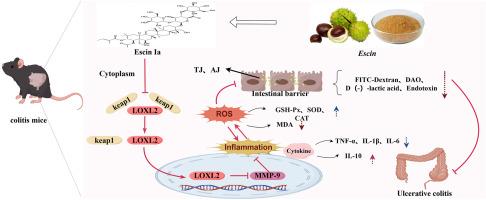
We demonstrated that escin Ia remarkably improved the colitis symptoms as well as histological features of DSS-treated mice, lowered the levels of proinflammatory cytokines as well as oxidative stress biomarkers, and subsequently restored the permeability of the intestinal mucosa. Additionally, high expression of LOXL2 significantly reduced the protective effects of escin Ia in both inflamed mice and Caco-2 cells. Furthermore, escin Ia exhibited a strong binding affinity and notable stability with LOXL2.
Conclusion
Escin Ia inhibits inflammation and oxidative stress through the LOXL2/MMP-9 pathway, thereby restoring intestinal mucosal barrier function. Improved recurrent symptoms in mice with enteritis.
期刊介绍:
The Journal of Ethnopharmacology is dedicated to the exchange of information and understandings about people''s use of plants, fungi, animals, microorganisms and minerals and their biological and pharmacological effects based on the principles established through international conventions. Early people confronted with illness and disease, discovered a wealth of useful therapeutic agents in the plant and animal kingdoms. The empirical knowledge of these medicinal substances and their toxic potential was passed on by oral tradition and sometimes recorded in herbals and other texts on materia medica. Many valuable drugs of today (e.g., atropine, ephedrine, tubocurarine, digoxin, reserpine) came into use through the study of indigenous remedies. Chemists continue to use plant-derived drugs (e.g., morphine, taxol, physostigmine, quinidine, emetine) as prototypes in their attempts to develop more effective and less toxic medicinals.




 京公网安备 11010802042870号
京ICP备2023020795号-1
京公网安备 11010802042870号
京ICP备2023020795号-1

 分享
分享
 求助内容:
求助内容: 应助结果提醒方式:
 扫码关注我们
