Chenxi Xu, Teng Zhao, Ji Qian, Ke Wang, Tianyang Yu, Wangming Tang, Li Li, Feng Wu and Renjie Chen
{"title":"Machine learning-assisted design of oxygen-containing inorganic coating materials on a separator for lithium metal anodes†","authors":"Chenxi Xu, Teng Zhao, Ji Qian, Ke Wang, Tianyang Yu, Wangming Tang, Li Li, Feng Wu and Renjie Chen","doi":"10.1039/D5QI00111K","DOIUrl":null,"url":null,"abstract":"<p >The growth of lithium dendrites and its associated challenges pose significant obstacles to the widespread adoption of lithium metal anodes. Although numerous inorganic materials offer the potential for stabilizing lithium metal anodes, trial-and-error experiments are time-consuming and cost-intensive. In this work, first, a high-throughput screening workflow integrated with machine learning and calculations has been used to identify possible materials, which incorporates several key indicators encompassing electronic conductivity, phase stability, mechanical properties, chemical stability, and lithium-ion transport performance. Four materials were used in experiments, and the results from both characterization and electrochemical testing show that HfO<small><sub>2</sub></small>@PP exhibits the best performance, which includes having the highest Young's modulus. Furthermore, an Li||Li symmetric cell assembled using HfO<small><sub>2</sub></small>@PP operating at 1 mA cm<small><sup>−2</sup></small> and 1 mA h cm<small><sup>−2</sup></small> exhibited stable cycling for over 1000 h, while an Li||LFP cell assembled using HfO<small><sub>2</sub></small>@PP has a capacity retention rate of more than 90% and an average coulombic efficiency of 99.7% after 200 cycles at 1 C. This work provides a design method and ideas for inorganic coating materials on separators for lithium metal anodes.</p>","PeriodicalId":79,"journal":{"name":"Inorganic Chemistry Frontiers","volume":" 12","pages":" 4032-4040"},"PeriodicalIF":6.4000,"publicationDate":"2025-03-18","publicationTypes":"Journal Article","fieldsOfStudy":null,"isOpenAccess":false,"openAccessPdf":"","citationCount":"0","resultStr":null,"platform":"Semanticscholar","paperid":null,"PeriodicalName":"Inorganic Chemistry Frontiers","FirstCategoryId":"92","ListUrlMain":"https://pubs.rsc.org/en/content/articlelanding/2025/qi/d5qi00111k","RegionNum":1,"RegionCategory":"化学","ArticlePicture":[],"TitleCN":null,"AbstractTextCN":null,"PMCID":null,"EPubDate":"","PubModel":"","JCR":"Q1","JCRName":"CHEMISTRY, INORGANIC & NUCLEAR","Score":null,"Total":0}
引用次数: 0
Abstract
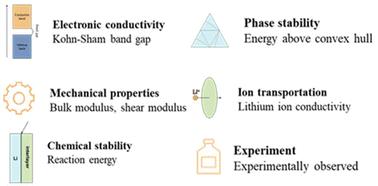
The growth of lithium dendrites and its associated challenges pose significant obstacles to the widespread adoption of lithium metal anodes. Although numerous inorganic materials offer the potential for stabilizing lithium metal anodes, trial-and-error experiments are time-consuming and cost-intensive. In this work, first, a high-throughput screening workflow integrated with machine learning and calculations has been used to identify possible materials, which incorporates several key indicators encompassing electronic conductivity, phase stability, mechanical properties, chemical stability, and lithium-ion transport performance. Four materials were used in experiments, and the results from both characterization and electrochemical testing show that HfO2@PP exhibits the best performance, which includes having the highest Young's modulus. Furthermore, an Li||Li symmetric cell assembled using HfO2@PP operating at 1 mA cm−2 and 1 mA h cm−2 exhibited stable cycling for over 1000 h, while an Li||LFP cell assembled using HfO2@PP has a capacity retention rate of more than 90% and an average coulombic efficiency of 99.7% after 200 cycles at 1 C. This work provides a design method and ideas for inorganic coating materials on separators for lithium metal anodes.
锂枝晶的生长及其相关挑战对锂金属的广泛采用构成了重大障碍。尽管许多无机材料提供了稳定锂金属阳极的潜力,但试错实验既耗时又成本高。在这项工作中,首先,使用嵌入机器学习和计算的高通量筛选工作流程来识别可能的材料,其中包含几个关键指标,包括电子导电性,相稳定性,机械性能,化学稳定性和锂离子输运性能。采用4种材料进行实验,表征和电化学测试结果均表明HfO2@PP表现最佳,杨氏模量最高,在1 mA cm-2、1 mAh cm-2下组装的Li||锂对称电池可稳定循环1000h以上,组装的Li||LFP电池在1C下循环200次后容量保持率超过90%,平均库仑效率达到99.7%。本工作为锂金属阳极分离器无机涂层材料的设计提供了一种思路和方法。



 京公网安备 11010802042870号
京ICP备2023020795号-1
京公网安备 11010802042870号
京ICP备2023020795号-1

 分享
分享
 求助内容:
求助内容: 应助结果提醒方式:
 扫码关注我们
