Seba AlAreeqi, Connor Ganley, Daniel Bahamon, Kyriaki Polychronopoulou, Paulette Clancy, Lourdes F. Vega
{"title":"Rational design of optimal bimetallic and trimetallic nickel-based single-atom alloys for bio-oil upgrading to hydrogen","authors":"Seba AlAreeqi, Connor Ganley, Daniel Bahamon, Kyriaki Polychronopoulou, Paulette Clancy, Lourdes F. Vega","doi":"10.1038/s41467-025-57949-6","DOIUrl":null,"url":null,"abstract":"<p>Designing highly active, cost-effective, stable, and coke-resistant catalysts is a hurdle in commercializing bio-oil steam reforming. Single-atom alloys (SAAs) are captivating atomic ensembles crosschecking affordability and activity, yet their stability is held questionable by trial-and-error synthesis practices. Herein, we employ descriptor-based density functional theory (DFT) calculations to elucidate the stability, activity, and regeneration of Ni-based SAA catalysts for acetic acid dehydrogenation. While 12 bimetallic candidates pass the cost/stability screening, they uncover varying dehydrogenation reactivity and selectivity, introduced by favoring different acetic acid adsorption modes on the SAA sites. We find that Pd-Ni catalyst provokes the utmost H<sub>2</sub> activity, however, ab-initio molecular simulations at 873 K reveals the ability of Cu-Ni site to effectively desorb hydrogen compared to Pd-Ni and Ni, attributed to the narrowed surface charge depletion region. Notably, this Cu-Ni performance is coupled with enhancing C<sup>*</sup>-gasification and acetic acid dehydrogenation with respect to Ni. Building upon these findings, DFT-screening of trimetallic M<sub>1</sub>-M<sub>2</sub>-Ni co-dopants recognizes 6 novel modulated single-sites with high stability, balanced H<sup>*</sup>-adsorption, and anti-coking susceptibility. This work provides invaluable data to accelerate the discovery of affordable and efficient <i>bimetallic</i> and <i>trimetallic</i> SAA catalysts for bio-oil upgrading to green hydrogen.</p>","PeriodicalId":19066,"journal":{"name":"Nature Communications","volume":"22 1","pages":""},"PeriodicalIF":15.7000,"publicationDate":"2025-03-18","publicationTypes":"Journal Article","fieldsOfStudy":null,"isOpenAccess":false,"openAccessPdf":"","citationCount":"0","resultStr":null,"platform":"Semanticscholar","paperid":null,"PeriodicalName":"Nature Communications","FirstCategoryId":"103","ListUrlMain":"https://doi.org/10.1038/s41467-025-57949-6","RegionNum":1,"RegionCategory":"综合性期刊","ArticlePicture":[],"TitleCN":null,"AbstractTextCN":null,"PMCID":null,"EPubDate":"","PubModel":"","JCR":"Q1","JCRName":"MULTIDISCIPLINARY SCIENCES","Score":null,"Total":0}
引用次数: 0
Abstract
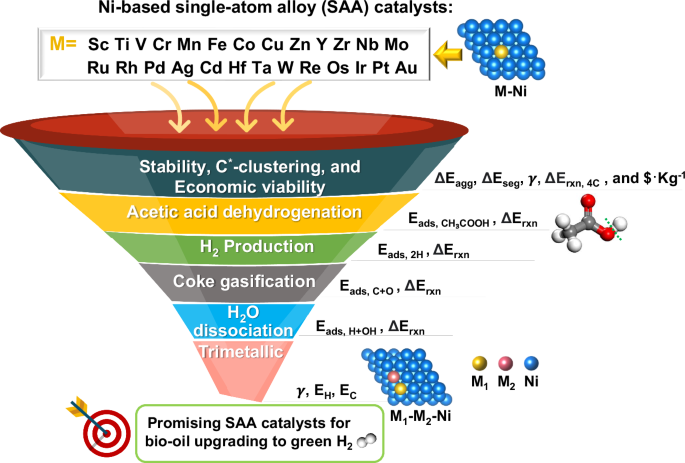
Designing highly active, cost-effective, stable, and coke-resistant catalysts is a hurdle in commercializing bio-oil steam reforming. Single-atom alloys (SAAs) are captivating atomic ensembles crosschecking affordability and activity, yet their stability is held questionable by trial-and-error synthesis practices. Herein, we employ descriptor-based density functional theory (DFT) calculations to elucidate the stability, activity, and regeneration of Ni-based SAA catalysts for acetic acid dehydrogenation. While 12 bimetallic candidates pass the cost/stability screening, they uncover varying dehydrogenation reactivity and selectivity, introduced by favoring different acetic acid adsorption modes on the SAA sites. We find that Pd-Ni catalyst provokes the utmost H2 activity, however, ab-initio molecular simulations at 873 K reveals the ability of Cu-Ni site to effectively desorb hydrogen compared to Pd-Ni and Ni, attributed to the narrowed surface charge depletion region. Notably, this Cu-Ni performance is coupled with enhancing C*-gasification and acetic acid dehydrogenation with respect to Ni. Building upon these findings, DFT-screening of trimetallic M1-M2-Ni co-dopants recognizes 6 novel modulated single-sites with high stability, balanced H*-adsorption, and anti-coking susceptibility. This work provides invaluable data to accelerate the discovery of affordable and efficient bimetallic and trimetallic SAA catalysts for bio-oil upgrading to green hydrogen.
期刊介绍:
Nature Communications, an open-access journal, publishes high-quality research spanning all areas of the natural sciences. Papers featured in the journal showcase significant advances relevant to specialists in each respective field. With a 2-year impact factor of 16.6 (2022) and a median time of 8 days from submission to the first editorial decision, Nature Communications is committed to rapid dissemination of research findings. As a multidisciplinary journal, it welcomes contributions from biological, health, physical, chemical, Earth, social, mathematical, applied, and engineering sciences, aiming to highlight important breakthroughs within each domain.



 京公网安备 11010802042870号
京ICP备2023020795号-1
京公网安备 11010802042870号
京ICP备2023020795号-1

 分享
分享
 求助内容:
求助内容: 应助结果提醒方式:
 扫码关注我们
