Tofayel Sheikh Mohammad, Pavel Sakharov, Sakthi Raje, Graham de Ruiter
{"title":"Z-Selective Semihydrogenation of Alkynes Catalyzed by a Co(I)PCNHCP Pincer Complex: A Simple, Fast, and Practical Methodology","authors":"Tofayel Sheikh Mohammad, Pavel Sakharov, Sakthi Raje, Graham de Ruiter","doi":"10.1021/acscatal.5c00792","DOIUrl":null,"url":null,"abstract":"The stereoselective synthesis of alkenes from their corresponding internal alkynes is a highly desirable and atom-economical reaction that is typically performed via transfer hydrogenation. Very few practical methods have been developed that allow for the direct hydrogenation of alkynes under mild reaction conditions and with high stereoselectivities. Here, we demonstrated that a well-defined cobalt catalyst [(PC<sub>NHC</sub>P)Co(N<sub>2</sub>)][BAr<sub>4</sub><sup>F</sup>] (<b>1</b>) catalyzes the semihydrogenation of alkynes under mild conditions (25 °C; 1 bar H<sub>2</sub>) and with high stereoselectivities (>99:1). The reaction does not require any additives, is fast (<60 min), and is compatible with a variety of functional groups that include aldehydes, ketones, esters, and alcohols. Even natural products can be used with our hydrogenation protocol highlighting its versatility. Our mechanistic studies indicate the presence of a transient Co(III)-dihydride that is responsible for the hydrogenation of the herein reported internal and terminal alkynes.","PeriodicalId":9,"journal":{"name":"ACS Catalysis ","volume":"55 1","pages":""},"PeriodicalIF":13.1000,"publicationDate":"2025-03-18","publicationTypes":"Journal Article","fieldsOfStudy":null,"isOpenAccess":false,"openAccessPdf":"","citationCount":"0","resultStr":null,"platform":"Semanticscholar","paperid":null,"PeriodicalName":"ACS Catalysis ","FirstCategoryId":"92","ListUrlMain":"https://doi.org/10.1021/acscatal.5c00792","RegionNum":1,"RegionCategory":"化学","ArticlePicture":[],"TitleCN":null,"AbstractTextCN":null,"PMCID":null,"EPubDate":"","PubModel":"","JCR":"Q1","JCRName":"CHEMISTRY, PHYSICAL","Score":null,"Total":0}
引用次数: 0
Abstract
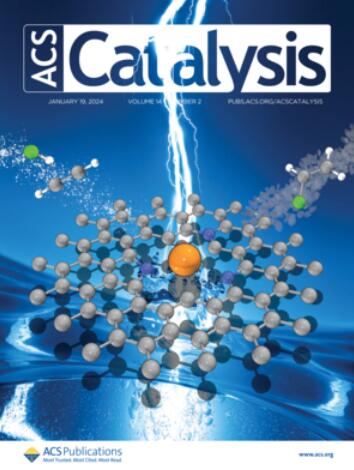
The stereoselective synthesis of alkenes from their corresponding internal alkynes is a highly desirable and atom-economical reaction that is typically performed via transfer hydrogenation. Very few practical methods have been developed that allow for the direct hydrogenation of alkynes under mild reaction conditions and with high stereoselectivities. Here, we demonstrated that a well-defined cobalt catalyst [(PCNHCP)Co(N2)][BAr4F] (1) catalyzes the semihydrogenation of alkynes under mild conditions (25 °C; 1 bar H2) and with high stereoselectivities (>99:1). The reaction does not require any additives, is fast (<60 min), and is compatible with a variety of functional groups that include aldehydes, ketones, esters, and alcohols. Even natural products can be used with our hydrogenation protocol highlighting its versatility. Our mechanistic studies indicate the presence of a transient Co(III)-dihydride that is responsible for the hydrogenation of the herein reported internal and terminal alkynes.
由相应的内炔立体选择性合成烯烃是一种非常理想和原子经济的反应,通常通过转移氢化进行。很少有实际的方法已经开发,允许在温和的反应条件下直接加氢的炔烃和高立体选择性。在这里,我们证明了一个定义明确的钴催化剂[(PCNHCP)Co(N2)][BAr4F](1)在温和的条件下(25℃;1 bar H2),具有高立体选择性(>99:1)。该反应不需要任何添加剂,反应速度快(60分钟),与多种官能团(包括醛、酮、酯和醇)兼容。即使是天然产品也可以使用我们的氢化方案,突出其通用性。我们的机理研究表明,存在一种瞬态Co(III)-二氢化物,它负责本文报道的内炔和端炔的加氢。
期刊介绍:
ACS Catalysis is an esteemed journal that publishes original research in the fields of heterogeneous catalysis, molecular catalysis, and biocatalysis. It offers broad coverage across diverse areas such as life sciences, organometallics and synthesis, photochemistry and electrochemistry, drug discovery and synthesis, materials science, environmental protection, polymer discovery and synthesis, and energy and fuels.
The scope of the journal is to showcase innovative work in various aspects of catalysis. This includes new reactions and novel synthetic approaches utilizing known catalysts, the discovery or modification of new catalysts, elucidation of catalytic mechanisms through cutting-edge investigations, practical enhancements of existing processes, as well as conceptual advances in the field. Contributions to ACS Catalysis can encompass both experimental and theoretical research focused on catalytic molecules, macromolecules, and materials that exhibit catalytic turnover.




 京公网安备 11010802042870号
京ICP备2023020795号-1
京公网安备 11010802042870号
京ICP备2023020795号-1

 分享
分享
 求助内容:
求助内容: 应助结果提醒方式:
 扫码关注我们
