{"title":"Over-the-Air Federated Learning in MIMO Cloud Radio Access Networks","authors":"Haoming Ma;Xiaojun Yuan;Zhi Ding","doi":"10.1109/TWC.2025.3549499","DOIUrl":null,"url":null,"abstract":"To address the limited server coverage of traditional over-the-air federated learning (OA-FL), we propose a new OA-FL framework for MIMO-based cloud radio access network (Cloud-RAN), called MIMO Cloud-RAN OA-FL (MIMOCROF). The proposed MIMOCROF consists of three stages in each training round. The first stage of edge aggregation allows each access point (AP) to collect local updates from edge devices and construct an edge update using MIMO multiple access. In the second stage of global aggregation, the cloud server (CS) aggregates edge updates received from the APs to form a global update through a fronthaul network. In the third stage of model updating and broadcasting, the CS sends the updated global model parameters to the APs, and the latter then broadcast the parameters to their served devices. To effectively exploit inter-AP correlation, we model the global aggregation stage as a lossy distributed source coding (L-DSC) problem. Based on the rate-distortion theory, we further analyze the performance of the MIMOCROF framework. We formulate a communication-learning optimization problem to improve the system performance by considering the inter-AP correlation. To solve this problem, we develop an algorithm by using alternating optimization (AO) and majorization-minimization (MM). Furthermore, we propose a practical L-DSC that exploits inter-AP correlation. Numerical results show that the proposed practical L-DSC effectively utilizes inter-AP correlation and is superior to other baseline schemes in performance.","PeriodicalId":13431,"journal":{"name":"IEEE Transactions on Wireless Communications","volume":"24 7","pages":"5825-5839"},"PeriodicalIF":10.7000,"publicationDate":"2025-03-17","publicationTypes":"Journal Article","fieldsOfStudy":null,"isOpenAccess":false,"openAccessPdf":"","citationCount":"0","resultStr":null,"platform":"Semanticscholar","paperid":null,"PeriodicalName":"IEEE Transactions on Wireless Communications","FirstCategoryId":"94","ListUrlMain":"https://ieeexplore.ieee.org/document/10930579/","RegionNum":1,"RegionCategory":"计算机科学","ArticlePicture":[],"TitleCN":null,"AbstractTextCN":null,"PMCID":null,"EPubDate":"","PubModel":"","JCR":"Q1","JCRName":"ENGINEERING, ELECTRICAL & ELECTRONIC","Score":null,"Total":0}
引用次数: 0
Abstract
To address the limited server coverage of traditional over-the-air federated learning (OA-FL), we propose a new OA-FL framework for MIMO-based cloud radio access network (Cloud-RAN), called MIMO Cloud-RAN OA-FL (MIMOCROF). The proposed MIMOCROF consists of three stages in each training round. The first stage of edge aggregation allows each access point (AP) to collect local updates from edge devices and construct an edge update using MIMO multiple access. In the second stage of global aggregation, the cloud server (CS) aggregates edge updates received from the APs to form a global update through a fronthaul network. In the third stage of model updating and broadcasting, the CS sends the updated global model parameters to the APs, and the latter then broadcast the parameters to their served devices. To effectively exploit inter-AP correlation, we model the global aggregation stage as a lossy distributed source coding (L-DSC) problem. Based on the rate-distortion theory, we further analyze the performance of the MIMOCROF framework. We formulate a communication-learning optimization problem to improve the system performance by considering the inter-AP correlation. To solve this problem, we develop an algorithm by using alternating optimization (AO) and majorization-minimization (MM). Furthermore, we propose a practical L-DSC that exploits inter-AP correlation. Numerical results show that the proposed practical L-DSC effectively utilizes inter-AP correlation and is superior to other baseline schemes in performance.
期刊介绍:
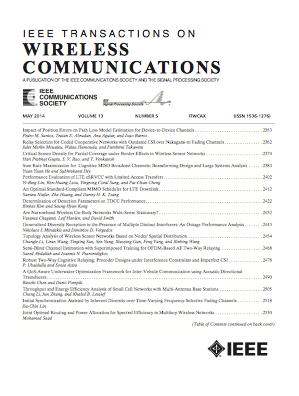
The IEEE Transactions on Wireless Communications is a prestigious publication that showcases cutting-edge advancements in wireless communications. It welcomes both theoretical and practical contributions in various areas. The scope of the Transactions encompasses a wide range of topics, including modulation and coding, detection and estimation, propagation and channel characterization, and diversity techniques. The journal also emphasizes the physical and link layer communication aspects of network architectures and protocols.
The journal is open to papers on specific topics or non-traditional topics related to specific application areas. This includes simulation tools and methodologies, orthogonal frequency division multiplexing, MIMO systems, and wireless over optical technologies.
Overall, the IEEE Transactions on Wireless Communications serves as a platform for high-quality manuscripts that push the boundaries of wireless communications and contribute to advancements in the field.



 京公网安备 11010802042870号
京ICP备2023020795号-1
京公网安备 11010802042870号
京ICP备2023020795号-1

 分享
分享
 求助内容:
求助内容: 应助结果提醒方式:
 扫码关注我们
