Transgenic crops expressing Cry and Vip3Aa insecticidal proteins from the bacterium Bacillus thuringiensis are a primary tool for controlling fall armyworm (Spodoptera frugiperda) populations. The evolution of resistance to Cry proteins in the native range of the fall armyworm has increased reliance and intensified the selection of resistance to Vip3Aa. In this study, we identified mechanisms of resistance to Vip3Aa in the LA-RR strain of S. frugiperda originating from Louisiana (USA).
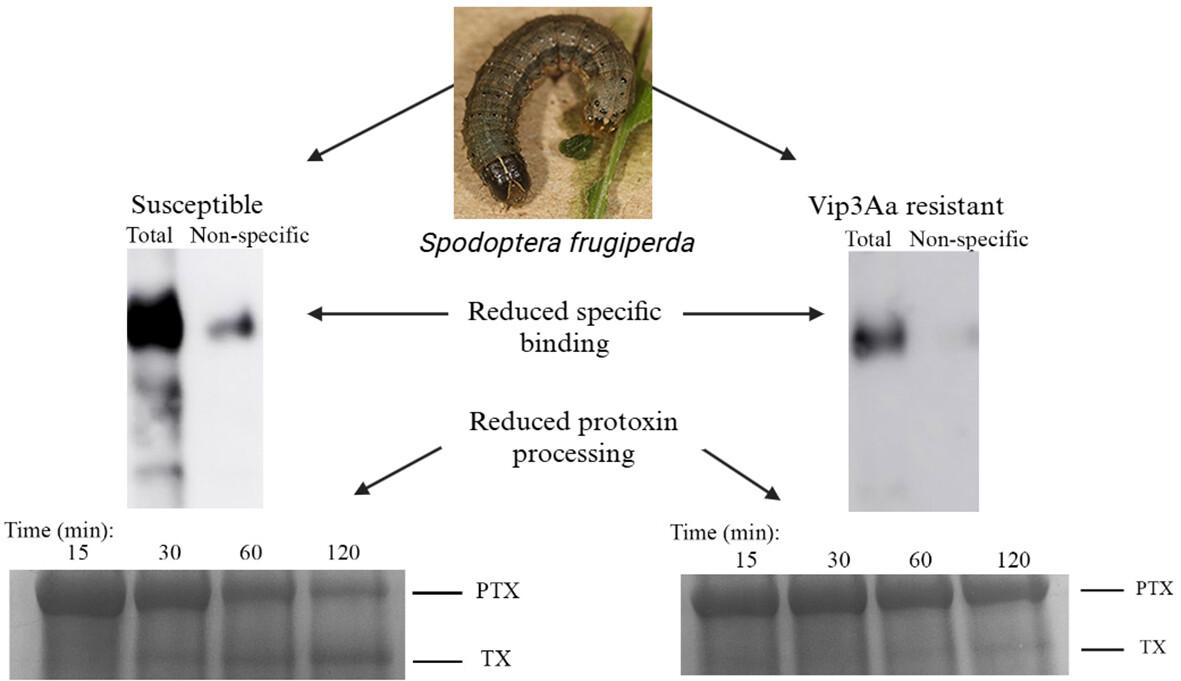
Midgut epithelial damage in susceptible larvae was evidenced by a significant drop in midgut pH after feeding on either Vip3Aa protoxin or activated toxin. In contrast, this midgut pH drop was only detected for activated Vip3Aa toxin in LA-RR larvae. Midgut fluids from LA-RR larvae displayed delayed processing of Vip3Aa protoxin when compared to fluids from susceptible larvae, and this slower processing was associated with reduced activity and expression of trypsin and chymotrypsin enzyme genes in the LA-RR strain. In bioassays, LA-RR larvae were significantly more susceptible to Vip3Aa protoxin pre-processed by midgut fluids from susceptible than from LA-RR larvae. In addition, midgut brush border membrane vesicles from LA-RR larvae exhibited lower specific Vip3Aa toxin binding than vesicles from the susceptible strain.
The results of this study support that both slower proteolytic processing and reduced specific binding are associated with resistance to Vip3Aa in a S. frugiperda strain from the Western hemisphere, the native range of this pest. This information increases our understanding of resistance to Vip3Aa and advances monitoring and fall armyworm management. © 2025 Society of Chemical Industry.





 京公网安备 11010802042870号
京ICP备2023020795号-1
京公网安备 11010802042870号
京ICP备2023020795号-1

 分享
分享
 求助内容:
求助内容: 应助结果提醒方式:
 扫码关注我们
