Jin Wang , Xinyu Lu , Huafeng Wang , Yuan Zhong , Zhihui Dai , Tianxiang Wei
{"title":"Target-induced reconstruction of Ru(bpy)32+-loaded gold nanocage for one-step highly sensitive detection of Hg2+","authors":"Jin Wang , Xinyu Lu , Huafeng Wang , Yuan Zhong , Zhihui Dai , Tianxiang Wei","doi":"10.1016/j.talanta.2025.127955","DOIUrl":null,"url":null,"abstract":"<div><div>In this work, Ru(bpy)<sub>3</sub><sup>2+</sup>-loaded gold nanocage (AuNCs) (Ru–AuNCs) was prepared and found to display a distinct property of electrochemiluminescence (ECL) enhancement under mercury ions (Hg<sup>2+</sup>) interaction. Based on this, we designed a screen-printed bipolar electrode-ECL (SPBPE-ECL) sensing platform by coupling with the thymine-Hg<sup>2+</sup>-thymine (T-Hg<sup>2+</sup>-T) binding pattern for one-step highly sensitive detection of Hg<sup>2+</sup>. This ECL sensor showed a wide linear detection range (0.75 – 850 μg L<sup>−1</sup>) and low detection limit (0.1290 μg L<sup>−1</sup>) toward Hg<sup>2+</sup>, with a one-step detection procedure and disposable feature, displaying potential applicability in the point-of-care-testing (POCT) of Hg<sup>2+</sup> in the environment. In addition, the Hg<sup>2+</sup>-mediated ECL signal enhancement mechanism of Ru–AuNCs was also investigated. It was confirmed that Hg<sup>2+</sup> interaction etched the cage structure of Ru–AuNCs, which sped up the release of more Ru(bpy)<sub>3</sub><sup>2+</sup> around the sensing electrode. Furthermore, Au–Hg alloy structure was formed on the surface of Ru–AuNCs, which also improved the ECL signal. This target-induced in-situ sensing material surface reconstruction strategy would provide a better design concept for the construction of ECL POCT sensor.</div></div>","PeriodicalId":435,"journal":{"name":"Talanta","volume":"292 ","pages":"Article 127955"},"PeriodicalIF":6.1000,"publicationDate":"2025-09-01","publicationTypes":"Journal Article","fieldsOfStudy":null,"isOpenAccess":false,"openAccessPdf":"","citationCount":"0","resultStr":null,"platform":"Semanticscholar","paperid":null,"PeriodicalName":"Talanta","FirstCategoryId":"92","ListUrlMain":"https://www.sciencedirect.com/science/article/pii/S003991402500445X","RegionNum":1,"RegionCategory":"化学","ArticlePicture":[],"TitleCN":null,"AbstractTextCN":null,"PMCID":null,"EPubDate":"2025/3/17 0:00:00","PubModel":"Epub","JCR":"Q1","JCRName":"CHEMISTRY, ANALYTICAL","Score":null,"Total":0}
引用次数: 0
Abstract
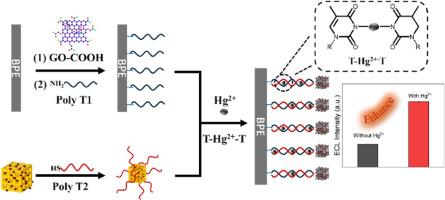
In this work, Ru(bpy)32+-loaded gold nanocage (AuNCs) (Ru–AuNCs) was prepared and found to display a distinct property of electrochemiluminescence (ECL) enhancement under mercury ions (Hg2+) interaction. Based on this, we designed a screen-printed bipolar electrode-ECL (SPBPE-ECL) sensing platform by coupling with the thymine-Hg2+-thymine (T-Hg2+-T) binding pattern for one-step highly sensitive detection of Hg2+. This ECL sensor showed a wide linear detection range (0.75 – 850 μg L−1) and low detection limit (0.1290 μg L−1) toward Hg2+, with a one-step detection procedure and disposable feature, displaying potential applicability in the point-of-care-testing (POCT) of Hg2+ in the environment. In addition, the Hg2+-mediated ECL signal enhancement mechanism of Ru–AuNCs was also investigated. It was confirmed that Hg2+ interaction etched the cage structure of Ru–AuNCs, which sped up the release of more Ru(bpy)32+ around the sensing electrode. Furthermore, Au–Hg alloy structure was formed on the surface of Ru–AuNCs, which also improved the ECL signal. This target-induced in-situ sensing material surface reconstruction strategy would provide a better design concept for the construction of ECL POCT sensor.
期刊介绍:
Talanta provides a forum for the publication of original research papers, short communications, and critical reviews in all branches of pure and applied analytical chemistry. Papers are evaluated based on established guidelines, including the fundamental nature of the study, scientific novelty, substantial improvement or advantage over existing technology or methods, and demonstrated analytical applicability. Original research papers on fundamental studies, and on novel sensor and instrumentation developments, are encouraged. Novel or improved applications in areas such as clinical and biological chemistry, environmental analysis, geochemistry, materials science and engineering, and analytical platforms for omics development are welcome.
Analytical performance of methods should be determined, including interference and matrix effects, and methods should be validated by comparison with a standard method, or analysis of a certified reference material. Simple spiking recoveries may not be sufficient. The developed method should especially comprise information on selectivity, sensitivity, detection limits, accuracy, and reliability. However, applying official validation or robustness studies to a routine method or technique does not necessarily constitute novelty. Proper statistical treatment of the data should be provided. Relevant literature should be cited, including related publications by the authors, and authors should discuss how their proposed methodology compares with previously reported methods.



 京公网安备 11010802042870号
京ICP备2023020795号-1
京公网安备 11010802042870号
京ICP备2023020795号-1

 分享
分享
 求助内容:
求助内容: 应助结果提醒方式:
 扫码关注我们
