{"title":"Deep learning method for malaria parasite evaluation from microscopic blood smear","authors":"Abhinav Dahiya , Devvrat Raghuvanshi , Chhaya Sharma , Kamaldeep Joshi , Ashima Nehra , Archana Sharma , Radha Jangra , Parul Badhwar , Renu Tuteja , Sarvajeet S. Gill , Ritu Gill","doi":"10.1016/j.artmed.2025.103114","DOIUrl":null,"url":null,"abstract":"<div><h3>Objective</h3><div>Malaria remains a leading cause of global morbidity and mortality, responsible for approximately 5,97,000 deaths according to World Malaria Report 2024. The study aims to systematically review current methodologies for automated analysis of the <em>Plasmodium</em> genus in malaria diagnostics. Specifically, it focuses on computer-assisted methods, examining databases, blood smear types, staining techniques, and diagnostic models used for malaria characterization while identifying the limitations and contributions of recent studies.</div></div><div><h3>Methods</h3><div>A systematic literature review was conducted following the Preferred Reporting Items for Systematic Reviews and Meta-Analyses (PRISMA) guidelines. Peer-reviewed and published studies from 2020 to 2024 were retrieved from Web of Science and Scopus. Inclusion criteria focused on studies utilizing deep learning and machine learning models for automated malaria detection from microscopic blood smears. The review considered various blood smear types, staining techniques, and diagnostic models, providing a comprehensive evaluation of the automated diagnostic landscape for malaria.</div></div><div><h3>Results</h3><div>The NIH database is the standardized and most widely tested database for malaria diagnostics. Giemsa stained-thin blood smear is the most efficient diagnostic method for the detection and observation of the <em>plasmodium</em> lifecycle. This study has been able to identify three categories of ML models most suitable for digital diagnostic of malaria, i.e., Most Accurate- ResNet and VGG with peak accuracy of 99.12 %, Most Popular- custom CNN-based models used by 58 % of studies, and least complex- CADx model. A few pre and post-processing techniques like Gaussian filter and auto encoder for noise reduction have also been discussed for improved accuracy of models.</div></div><div><h3>Conclusion</h3><div>Automated methods for malaria diagnostics show considerable promise in improving diagnostic accuracy and reducing human error. While deep learning models have demonstrated high performance, challenges remain in data standardization and real-world application. Addressing these gaps could lead to more reliable and scalable diagnostic tools, aiding global malaria control efforts.</div></div>","PeriodicalId":55458,"journal":{"name":"Artificial Intelligence in Medicine","volume":"163 ","pages":"Article 103114"},"PeriodicalIF":6.2000,"publicationDate":"2025-05-01","publicationTypes":"Journal Article","fieldsOfStudy":null,"isOpenAccess":false,"openAccessPdf":"","citationCount":"0","resultStr":null,"platform":"Semanticscholar","paperid":null,"PeriodicalName":"Artificial Intelligence in Medicine","FirstCategoryId":"5","ListUrlMain":"https://www.sciencedirect.com/science/article/pii/S0933365725000491","RegionNum":2,"RegionCategory":"医学","ArticlePicture":[],"TitleCN":null,"AbstractTextCN":null,"PMCID":null,"EPubDate":"2025/3/15 0:00:00","PubModel":"Epub","JCR":"Q1","JCRName":"COMPUTER SCIENCE, ARTIFICIAL INTELLIGENCE","Score":null,"Total":0}
引用次数: 0
Abstract
Objective
Malaria remains a leading cause of global morbidity and mortality, responsible for approximately 5,97,000 deaths according to World Malaria Report 2024. The study aims to systematically review current methodologies for automated analysis of the Plasmodium genus in malaria diagnostics. Specifically, it focuses on computer-assisted methods, examining databases, blood smear types, staining techniques, and diagnostic models used for malaria characterization while identifying the limitations and contributions of recent studies.
Methods
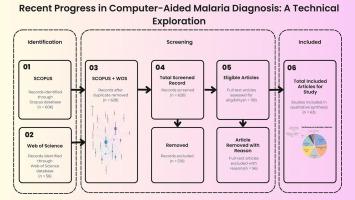
A systematic literature review was conducted following the Preferred Reporting Items for Systematic Reviews and Meta-Analyses (PRISMA) guidelines. Peer-reviewed and published studies from 2020 to 2024 were retrieved from Web of Science and Scopus. Inclusion criteria focused on studies utilizing deep learning and machine learning models for automated malaria detection from microscopic blood smears. The review considered various blood smear types, staining techniques, and diagnostic models, providing a comprehensive evaluation of the automated diagnostic landscape for malaria.
Results
The NIH database is the standardized and most widely tested database for malaria diagnostics. Giemsa stained-thin blood smear is the most efficient diagnostic method for the detection and observation of the plasmodium lifecycle. This study has been able to identify three categories of ML models most suitable for digital diagnostic of malaria, i.e., Most Accurate- ResNet and VGG with peak accuracy of 99.12 %, Most Popular- custom CNN-based models used by 58 % of studies, and least complex- CADx model. A few pre and post-processing techniques like Gaussian filter and auto encoder for noise reduction have also been discussed for improved accuracy of models.
Conclusion
Automated methods for malaria diagnostics show considerable promise in improving diagnostic accuracy and reducing human error. While deep learning models have demonstrated high performance, challenges remain in data standardization and real-world application. Addressing these gaps could lead to more reliable and scalable diagnostic tools, aiding global malaria control efforts.
期刊介绍:
Artificial Intelligence in Medicine publishes original articles from a wide variety of interdisciplinary perspectives concerning the theory and practice of artificial intelligence (AI) in medicine, medically-oriented human biology, and health care.
Artificial intelligence in medicine may be characterized as the scientific discipline pertaining to research studies, projects, and applications that aim at supporting decision-based medical tasks through knowledge- and/or data-intensive computer-based solutions that ultimately support and improve the performance of a human care provider.



 京公网安备 11010802042870号
京ICP备2023020795号-1
京公网安备 11010802042870号
京ICP备2023020795号-1

 分享
分享
 求助内容:
求助内容: 应助结果提醒方式:
 扫码关注我们
