{"title":"Antitumor immune response elicited by M2 TAM-specific DDS via C-type lectin CD209b using cholesteryl pullulan nanogel as a protein drug carrier†","authors":"Takaaki Nakatsukasa, Daisuke Muraoka, Situo Deng, Kiyoshi Yasui, Shin-ichi Sawada, Asako Shimoda, Hirokazu Matsushita, Keitaro Matsumoto, Takeshi Nagayasu, Naozumi Harada, Kazunari Akiyoshi and Hiroaki Ikeda","doi":"10.1039/D5BM00342C","DOIUrl":null,"url":null,"abstract":"<p >Many cancer patients develop resistance to immunotherapy, highlighting the urgent need for novel therapeutic strategies. Various factors contribute to tumor resistance to immunotherapy, among which tumor-associated macrophages (TAMs) are critical regulators of tumor sensitivity. Therefore, combining cancer immunotherapies with drug delivery systems (DDSs) targeting TAMs has become an intriguing treatment strategy. However, the target molecules used in DDSs are limited to a few receptors expressed on TAMs. Therefore, the identification of novel target molecules for TAM-specific DDS is urgently needed. The current study evaluated the ability of a cholesteryl pullulan (CHP) nanogel to target TAMs <em>via</em> mDC-SIGN (CD209b). This nanogel encapsulated the cytotoxic protein drug Pseudomonas exotoxin A and was injected into a tumor-bearing mouse model. This treatment significantly reduced the abundance of CD209b-positive M2 TAMs and enhanced antitumor immune responses. Ultimately, tumor growth was suppressed, even in a low-immunogenic tumor model. Hence, CD209b is an effective target molecule for M2 TAM-specific DDSs that can be used to develop novel cancer therapies.</p>","PeriodicalId":65,"journal":{"name":"Biomaterials Science","volume":" 9","pages":" 2340-2350"},"PeriodicalIF":5.7000,"publicationDate":"2025-03-17","publicationTypes":"Journal Article","fieldsOfStudy":null,"isOpenAccess":false,"openAccessPdf":"","citationCount":"0","resultStr":null,"platform":"Semanticscholar","paperid":null,"PeriodicalName":"Biomaterials Science","FirstCategoryId":"5","ListUrlMain":"https://pubs.rsc.org/en/content/articlelanding/2025/bm/d5bm00342c","RegionNum":3,"RegionCategory":"医学","ArticlePicture":[],"TitleCN":null,"AbstractTextCN":null,"PMCID":null,"EPubDate":"","PubModel":"","JCR":"Q1","JCRName":"MATERIALS SCIENCE, BIOMATERIALS","Score":null,"Total":0}
引用次数: 0
Abstract
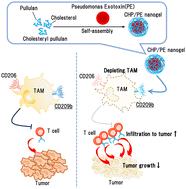
Many cancer patients develop resistance to immunotherapy, highlighting the urgent need for novel therapeutic strategies. Various factors contribute to tumor resistance to immunotherapy, among which tumor-associated macrophages (TAMs) are critical regulators of tumor sensitivity. Therefore, combining cancer immunotherapies with drug delivery systems (DDSs) targeting TAMs has become an intriguing treatment strategy. However, the target molecules used in DDSs are limited to a few receptors expressed on TAMs. Therefore, the identification of novel target molecules for TAM-specific DDS is urgently needed. The current study evaluated the ability of a cholesteryl pullulan (CHP) nanogel to target TAMs via mDC-SIGN (CD209b). This nanogel encapsulated the cytotoxic protein drug Pseudomonas exotoxin A and was injected into a tumor-bearing mouse model. This treatment significantly reduced the abundance of CD209b-positive M2 TAMs and enhanced antitumor immune responses. Ultimately, tumor growth was suppressed, even in a low-immunogenic tumor model. Hence, CD209b is an effective target molecule for M2 TAM-specific DDSs that can be used to develop novel cancer therapies.
期刊介绍:
Biomaterials Science is an international high impact journal exploring the science of biomaterials and their translation towards clinical use. Its scope encompasses new concepts in biomaterials design, studies into the interaction of biomaterials with the body, and the use of materials to answer fundamental biological questions.



 京公网安备 11010802042870号
京ICP备2023020795号-1
京公网安备 11010802042870号
京ICP备2023020795号-1

 分享
分享
 求助内容:
求助内容: 应助结果提醒方式:
 扫码关注我们
