Jean Spièce, Valentin Fonck, Charalambos Evangeli, Phil S. Dobson, Jonathan M. R. Weaver, Pascal Gehring
{"title":"Direct Measurement of the Local Electrocaloric Effect in 2D α-In2Se3 by Scanning Electrocaloric Thermometry","authors":"Jean Spièce, Valentin Fonck, Charalambos Evangeli, Phil S. Dobson, Jonathan M. R. Weaver, Pascal Gehring","doi":"10.1002/smtd.202401715","DOIUrl":null,"url":null,"abstract":"<p>The electrocaloric effect refers to the temperature change in a material when an electric field is applied or removed. Significant breakthroughs revealed its potential for solid-state cooling technologies in past decades. These devices offer a sustainable alternative to traditional vapor compression refrigeration, with advantages such as compactness, silent operation, and the absence of moving parts or refrigerants. Electrocaloric effects are typically studied using indirect methods based on polarization data, which suffer from inaccuracies related to assumptions about heat capacity. Direct methods, although more precise, require device fabrication and face challenges in studying meso- or nanoscale systems, like 2D materials, and materials with non-uniform polarization textures where high spatial resolution is required. In this study, a novel technique, Scanning Electrocaloric Thermometry, is introduced for characterizing the local electrocaloric effect in nanomaterials. This approach achieves high spatial resolution by locally applying electric fields and by simultaneously measuring the resulting temperature change. By employing AC excitation, the measurement sensitivity is further enhanced and the electrocaloric effect is disentangled from other heating mechanisms such as Joule heating and dielectric losses. The effectiveness of the method is demonstrated by examining electrocaloric and heat dissipation phenomena in 2D In<sub>2</sub>Se<sub>3</sub> micrometer-sized flakes poly(vinylidene fluoride-trifluoroethylene) films.</p>","PeriodicalId":229,"journal":{"name":"Small Methods","volume":"9 5","pages":""},"PeriodicalIF":9.1000,"publicationDate":"2025-03-17","publicationTypes":"Journal Article","fieldsOfStudy":null,"isOpenAccess":false,"openAccessPdf":"","citationCount":"0","resultStr":null,"platform":"Semanticscholar","paperid":null,"PeriodicalName":"Small Methods","FirstCategoryId":"88","ListUrlMain":"https://onlinelibrary.wiley.com/doi/10.1002/smtd.202401715","RegionNum":2,"RegionCategory":"材料科学","ArticlePicture":[],"TitleCN":null,"AbstractTextCN":null,"PMCID":null,"EPubDate":"","PubModel":"","JCR":"Q1","JCRName":"CHEMISTRY, PHYSICAL","Score":null,"Total":0}
引用次数: 0
Abstract
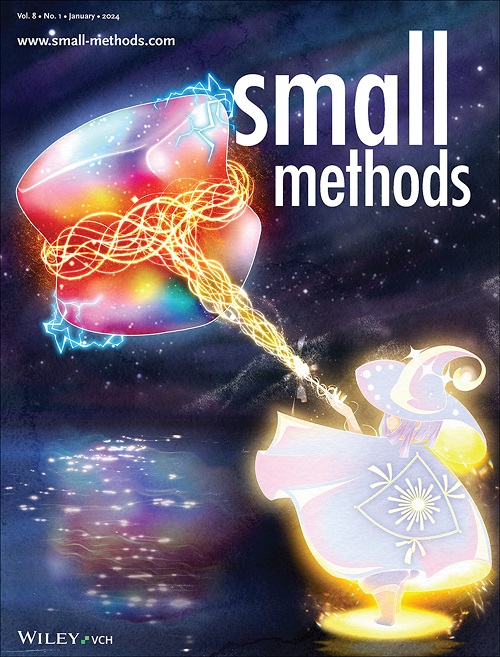
The electrocaloric effect refers to the temperature change in a material when an electric field is applied or removed. Significant breakthroughs revealed its potential for solid-state cooling technologies in past decades. These devices offer a sustainable alternative to traditional vapor compression refrigeration, with advantages such as compactness, silent operation, and the absence of moving parts or refrigerants. Electrocaloric effects are typically studied using indirect methods based on polarization data, which suffer from inaccuracies related to assumptions about heat capacity. Direct methods, although more precise, require device fabrication and face challenges in studying meso- or nanoscale systems, like 2D materials, and materials with non-uniform polarization textures where high spatial resolution is required. In this study, a novel technique, Scanning Electrocaloric Thermometry, is introduced for characterizing the local electrocaloric effect in nanomaterials. This approach achieves high spatial resolution by locally applying electric fields and by simultaneously measuring the resulting temperature change. By employing AC excitation, the measurement sensitivity is further enhanced and the electrocaloric effect is disentangled from other heating mechanisms such as Joule heating and dielectric losses. The effectiveness of the method is demonstrated by examining electrocaloric and heat dissipation phenomena in 2D In2Se3 micrometer-sized flakes poly(vinylidene fluoride-trifluoroethylene) films.
Small MethodsMaterials Science-General Materials Science
CiteScore
17.40
自引率
1.60%
发文量
347
期刊介绍:
Small Methods is a multidisciplinary journal that publishes groundbreaking research on methods relevant to nano- and microscale research. It welcomes contributions from the fields of materials science, biomedical science, chemistry, and physics, showcasing the latest advancements in experimental techniques.
With a notable 2022 Impact Factor of 12.4 (Journal Citation Reports, Clarivate Analytics, 2023), Small Methods is recognized for its significant impact on the scientific community.
The online ISSN for Small Methods is 2366-9608.



 京公网安备 11010802042870号
京ICP备2023020795号-1
京公网安备 11010802042870号
京ICP备2023020795号-1

 分享
分享
 求助内容:
求助内容: 应助结果提醒方式:
 扫码关注我们
