Lan Yao , He Li , Xinyu Hu , Zhen Li , Haowen Dong , Yanyan Jiang , Jianping Cao
{"title":"High genotype diversity and zoonotic potential of Enterocytozoon bieneusi in laboratory mice from two medical experimental animal centers","authors":"Lan Yao , He Li , Xinyu Hu , Zhen Li , Haowen Dong , Yanyan Jiang , Jianping Cao","doi":"10.1016/j.actatropica.2025.107585","DOIUrl":null,"url":null,"abstract":"<div><div><em>Enterocytozoon bieneusi</em> is a common zoonotic pathogen in wild, farmed and pet rodents worldwide. Recently, one study reported <em>E. bieneusi</em> infection in laboratory mice. To investigate the positive rate and genotype distribution of <em>E. bieneusi</em> in laboratory mice and assess the zoonotic potential of <em>E. bieneusi</em> isolates, 390 mixed mouse fecal specimens were collected from two medical experimental animal centers in Heilongjiang Province, China. <em>E. bieneusi</em> was identified and genotyped by nested PCR amplification and sequence analysis of the internal transcribed spacer (ITS) region of the ribosomal RNA (rRNA) gene. Seventy-one specimens (18.2%) were positive for <em>E. bieneusi</em>, and 38 genotypes were identified, including eight known genotypes (EbpC, D, Peru8, CS-4, Henan-III, CHC5, ETMK4 and SHWR14) and 30 novel genotypes (HLJLM1 to HLJLM30). Genotypes CHC5 and ETMK4 were firstly detected in rodents. Genotype EbpC showed a dominance (50.7%, 36/71) in positive specimens. Zoonotic genotypes (EbpC, D, Peru8, Henan-III and CS-4) accounted for 64.8% (46/71) of <em>E. bieneusi</em>-positive specimens. In phylogenetic analysis, the novel genotypes fell into three subgroups (1a, 1d, 1e) of Group 1. The identification of known zoonotic genotypes and the phylogenetic result of novel genotypes indicate the potential of laboratory mice in the transmission of <em>E. bieneusi</em> to humans. The routine detection of <em>E. bieneusi</em> should be a recommended practice in laboratory animals to ensure the accuracy of the experimental results. Meanwhile, health education of the potential zoonotic transmission of <em>E. bieneus</em>i should be provided to those people having close contact with laboratory mice and their feces.</div></div>","PeriodicalId":7240,"journal":{"name":"Acta tropica","volume":"264 ","pages":"Article 107585"},"PeriodicalIF":2.5000,"publicationDate":"2025-04-01","publicationTypes":"Journal Article","fieldsOfStudy":null,"isOpenAccess":false,"openAccessPdf":"","citationCount":"0","resultStr":null,"platform":"Semanticscholar","paperid":null,"PeriodicalName":"Acta tropica","FirstCategoryId":"3","ListUrlMain":"https://www.sciencedirect.com/science/article/pii/S0001706X25000634","RegionNum":3,"RegionCategory":"医学","ArticlePicture":[],"TitleCN":null,"AbstractTextCN":null,"PMCID":null,"EPubDate":"2025/3/15 0:00:00","PubModel":"Epub","JCR":"Q2","JCRName":"PARASITOLOGY","Score":null,"Total":0}
引用次数: 0
Abstract
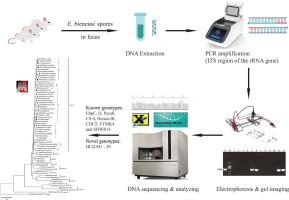
Enterocytozoon bieneusi is a common zoonotic pathogen in wild, farmed and pet rodents worldwide. Recently, one study reported E. bieneusi infection in laboratory mice. To investigate the positive rate and genotype distribution of E. bieneusi in laboratory mice and assess the zoonotic potential of E. bieneusi isolates, 390 mixed mouse fecal specimens were collected from two medical experimental animal centers in Heilongjiang Province, China. E. bieneusi was identified and genotyped by nested PCR amplification and sequence analysis of the internal transcribed spacer (ITS) region of the ribosomal RNA (rRNA) gene. Seventy-one specimens (18.2%) were positive for E. bieneusi, and 38 genotypes were identified, including eight known genotypes (EbpC, D, Peru8, CS-4, Henan-III, CHC5, ETMK4 and SHWR14) and 30 novel genotypes (HLJLM1 to HLJLM30). Genotypes CHC5 and ETMK4 were firstly detected in rodents. Genotype EbpC showed a dominance (50.7%, 36/71) in positive specimens. Zoonotic genotypes (EbpC, D, Peru8, Henan-III and CS-4) accounted for 64.8% (46/71) of E. bieneusi-positive specimens. In phylogenetic analysis, the novel genotypes fell into three subgroups (1a, 1d, 1e) of Group 1. The identification of known zoonotic genotypes and the phylogenetic result of novel genotypes indicate the potential of laboratory mice in the transmission of E. bieneusi to humans. The routine detection of E. bieneusi should be a recommended practice in laboratory animals to ensure the accuracy of the experimental results. Meanwhile, health education of the potential zoonotic transmission of E. bieneusi should be provided to those people having close contact with laboratory mice and their feces.
期刊介绍:
Acta Tropica, is an international journal on infectious diseases that covers public health sciences and biomedical research with particular emphasis on topics relevant to human and animal health in the tropics and the subtropics.



 京公网安备 11010802042870号
京ICP备2023020795号-1
京公网安备 11010802042870号
京ICP备2023020795号-1

 分享
分享
 求助内容:
求助内容: 应助结果提醒方式:
 扫码关注我们
