Extracted step parameters during the timed up and go test discriminate between groups with different levels of cognitive ability-a cross-sectional study.
Niklas Löfgren, Lars Berglund, Vilmantas Giedraitis, Kjartan Halvorsen, Erik Rosendahl, Kevin J McKee, Anna Cristina Åberg
{"title":"Extracted step parameters during the timed up and go test discriminate between groups with different levels of cognitive ability-a cross-sectional study.","authors":"Niklas Löfgren, Lars Berglund, Vilmantas Giedraitis, Kjartan Halvorsen, Erik Rosendahl, Kevin J McKee, Anna Cristina Åberg","doi":"10.1186/s12877-025-05828-6","DOIUrl":null,"url":null,"abstract":"<p><strong>Background: </strong>Identifying cognitive impairment at an early stage is important to enable preventive treatment and lifestyle changes. As gait deviations precede cognitive impairment, the aim of this study was to investigate if step parameters during different Timed Up and Go (TUG) conditions could discriminate between people with different cognitive ability.</p><p><strong>Methods: </strong>Participants (N = 304) were divided into the following groups: (1) controls, n = 50, mean age:73, 44% women; (2) Subjective cognitive Impairment (SCI), n = 71, mean age:67, 45% women; (3) Mild Cognitive Impairment (MCI), n = 126, mean age: 73, 42% women; and (4) dementia disorders, n = 57, mean age: 78, 51% women. Participants conducted TUG and two motor-cognitive TUG-conditions: TUG while naming animals (TUGdt-NA) and reciting months in reverse order (TUGdt-MB). Tests were video recorded for data extraction of valid spatiotemporal parameters: step length, step width, step duration, single step duration and double step duration. Step length was investigated with the step length/body height ratio (step length divided by body height). Logistic regression models (adjusted for age, sex and education) investigated associations between step parameters and dichotomous variables of groups adjacent in cognitive ability: dementia disorders vs. MCI, MCI vs. SCI, and SCI vs. controls. Results were presented as standardized odds ratios (sORs), with 95% confidence intervals (CI<sup>95</sup>) and p-values (significance level: p < 0.05). The areas under the Receiver Operating Characteristic curves were presented for the step parameters/conditions with the highest sORs and, where relevant, optimal cutoff values were calculated.</p><p><strong>Results: </strong>Step length showed greatest overall ability to significantly discriminate between adjacent groups (sOR ≤ . 67, CI<sup>95</sup>: .45-.99, p = ≤ . 047) during all group comparisons/conditions except three. The highest sOR for step-length was obtained when discriminating between SCI vs controls during TUGdt-MB (sOR = .51, CI<sup>95</sup>:.29- .87, p = .014), whereby the area under the curve was calculated (c-statistics = .700). The optimal cut-off indicated a step length of less than 32.9% (CI<sup>95</sup> = 22.1-43.0) of body height to identify SCI compared with controls.</p><p><strong>Conclusions: </strong>The results indicate that step length may be important to assess during TUG, for discrimination between groups with different cognitive ability; and that the presented cut-off has potential to aid early detection of cognitive impairment.</p><p><strong>Trial registration number: </strong>NCT05893524 (retrospectively registered 08/06/23).</p>","PeriodicalId":9056,"journal":{"name":"BMC Geriatrics","volume":"25 1","pages":"182"},"PeriodicalIF":3.8000,"publicationDate":"2025-03-17","publicationTypes":"Journal Article","fieldsOfStudy":null,"isOpenAccess":false,"openAccessPdf":"https://www.ncbi.nlm.nih.gov/pmc/articles/PMC11912623/pdf/","citationCount":"0","resultStr":null,"platform":"Semanticscholar","paperid":null,"PeriodicalName":"BMC Geriatrics","FirstCategoryId":"3","ListUrlMain":"https://doi.org/10.1186/s12877-025-05828-6","RegionNum":2,"RegionCategory":"医学","ArticlePicture":[],"TitleCN":null,"AbstractTextCN":null,"PMCID":null,"EPubDate":"","PubModel":"","JCR":"Q2","JCRName":"GERIATRICS & GERONTOLOGY","Score":null,"Total":0}
引用次数: 0
Abstract
Background: Identifying cognitive impairment at an early stage is important to enable preventive treatment and lifestyle changes. As gait deviations precede cognitive impairment, the aim of this study was to investigate if step parameters during different Timed Up and Go (TUG) conditions could discriminate between people with different cognitive ability.
Methods: Participants (N = 304) were divided into the following groups: (1) controls, n = 50, mean age:73, 44% women; (2) Subjective cognitive Impairment (SCI), n = 71, mean age:67, 45% women; (3) Mild Cognitive Impairment (MCI), n = 126, mean age: 73, 42% women; and (4) dementia disorders, n = 57, mean age: 78, 51% women. Participants conducted TUG and two motor-cognitive TUG-conditions: TUG while naming animals (TUGdt-NA) and reciting months in reverse order (TUGdt-MB). Tests were video recorded for data extraction of valid spatiotemporal parameters: step length, step width, step duration, single step duration and double step duration. Step length was investigated with the step length/body height ratio (step length divided by body height). Logistic regression models (adjusted for age, sex and education) investigated associations between step parameters and dichotomous variables of groups adjacent in cognitive ability: dementia disorders vs. MCI, MCI vs. SCI, and SCI vs. controls. Results were presented as standardized odds ratios (sORs), with 95% confidence intervals (CI95) and p-values (significance level: p < 0.05). The areas under the Receiver Operating Characteristic curves were presented for the step parameters/conditions with the highest sORs and, where relevant, optimal cutoff values were calculated.
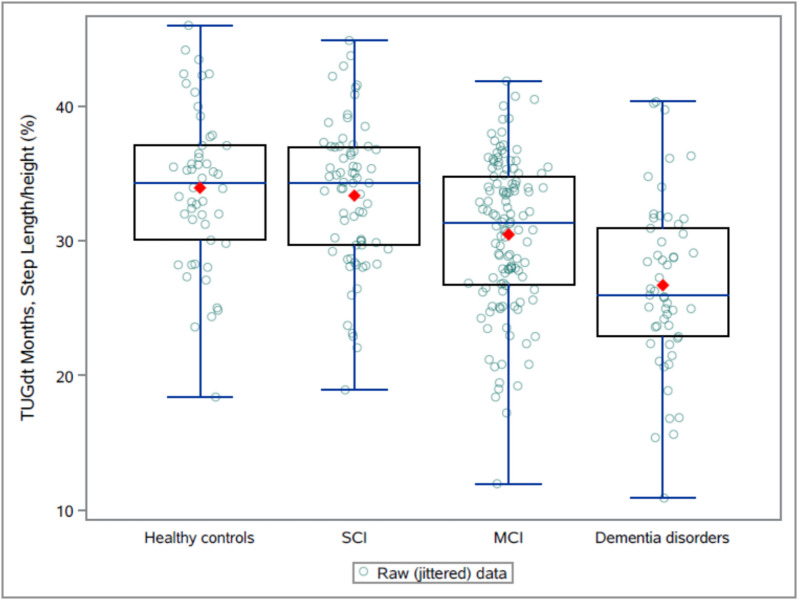
Results: Step length showed greatest overall ability to significantly discriminate between adjacent groups (sOR ≤ . 67, CI95: .45-.99, p = ≤ . 047) during all group comparisons/conditions except three. The highest sOR for step-length was obtained when discriminating between SCI vs controls during TUGdt-MB (sOR = .51, CI95:.29- .87, p = .014), whereby the area under the curve was calculated (c-statistics = .700). The optimal cut-off indicated a step length of less than 32.9% (CI95 = 22.1-43.0) of body height to identify SCI compared with controls.
Conclusions: The results indicate that step length may be important to assess during TUG, for discrimination between groups with different cognitive ability; and that the presented cut-off has potential to aid early detection of cognitive impairment.
期刊介绍:
BMC Geriatrics is an open access journal publishing original peer-reviewed research articles in all aspects of the health and healthcare of older people, including the effects of healthcare systems and policies. The journal also welcomes research focused on the aging process, including cellular, genetic, and physiological processes and cognitive modifications.






 京公网安备 11010802042870号
京ICP备2023020795号-1
京公网安备 11010802042870号
京ICP备2023020795号-1

 分享
分享
 求助内容:
求助内容: 应助结果提醒方式:
 扫码关注我们
