Antonino Casile, Aurelie Cordier, Jiye G Kim, Andrea Cometa, Joseph R Madsen, Scellig Stone, Guy Ben-Yosef, Shimon Ullman, William Anderson, Gabriel Kreiman
{"title":"Neural correlates of minimal recognizable configurations in the human brain.","authors":"Antonino Casile, Aurelie Cordier, Jiye G Kim, Andrea Cometa, Joseph R Madsen, Scellig Stone, Guy Ben-Yosef, Shimon Ullman, William Anderson, Gabriel Kreiman","doi":"10.1016/j.celrep.2025.115429","DOIUrl":null,"url":null,"abstract":"<p><p>Inferring object identity from incomplete information is a ubiquitous challenge for the visual system. Here, we study the neural mechanisms underlying processing of minimally recognizable configurations (MIRCs) and their subparts, which are unrecognizable (sub-MIRCs). MIRCs and sub-MIRCs are very similar at the pixel level, yet they lead to a dramatic gap in recognition performance. To evaluate how the brain processes such images, we invasively record human neurophysiological responses. Correct identification of MIRCs is associated with a dynamic interplay of feedback and feedforward mechanisms between frontal and temporal areas. Interpretation of sub-MIRC images improves dramatically after exposure to the corresponding full objects. This rapid and unsupervised learning is accompanied by changes in neural responses in the temporal cortex. These results are at odds with purely feedforward models of object recognition and suggest a role for the frontal lobe in providing top-down signals related to object identity in difficult visual tasks.</p>","PeriodicalId":9798,"journal":{"name":"Cell reports","volume":"44 3","pages":"115429"},"PeriodicalIF":6.9000,"publicationDate":"2025-03-25","publicationTypes":"Journal Article","fieldsOfStudy":null,"isOpenAccess":false,"openAccessPdf":"https://www.ncbi.nlm.nih.gov/pmc/articles/PMC12045337/pdf/","citationCount":"0","resultStr":null,"platform":"Semanticscholar","paperid":null,"PeriodicalName":"Cell reports","FirstCategoryId":"99","ListUrlMain":"https://doi.org/10.1016/j.celrep.2025.115429","RegionNum":1,"RegionCategory":"生物学","ArticlePicture":[],"TitleCN":null,"AbstractTextCN":null,"PMCID":null,"EPubDate":"2025/3/16 0:00:00","PubModel":"Epub","JCR":"Q1","JCRName":"CELL BIOLOGY","Score":null,"Total":0}
引用次数: 0
Abstract
Inferring object identity from incomplete information is a ubiquitous challenge for the visual system. Here, we study the neural mechanisms underlying processing of minimally recognizable configurations (MIRCs) and their subparts, which are unrecognizable (sub-MIRCs). MIRCs and sub-MIRCs are very similar at the pixel level, yet they lead to a dramatic gap in recognition performance. To evaluate how the brain processes such images, we invasively record human neurophysiological responses. Correct identification of MIRCs is associated with a dynamic interplay of feedback and feedforward mechanisms between frontal and temporal areas. Interpretation of sub-MIRC images improves dramatically after exposure to the corresponding full objects. This rapid and unsupervised learning is accompanied by changes in neural responses in the temporal cortex. These results are at odds with purely feedforward models of object recognition and suggest a role for the frontal lobe in providing top-down signals related to object identity in difficult visual tasks.
期刊介绍:
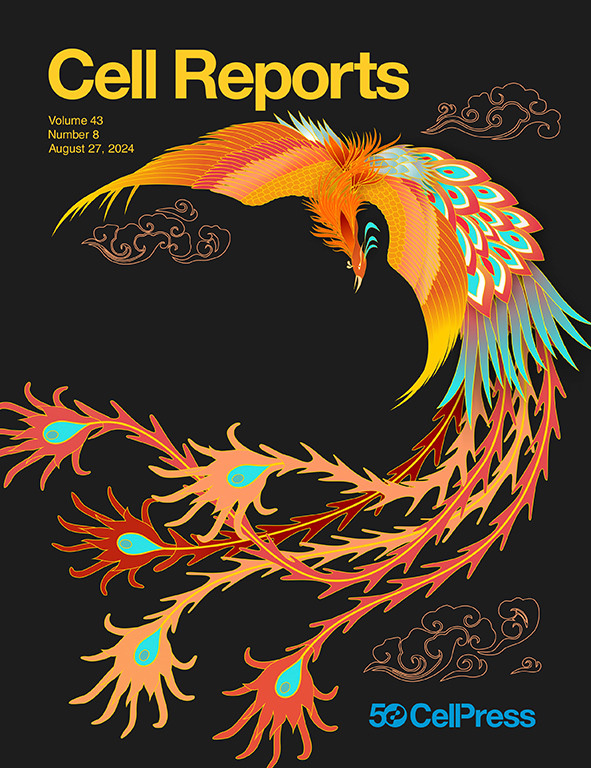
Cell Reports publishes high-quality research across the life sciences and focuses on new biological insight as its primary criterion for publication. The journal offers three primary article types: Reports, which are shorter single-point articles, research articles, which are longer and provide deeper mechanistic insights, and resources, which highlight significant technical advances or major informational datasets that contribute to biological advances. Reviews covering recent literature in emerging and active fields are also accepted.
The Cell Reports Portfolio includes gold open-access journals that cover life, medical, and physical sciences, and its mission is to make cutting-edge research and methodologies available to a wide readership.
The journal's professional in-house editors work closely with authors, reviewers, and the scientific advisory board, which consists of current and future leaders in their respective fields. The advisory board guides the scope, content, and quality of the journal, but editorial decisions are independently made by the in-house scientific editors of Cell Reports.



 京公网安备 11010802042870号
京ICP备2023020795号-1
京公网安备 11010802042870号
京ICP备2023020795号-1

 分享
分享
 求助内容:
求助内容: 应助结果提醒方式:
 扫码关注我们
