Mary Madelyn Lowdermilk, Devon Michael Evanovich, Jue Teresa Wang, Danielle Bennett Pier, Anjali Sadhwani, Benjamin Zendejas, Dusica Bajic
{"title":"Retrospective analysis of early neurodevelopmental outcomes after esophageal atresia repair at a single institution: <i>short-gap</i> vs. <i>long-gap</i> defect.","authors":"Mary Madelyn Lowdermilk, Devon Michael Evanovich, Jue Teresa Wang, Danielle Bennett Pier, Anjali Sadhwani, Benjamin Zendejas, Dusica Bajic","doi":"10.3389/fped.2025.1527880","DOIUrl":null,"url":null,"abstract":"<p><strong>Background: </strong>With increased survival of infants born with esophageal atresia (EA), there is a knowledge gap regarding neurodevelopmental outcomes. We aimed to quantify the frequency of (1) documented developmental delay, and (2) implementation of early intervention services in the first and the second year of life following repair of <i>short-</i> and <i>long-gap</i> EA.</p><p><strong>Method: </strong>We retrospectively analyzed term-born (<i>n</i> = 44) and premature infants (<i>n</i> = 26) following EA repair at a single institution (2009-2020). Infants with anomalies associated with known neurological disorders were excluded. Clinical data was obtained from the electronic medical record, and presented as means and percentages. Developmental delay included clinically documented motor, speech/language, and cognitive delays that were stratified according to a surgical group: <i>short-</i> and <i>long-gap</i> EA.</p><p><strong>Results: </strong>Nearly half of <i>short-gap</i> (24/54; <b>44%</b>) and most of <i>long-gap</i> EA patients (12/16; <b>75%</b>) had documented developmental delay in the first year of life that persisted into the second year of life [<b>52%</b> [28/54] <i>short-gap</i>; <b>69%</b> [11/16] <i>long-gap</i> EA]. Developmental delay was noted irrespective of gestational age at birth, co-existing cardiac anomalies, or presence of cranial/brain findings on imaging. By age 2, <b>70%</b> (38/54) of <i>short-gap</i> and <b>69%</b> (11/16) of <i>long-gap</i> EA patients had received early intervention.</p><p><strong>Interpretation: </strong>Infants born with EA are at high-risk for developmental delay. Early neurodevelopmental assessments and intervention is recommended for EA patients.</p>","PeriodicalId":12637,"journal":{"name":"Frontiers in Pediatrics","volume":"13 ","pages":"1527880"},"PeriodicalIF":2.0000,"publicationDate":"2025-02-28","publicationTypes":"Journal Article","fieldsOfStudy":null,"isOpenAccess":false,"openAccessPdf":"https://www.ncbi.nlm.nih.gov/pmc/articles/PMC11906458/pdf/","citationCount":"0","resultStr":null,"platform":"Semanticscholar","paperid":null,"PeriodicalName":"Frontiers in Pediatrics","FirstCategoryId":"3","ListUrlMain":"https://doi.org/10.3389/fped.2025.1527880","RegionNum":3,"RegionCategory":"医学","ArticlePicture":[],"TitleCN":null,"AbstractTextCN":null,"PMCID":null,"EPubDate":"2025/1/1 0:00:00","PubModel":"eCollection","JCR":"Q2","JCRName":"PEDIATRICS","Score":null,"Total":0}
引用次数: 0
Abstract
Background: With increased survival of infants born with esophageal atresia (EA), there is a knowledge gap regarding neurodevelopmental outcomes. We aimed to quantify the frequency of (1) documented developmental delay, and (2) implementation of early intervention services in the first and the second year of life following repair of short- and long-gap EA.
Method: We retrospectively analyzed term-born (n = 44) and premature infants (n = 26) following EA repair at a single institution (2009-2020). Infants with anomalies associated with known neurological disorders were excluded. Clinical data was obtained from the electronic medical record, and presented as means and percentages. Developmental delay included clinically documented motor, speech/language, and cognitive delays that were stratified according to a surgical group: short- and long-gap EA.
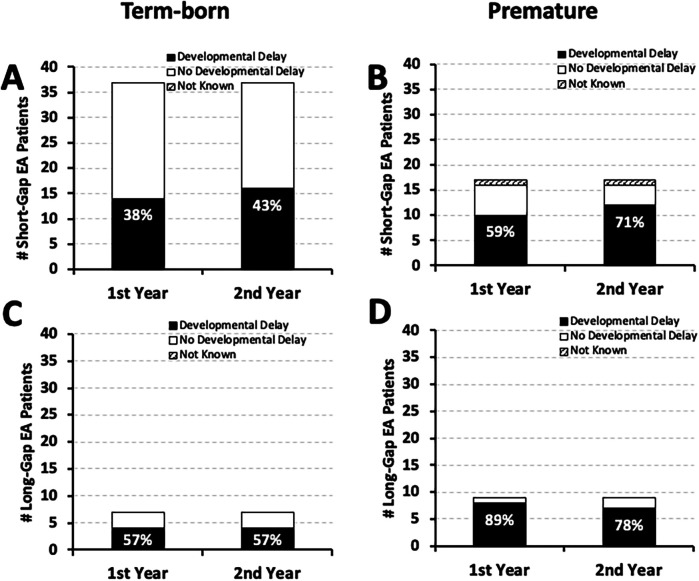
Results: Nearly half of short-gap (24/54; 44%) and most of long-gap EA patients (12/16; 75%) had documented developmental delay in the first year of life that persisted into the second year of life [52% [28/54] short-gap; 69% [11/16] long-gap EA]. Developmental delay was noted irrespective of gestational age at birth, co-existing cardiac anomalies, or presence of cranial/brain findings on imaging. By age 2, 70% (38/54) of short-gap and 69% (11/16) of long-gap EA patients had received early intervention.
Interpretation: Infants born with EA are at high-risk for developmental delay. Early neurodevelopmental assessments and intervention is recommended for EA patients.
期刊介绍:
Frontiers in Pediatrics (Impact Factor 2.33) publishes rigorously peer-reviewed research broadly across the field, from basic to clinical research that meets ongoing challenges in pediatric patient care and child health. Field Chief Editors Arjan Te Pas at Leiden University and Michael L. Moritz at the Children''s Hospital of Pittsburgh are supported by an outstanding Editorial Board of international experts. This multidisciplinary open-access journal is at the forefront of disseminating and communicating scientific knowledge and impactful discoveries to researchers, academics, clinicians and the public worldwide.
Frontiers in Pediatrics also features Research Topics, Frontiers special theme-focused issues managed by Guest Associate Editors, addressing important areas in pediatrics. In this fashion, Frontiers serves as an outlet to publish the broadest aspects of pediatrics in both basic and clinical research, including high-quality reviews, case reports, editorials and commentaries related to all aspects of pediatrics.





 京公网安备 11010802042870号
京ICP备2023020795号-1
京公网安备 11010802042870号
京ICP备2023020795号-1

 分享
分享
 求助内容:
求助内容: 应助结果提醒方式:
 扫码关注我们
