Bernabe Battista, Bruno Hernandez-Cravero, Monica P Colaiácovo, Luisa Cochella, Andres Binolfi, Diego de Mendoza
{"title":"An inducible and reversible system to regulate unsaturated fatty acid biosynthesis in C. elegans.","authors":"Bernabe Battista, Bruno Hernandez-Cravero, Monica P Colaiácovo, Luisa Cochella, Andres Binolfi, Diego de Mendoza","doi":"10.1093/g3journal/jkaf025","DOIUrl":null,"url":null,"abstract":"<p><p>Unsaturated fatty acids (UFAs) play crucial roles in various physiological and pathological processes. In animals, these lipids are synthesized from saturated fatty acids through the action of delta 9 (Δ9) desaturases. In C. elegans, three Δ9 desaturases are encoded by the genes fat-5, fat-6, and fat-7. The presence of multiple Δ9 desaturases has posed a significant challenge in developing a rapid and efficient approach to control UFA production in C. elegans and other model organisms. Utilizing the auxin-inducible degradation system, we specifically targeted the C. elegans fat-7 gene, responsible for the major stearoyl-CoA desaturase (SCD), while deleting fat-5 and fat-6. This design resulted in a strain that can be reversibly depleted of UFAs in the cells of interest. Conditional depletion in all somatic cells exhibited a pronounced auxin-dependent defect in UFA production. Using this system, we uncovered an essential requirement for de novo UFA production during the L1 and L2 stages. Moreover, our results support a direct connection between UFA levels, fat storage, and increased lipid turnover. This system will enable further studies exploring the cellular and physiological consequences of impairing UFA biosynthesis at different developmental stages or in specific tissues.</p>","PeriodicalId":12468,"journal":{"name":"G3: Genes|Genomes|Genetics","volume":" ","pages":""},"PeriodicalIF":2.2000,"publicationDate":"2025-04-17","publicationTypes":"Journal Article","fieldsOfStudy":null,"isOpenAccess":false,"openAccessPdf":"https://www.ncbi.nlm.nih.gov/pmc/articles/PMC12005147/pdf/","citationCount":"0","resultStr":null,"platform":"Semanticscholar","paperid":null,"PeriodicalName":"G3: Genes|Genomes|Genetics","FirstCategoryId":"99","ListUrlMain":"https://doi.org/10.1093/g3journal/jkaf025","RegionNum":3,"RegionCategory":"生物学","ArticlePicture":[],"TitleCN":null,"AbstractTextCN":null,"PMCID":null,"EPubDate":"","PubModel":"","JCR":"Q3","JCRName":"GENETICS & HEREDITY","Score":null,"Total":0}
引用次数: 0
Abstract
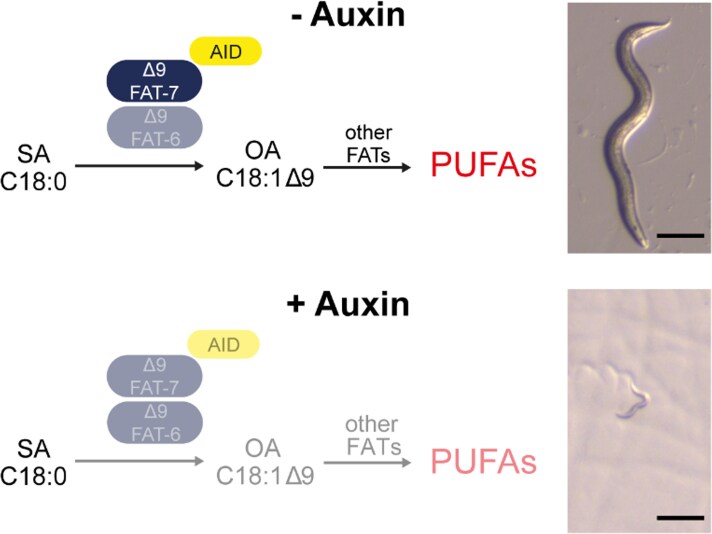
Unsaturated fatty acids (UFAs) play crucial roles in various physiological and pathological processes. In animals, these lipids are synthesized from saturated fatty acids through the action of delta 9 (Δ9) desaturases. In C. elegans, three Δ9 desaturases are encoded by the genes fat-5, fat-6, and fat-7. The presence of multiple Δ9 desaturases has posed a significant challenge in developing a rapid and efficient approach to control UFA production in C. elegans and other model organisms. Utilizing the auxin-inducible degradation system, we specifically targeted the C. elegans fat-7 gene, responsible for the major stearoyl-CoA desaturase (SCD), while deleting fat-5 and fat-6. This design resulted in a strain that can be reversibly depleted of UFAs in the cells of interest. Conditional depletion in all somatic cells exhibited a pronounced auxin-dependent defect in UFA production. Using this system, we uncovered an essential requirement for de novo UFA production during the L1 and L2 stages. Moreover, our results support a direct connection between UFA levels, fat storage, and increased lipid turnover. This system will enable further studies exploring the cellular and physiological consequences of impairing UFA biosynthesis at different developmental stages or in specific tissues.
期刊介绍:
G3: Genes, Genomes, Genetics provides a forum for the publication of high‐quality foundational research, particularly research that generates useful genetic and genomic information such as genome maps, single gene studies, genome‐wide association and QTL studies, as well as genome reports, mutant screens, and advances in methods and technology. The Editorial Board of G3 believes that rapid dissemination of these data is the necessary foundation for analysis that leads to mechanistic insights.
G3, published by the Genetics Society of America, meets the critical and growing need of the genetics community for rapid review and publication of important results in all areas of genetics. G3 offers the opportunity to publish the puzzling finding or to present unpublished results that may not have been submitted for review and publication due to a perceived lack of a potential high-impact finding. G3 has earned the DOAJ Seal, which is a mark of certification for open access journals, awarded by DOAJ to journals that achieve a high level of openness, adhere to Best Practice and high publishing standards.





 京公网安备 11010802042870号
京ICP备2023020795号-1
京公网安备 11010802042870号
京ICP备2023020795号-1

 分享
分享
 求助内容:
求助内容: 应助结果提醒方式:
 扫码关注我们
