{"title":"Reprogramming tumor-associated macrophages in gastric cancer: a pathway to enhanced immunotherapy.","authors":"Yibo He, Qianran Hong, Shiliang Chen, Jiayi Zhou, Shengliang Qiu","doi":"10.3389/fimmu.2025.1558091","DOIUrl":null,"url":null,"abstract":"<p><p>Gastric cancer (GC) remains a significant global health concern due to its poor prognosis and limited therapeutic options, particularly in advanced stages. Tumor microenvironment (TME), particularly tumor-associated macrophages (TAMs), plays a key role in tumor progression, immune evasion, and therapy resistance. TAMs exhibit plasticity, shifting between pro-inflammatory M1 and immunosuppressive M2 phenotypes, with the latter predominating in GC and contributing to poor outcomes. Recent therapeutic advancements focus on targeting TAMs, including inhibiting M2 polarization, reprogramming TAMs to M1 phenotypes, and combining TAM-targeted approaches with immune checkpoint inhibitors. Innovations in nanotechnology, metabolic reprogramming, and targeting key pathways such as interleukin-6 and C-C motif ligand 2/C-C motif chemokine receptor 2 further enhance these strategies. However, challenges remain, including the spatial and functional heterogeneity of TAMs within the TME and the need for selective targeting to avoid disrupting immune homeostasis. Ongoing research on TAM origins, functions, and interactions within the TME is crucial for developing precise and effective therapies. These advances hold promise not only for improving outcomes in GC but also for addressing other cancers with similarly complex microenvironments.</p>","PeriodicalId":12622,"journal":{"name":"Frontiers in Immunology","volume":"16 ","pages":"1558091"},"PeriodicalIF":5.9000,"publicationDate":"2025-03-03","publicationTypes":"Journal Article","fieldsOfStudy":null,"isOpenAccess":false,"openAccessPdf":"https://www.ncbi.nlm.nih.gov/pmc/articles/PMC11911521/pdf/","citationCount":"0","resultStr":null,"platform":"Semanticscholar","paperid":null,"PeriodicalName":"Frontiers in Immunology","FirstCategoryId":"3","ListUrlMain":"https://doi.org/10.3389/fimmu.2025.1558091","RegionNum":2,"RegionCategory":"医学","ArticlePicture":[],"TitleCN":null,"AbstractTextCN":null,"PMCID":null,"EPubDate":"2025/1/1 0:00:00","PubModel":"eCollection","JCR":"Q1","JCRName":"IMMUNOLOGY","Score":null,"Total":0}
引用次数: 0
Abstract
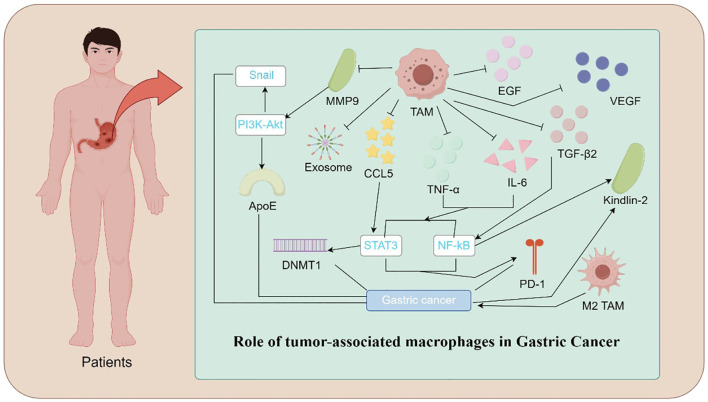
Gastric cancer (GC) remains a significant global health concern due to its poor prognosis and limited therapeutic options, particularly in advanced stages. Tumor microenvironment (TME), particularly tumor-associated macrophages (TAMs), plays a key role in tumor progression, immune evasion, and therapy resistance. TAMs exhibit plasticity, shifting between pro-inflammatory M1 and immunosuppressive M2 phenotypes, with the latter predominating in GC and contributing to poor outcomes. Recent therapeutic advancements focus on targeting TAMs, including inhibiting M2 polarization, reprogramming TAMs to M1 phenotypes, and combining TAM-targeted approaches with immune checkpoint inhibitors. Innovations in nanotechnology, metabolic reprogramming, and targeting key pathways such as interleukin-6 and C-C motif ligand 2/C-C motif chemokine receptor 2 further enhance these strategies. However, challenges remain, including the spatial and functional heterogeneity of TAMs within the TME and the need for selective targeting to avoid disrupting immune homeostasis. Ongoing research on TAM origins, functions, and interactions within the TME is crucial for developing precise and effective therapies. These advances hold promise not only for improving outcomes in GC but also for addressing other cancers with similarly complex microenvironments.
期刊介绍:
Frontiers in Immunology is a leading journal in its field, publishing rigorously peer-reviewed research across basic, translational and clinical immunology. This multidisciplinary open-access journal is at the forefront of disseminating and communicating scientific knowledge and impactful discoveries to researchers, academics, clinicians and the public worldwide.
Frontiers in Immunology is the official Journal of the International Union of Immunological Societies (IUIS). Encompassing the entire field of Immunology, this journal welcomes papers that investigate basic mechanisms of immune system development and function, with a particular emphasis given to the description of the clinical and immunological phenotype of human immune disorders, and on the definition of their molecular basis.



 京公网安备 11010802042870号
京ICP备2023020795号-1
京公网安备 11010802042870号
京ICP备2023020795号-1

 分享
分享
 求助内容:
求助内容: 应助结果提醒方式:
 扫码关注我们
