{"title":"Lasso-Based Nomogram for Predicting Early Recurrence Following Radical Resection in Hepatocellular Carcinoma.","authors":"Guoqun Zheng, Minjie Zheng, Peng Hu, Yu Zhu, Wenlong Zhang, Fabiao Zhang","doi":"10.2147/JHC.S510581","DOIUrl":null,"url":null,"abstract":"<p><strong>Background: </strong>Hepatocellular carcinoma (HCC) is a common malignancy with a high recurrence rate following curative resection. This study aimed to identify factors contributing to early recurrence (within 2 years) and develop a Lasso-based nomogram for individualized risk assessment.</p><p><strong>Methods: </strong>We conducted a retrospective analysis of 206 hCC patients who underwent curative resection at Taizhou Hospital, Zhejiang Province, from January 2019 to August 2022. Patients were randomly divided into training (n=144) and validation (n=62) cohorts. Lasso regression was used to identify potential recurrence risk factors among 17 candidate predictors. A Cox proportional hazards model was constructed based on variables selected by Lasso. Model performance was assessed using receiver operating characteristic (ROC) curves, calibration plots, and decision curve analysis (DCA).</p><p><strong>Results: </strong>Five independent predictors of early HCC recurrence were identified: age, serum alanine aminotransferase (ALT) levels, cirrhosis, tumor diameter, and microvascular invasion (MVI). The nomogram demonstrated area under the curve (AUC) values for recurrence-free survival (RFS) of 0.828 (95% confidence interval [CI]: 0.753-0.904) at 1 year, 0.799 (95% CI: 0.718-0.880) at 2 years, and 0.742 (95% CI: 0.642-0.842) at 5 years in the training cohort. The corresponding AUCs in the validation cohort were 0.823 (95% CI: 0.686-0.960), 0.804 (95% CI: 0.686-0.922), and 0.857 (95% CI: 0.722-0.992) at 1, 2 and 5 years, respectively. Calibration curves and DCA confirmed the nomogram's high accuracy and clinical utility.</p><p><strong>Conclusion: </strong>The Lasso-Cox regression nomogram effectively predicts HCC recurrence within two years post-hepatectomy, providing a valuable tool for personalized postoperative management to improve patient outcomes.</p>","PeriodicalId":15906,"journal":{"name":"Journal of Hepatocellular Carcinoma","volume":"12 ","pages":"539-552"},"PeriodicalIF":3.4000,"publicationDate":"2025-03-12","publicationTypes":"Journal Article","fieldsOfStudy":null,"isOpenAccess":false,"openAccessPdf":"https://www.ncbi.nlm.nih.gov/pmc/articles/PMC11911823/pdf/","citationCount":"0","resultStr":null,"platform":"Semanticscholar","paperid":null,"PeriodicalName":"Journal of Hepatocellular Carcinoma","FirstCategoryId":"3","ListUrlMain":"https://doi.org/10.2147/JHC.S510581","RegionNum":3,"RegionCategory":"医学","ArticlePicture":[],"TitleCN":null,"AbstractTextCN":null,"PMCID":null,"EPubDate":"2025/1/1 0:00:00","PubModel":"eCollection","JCR":"Q2","JCRName":"ONCOLOGY","Score":null,"Total":0}
引用次数: 0
Abstract
Background: Hepatocellular carcinoma (HCC) is a common malignancy with a high recurrence rate following curative resection. This study aimed to identify factors contributing to early recurrence (within 2 years) and develop a Lasso-based nomogram for individualized risk assessment.
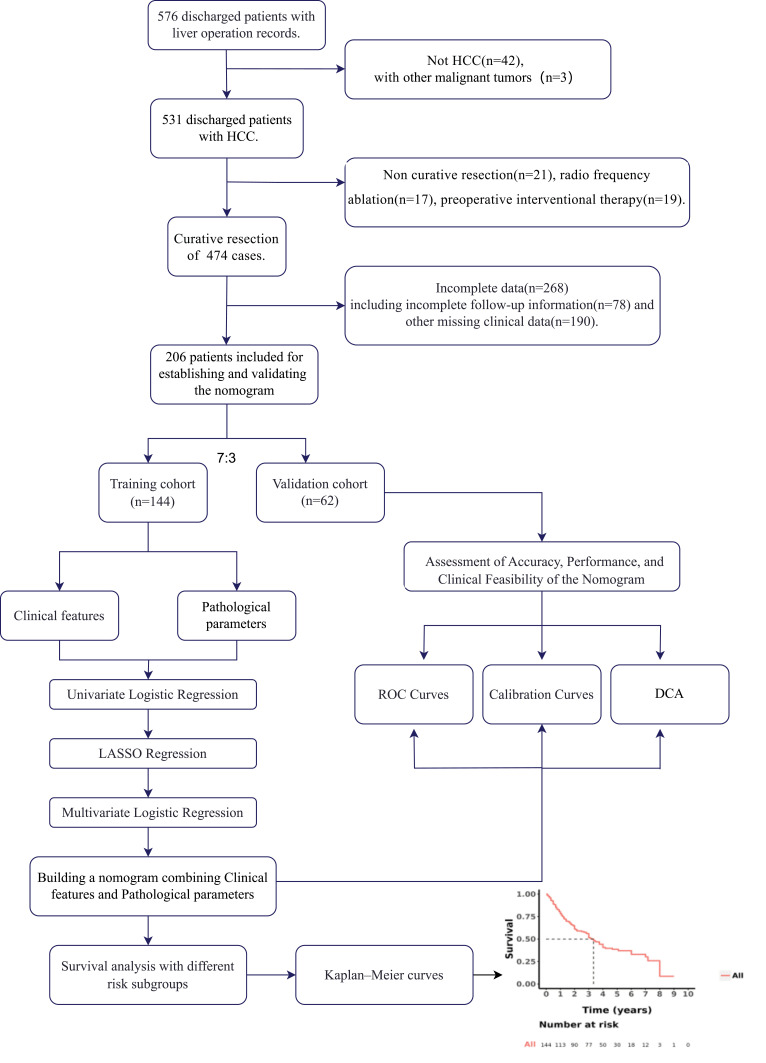
Methods: We conducted a retrospective analysis of 206 hCC patients who underwent curative resection at Taizhou Hospital, Zhejiang Province, from January 2019 to August 2022. Patients were randomly divided into training (n=144) and validation (n=62) cohorts. Lasso regression was used to identify potential recurrence risk factors among 17 candidate predictors. A Cox proportional hazards model was constructed based on variables selected by Lasso. Model performance was assessed using receiver operating characteristic (ROC) curves, calibration plots, and decision curve analysis (DCA).
Results: Five independent predictors of early HCC recurrence were identified: age, serum alanine aminotransferase (ALT) levels, cirrhosis, tumor diameter, and microvascular invasion (MVI). The nomogram demonstrated area under the curve (AUC) values for recurrence-free survival (RFS) of 0.828 (95% confidence interval [CI]: 0.753-0.904) at 1 year, 0.799 (95% CI: 0.718-0.880) at 2 years, and 0.742 (95% CI: 0.642-0.842) at 5 years in the training cohort. The corresponding AUCs in the validation cohort were 0.823 (95% CI: 0.686-0.960), 0.804 (95% CI: 0.686-0.922), and 0.857 (95% CI: 0.722-0.992) at 1, 2 and 5 years, respectively. Calibration curves and DCA confirmed the nomogram's high accuracy and clinical utility.
Conclusion: The Lasso-Cox regression nomogram effectively predicts HCC recurrence within two years post-hepatectomy, providing a valuable tool for personalized postoperative management to improve patient outcomes.






 京公网安备 11010802042870号
京ICP备2023020795号-1
京公网安备 11010802042870号
京ICP备2023020795号-1

 分享
分享
 求助内容:
求助内容: 应助结果提醒方式:
 扫码关注我们
