Obsessional thinking and autistic traits are each uniquely associated with greater traits of gender dysphoria in clinical and nonclinical adult samples.
{"title":"Obsessional thinking and autistic traits are each uniquely associated with greater traits of gender dysphoria in clinical and nonclinical adult samples.","authors":"Karl Mears, Dheeraj Rai, Punit Shah, Chris Ashwin","doi":"10.1186/s13229-025-00649-1","DOIUrl":null,"url":null,"abstract":"<p><strong>Background: </strong>Research has demonstrated a strong relationship between autism and gender dysphoria (GD) and that this relationship could be explained by obsessional interests which are characteristic of autism. However, these studies often measured obsessions using either single items which questions the reliability of the findings, or within autistic trait measures meaning the findings may simply index a more general relationship between autistic traits and GD. Therefore, the present study aimed to investigate the relationships between obsessional thoughts and traits of GD using a measure of obsessional thoughts alongside a measure of autistic traits, which was investigated in both non-clinical and clinical samples.</p><p><strong>Methods: </strong>A total of 145 non-clinical participants took part in Study 1 and all completed the Autism-Spectrum Quotient (AQ) as a measure of autistic traits, the Obsessive-Compulsive Inventory-Revised (OCI-R) obsessional thoughts subscale as a measure of obsessional thoughts, and the Gender-Identity/Gender-Dysphoria Questionnaire (GIDYQ) to measure traits of GD. For Study 2, a total of 226 participants took part in Study 2 and all completed the same measures as in Study 1. They included participants diagnosed with GD (N = 49), autism (N = 65), OCD (N = 46) and controls with no diagnosis (N = 66).</p><p><strong>Results: </strong>The hierarchical linear regression for Study 1 showed that both total AQ and OCI-R obsessional thoughts scores were uniquely associated with GIDYQ scores, with no interaction effect between the scores. The results for Study 2, from a hierarchical linear regression, once again found that obsessional thoughts and autistic traits were each uniquely associated with GIDYQ scores, but not their interaction. The GD and autistic groups both reported significantly greater traits of GD than the OCD and control groups, with the GD group reporting higher scores than the autistic group.</p><p><strong>Limitations: </strong>Participants self-reported their diagnoses for Study 2, but diagnostic tests to verify these were not administered. Traits of GD were also measured at a single point in time, despite such traits being transient and continuous.</p><p><strong>Conclusions: </strong>The results show both obsessional thoughts and autistic traits are uniquely associated with GD, and that autistic people experience greater traits of GD than other clinical groups.</p>","PeriodicalId":18733,"journal":{"name":"Molecular Autism","volume":"16 1","pages":"20"},"PeriodicalIF":5.5000,"publicationDate":"2025-03-17","publicationTypes":"Journal Article","fieldsOfStudy":null,"isOpenAccess":false,"openAccessPdf":"https://www.ncbi.nlm.nih.gov/pmc/articles/PMC11916952/pdf/","citationCount":"0","resultStr":null,"platform":"Semanticscholar","paperid":null,"PeriodicalName":"Molecular Autism","FirstCategoryId":"3","ListUrlMain":"https://doi.org/10.1186/s13229-025-00649-1","RegionNum":1,"RegionCategory":"医学","ArticlePicture":[],"TitleCN":null,"AbstractTextCN":null,"PMCID":null,"EPubDate":"","PubModel":"","JCR":"Q1","JCRName":"GENETICS & HEREDITY","Score":null,"Total":0}
引用次数: 0
Abstract
Background: Research has demonstrated a strong relationship between autism and gender dysphoria (GD) and that this relationship could be explained by obsessional interests which are characteristic of autism. However, these studies often measured obsessions using either single items which questions the reliability of the findings, or within autistic trait measures meaning the findings may simply index a more general relationship between autistic traits and GD. Therefore, the present study aimed to investigate the relationships between obsessional thoughts and traits of GD using a measure of obsessional thoughts alongside a measure of autistic traits, which was investigated in both non-clinical and clinical samples.
Methods: A total of 145 non-clinical participants took part in Study 1 and all completed the Autism-Spectrum Quotient (AQ) as a measure of autistic traits, the Obsessive-Compulsive Inventory-Revised (OCI-R) obsessional thoughts subscale as a measure of obsessional thoughts, and the Gender-Identity/Gender-Dysphoria Questionnaire (GIDYQ) to measure traits of GD. For Study 2, a total of 226 participants took part in Study 2 and all completed the same measures as in Study 1. They included participants diagnosed with GD (N = 49), autism (N = 65), OCD (N = 46) and controls with no diagnosis (N = 66).
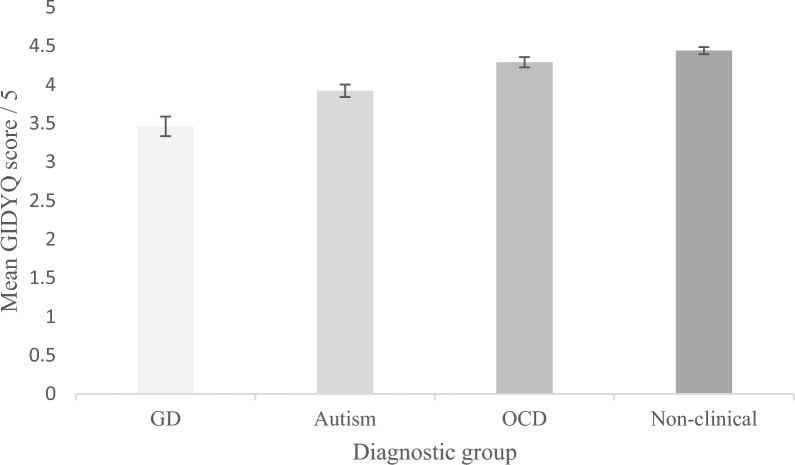
Results: The hierarchical linear regression for Study 1 showed that both total AQ and OCI-R obsessional thoughts scores were uniquely associated with GIDYQ scores, with no interaction effect between the scores. The results for Study 2, from a hierarchical linear regression, once again found that obsessional thoughts and autistic traits were each uniquely associated with GIDYQ scores, but not their interaction. The GD and autistic groups both reported significantly greater traits of GD than the OCD and control groups, with the GD group reporting higher scores than the autistic group.
Limitations: Participants self-reported their diagnoses for Study 2, but diagnostic tests to verify these were not administered. Traits of GD were also measured at a single point in time, despite such traits being transient and continuous.
Conclusions: The results show both obsessional thoughts and autistic traits are uniquely associated with GD, and that autistic people experience greater traits of GD than other clinical groups.
期刊介绍:
Molecular Autism is a peer-reviewed, open access journal that publishes high-quality basic, translational and clinical research that has relevance to the etiology, pathobiology, or treatment of autism and related neurodevelopmental conditions. Research that includes integration across levels is encouraged. Molecular Autism publishes empirical studies, reviews, and brief communications.



 京公网安备 11010802042870号
京ICP备2023020795号-1
京公网安备 11010802042870号
京ICP备2023020795号-1

 分享
分享
 求助内容:
求助内容: 应助结果提醒方式:
 扫码关注我们
