Kinnon Ross MacKinnon, Naail Khan, Katherine M Newman, Wren Ariel Gould, Gin Marshall, Travis Salway, Annie Pullen Sansfaçon, Hannah Kia, June Sh Lam
{"title":"Introducing Novel Methods to Identify Fraudulent Responses (Sampling With Sisyphus): Web-Based LGBTQ2S+ Mixed-Methods Study.","authors":"Kinnon Ross MacKinnon, Naail Khan, Katherine M Newman, Wren Ariel Gould, Gin Marshall, Travis Salway, Annie Pullen Sansfaçon, Hannah Kia, June Sh Lam","doi":"10.2196/63252","DOIUrl":null,"url":null,"abstract":"<p><strong>Background: </strong>The myth of Sisyphus teaches about resilience in the face of life challenges. Detransition after an initial gender transition is an emerging experience that requires sensitive and community-driven research. However, there are significant complexities and costs that researchers must confront to collect reliable data to better understand this phenomenon, including the lack of a uniform definition and challenges with recruitment.</p><p><strong>Objective: </strong>This paper presents the sampling and recruitment methods of a new study on detransition-related phenomena among lesbian, gay, bisexual, transgender, queer, and 2-spirit (LGBTQ2S+) populations. It introduces a novel protocol for identifying and removing bot, scam, and ineligible responses from survey datasets and presents preliminary descriptive sociodemographic results of the sample. This analysis does not present gender-affirming health care outcomes.</p><p><strong>Methods: </strong>To attract a large and heterogeneous sample, 3 different study flyers were created in English, French, and Spanish. Between December 1, 2023, and May 1, 2024, these flyers were distributed to >615 sexual and gender minority organizations and gender care providers in the United States and Canada, and paid advertisements totaling >CAD $7400 (US $5551) were promoted on 5 different social media platforms. Although many social media promotions were rejected or removed, the advertisements reached >7.7 million accounts. Study website visitors were directed from 35 different traffic sources, with the top 5 being Facebook (3,577,520/7,777,218, 46%), direct link (2,255,393/7,777,218, 29%), Reddit (1,011,038/7,777,218, 13%), Instagram (466,633/7,777,218, 6%), and X (formerly known as Twitter; 233,317/7,777,218, 3%). A systematic protocol was developed to identify scam, nonsense, and ineligible responses and to conduct web-based Zoom video platform screening with select participants.</p><p><strong>Results: </strong>Of the 1377 completed survey responses, 957 (69.5%) were deemed eligible and included in the analytic dataset after applying the exclusion protocol and conducting 113 virtual screenings. The mean age of the sample was 25.87 (SD 7.77; median 24, IQR 21-29 years). A majority of the participants were White (Canadian, American, or of European descent; 748/950, 78.7%), living in the United States (704/957, 73.6%), and assigned female at birth (754/953, 79.1%). Many participants reported having a sexual minority identity, with more than half the sample (543/955, 56.8%) indicating plurisexual orientations, such as bisexual or pansexual identities. A minority of participants (108/955, 11.3%) identified as straight or heterosexual. When asked about their gender-diverse identities after stopping or reversing gender transition, 33.2% (318/957) reported being nonbinary, 43.2% (413/957) transgender, and 40.5% (388/957) identified as detransitioned.</p><p><strong>Conclusions: </strong>Despite challenges encountered during the study promotion and data collection phases, a heterogeneous sample of >950 eligible participants was obtained, presenting opportunities for future analyses to better understand these LGBTQ2S+ experiences. This study is among the first to introduce an innovative strategy to sample a hard-to-reach and equity-deserving group, and to present an approach to remove fraudulent responses.</p>","PeriodicalId":16337,"journal":{"name":"Journal of Medical Internet Research","volume":"27 ","pages":"e63252"},"PeriodicalIF":6.0000,"publicationDate":"2025-03-17","publicationTypes":"Journal Article","fieldsOfStudy":null,"isOpenAccess":false,"openAccessPdf":"https://www.ncbi.nlm.nih.gov/pmc/articles/PMC11959198/pdf/","citationCount":"0","resultStr":null,"platform":"Semanticscholar","paperid":null,"PeriodicalName":"Journal of Medical Internet Research","FirstCategoryId":"3","ListUrlMain":"https://doi.org/10.2196/63252","RegionNum":2,"RegionCategory":"医学","ArticlePicture":[],"TitleCN":null,"AbstractTextCN":null,"PMCID":null,"EPubDate":"","PubModel":"","JCR":"Q1","JCRName":"HEALTH CARE SCIENCES & SERVICES","Score":null,"Total":0}
引用次数: 0
Abstract
Background: The myth of Sisyphus teaches about resilience in the face of life challenges. Detransition after an initial gender transition is an emerging experience that requires sensitive and community-driven research. However, there are significant complexities and costs that researchers must confront to collect reliable data to better understand this phenomenon, including the lack of a uniform definition and challenges with recruitment.
Objective: This paper presents the sampling and recruitment methods of a new study on detransition-related phenomena among lesbian, gay, bisexual, transgender, queer, and 2-spirit (LGBTQ2S+) populations. It introduces a novel protocol for identifying and removing bot, scam, and ineligible responses from survey datasets and presents preliminary descriptive sociodemographic results of the sample. This analysis does not present gender-affirming health care outcomes.
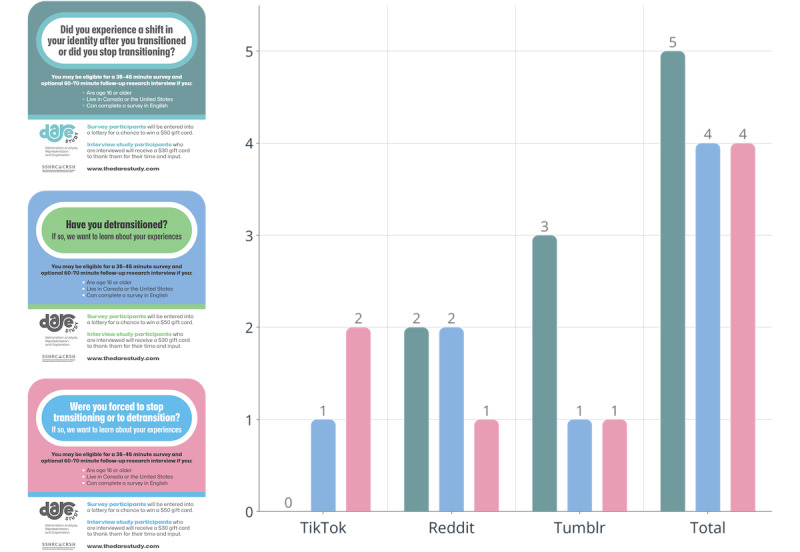
Methods: To attract a large and heterogeneous sample, 3 different study flyers were created in English, French, and Spanish. Between December 1, 2023, and May 1, 2024, these flyers were distributed to >615 sexual and gender minority organizations and gender care providers in the United States and Canada, and paid advertisements totaling >CAD $7400 (US $5551) were promoted on 5 different social media platforms. Although many social media promotions were rejected or removed, the advertisements reached >7.7 million accounts. Study website visitors were directed from 35 different traffic sources, with the top 5 being Facebook (3,577,520/7,777,218, 46%), direct link (2,255,393/7,777,218, 29%), Reddit (1,011,038/7,777,218, 13%), Instagram (466,633/7,777,218, 6%), and X (formerly known as Twitter; 233,317/7,777,218, 3%). A systematic protocol was developed to identify scam, nonsense, and ineligible responses and to conduct web-based Zoom video platform screening with select participants.
Results: Of the 1377 completed survey responses, 957 (69.5%) were deemed eligible and included in the analytic dataset after applying the exclusion protocol and conducting 113 virtual screenings. The mean age of the sample was 25.87 (SD 7.77; median 24, IQR 21-29 years). A majority of the participants were White (Canadian, American, or of European descent; 748/950, 78.7%), living in the United States (704/957, 73.6%), and assigned female at birth (754/953, 79.1%). Many participants reported having a sexual minority identity, with more than half the sample (543/955, 56.8%) indicating plurisexual orientations, such as bisexual or pansexual identities. A minority of participants (108/955, 11.3%) identified as straight or heterosexual. When asked about their gender-diverse identities after stopping or reversing gender transition, 33.2% (318/957) reported being nonbinary, 43.2% (413/957) transgender, and 40.5% (388/957) identified as detransitioned.
Conclusions: Despite challenges encountered during the study promotion and data collection phases, a heterogeneous sample of >950 eligible participants was obtained, presenting opportunities for future analyses to better understand these LGBTQ2S+ experiences. This study is among the first to introduce an innovative strategy to sample a hard-to-reach and equity-deserving group, and to present an approach to remove fraudulent responses.
期刊介绍:
The Journal of Medical Internet Research (JMIR) is a highly respected publication in the field of health informatics and health services. With a founding date in 1999, JMIR has been a pioneer in the field for over two decades.
As a leader in the industry, the journal focuses on digital health, data science, health informatics, and emerging technologies for health, medicine, and biomedical research. It is recognized as a top publication in these disciplines, ranking in the first quartile (Q1) by Impact Factor.
Notably, JMIR holds the prestigious position of being ranked #1 on Google Scholar within the "Medical Informatics" discipline.





 京公网安备 11010802042870号
京ICP备2023020795号-1
京公网安备 11010802042870号
京ICP备2023020795号-1

 分享
分享
 求助内容:
求助内容: 应助结果提醒方式:
 扫码关注我们
