{"title":"Factors and Experiences Associated With Unscheduled Hospital Readmission After Lateral Lumbar Interbody Fusion: A Case-Controlled Study.","authors":"Wangmi Liu, Feng Zhang, Yiqing Tao, Hao Li, Qixin Chen, Fangcai Li","doi":"10.1111/os.70022","DOIUrl":null,"url":null,"abstract":"<p><strong>Purpose: </strong>Understanding the risk factors associated with unscheduled readmission following lateral lumbar interbody fusion (LLIF) is crucial for mitigating the occurrence of these costly events. This study aims to ascertain the incidence and factors of unscheduled hospital readmission subsequent to LLIF.</p><p><strong>Methods: </strong>A retrospective analysis was conducted on patients who underwent LLIF at our institution from March 2016 to February 2023. Instances of unscheduled hospital readmission after LLIF were meticulously recorded, including baseline demographics, characteristics of spine pathology, surgical interventions, duration between two hospitalizations, and hospitalization costs and duration. Reasons for readmission were categorized based on their etiology. A case-control methodology was employed to compare unscheduled hospital readmission patients against planned readmission patients due to staged surgery. Parametric data were analyzed with a two-tailed T-test, nonparametric data with the Wilcoxon rank-sum test, and categorical data with the χ <sup>2</sup> test.</p><p><strong>Results: </strong>A total of 1521 patients who received LLIF at our institution were included in the study. A total of 59 patients (3.88%) were unscheduled readmitted due to adjacent segment disease (ASD), cage subsidence, the original surgical segments remaining narrow, spondylodiscitis, and pain. 51 patients (3.35%) experienced reoperation, predominantly attributable to ASD. Compared to planned readmission patients, unscheduled readmission patients tended to be younger, had a lower likelihood of having scoliosis, and were more likely to have short-segment surgery and higher initial hospitalization costs. Among unscheduled readmission patients, patients receiving short-segment surgery, as well as those who paid less during the initial hospitalization, demonstrated a higher likelihood of a 90-day readmission rate.</p><p><strong>Conclusion: </strong>Our findings indicated the heightened risks of unscheduled hospital readmission after LLIF. Taking targeted measures against these risk factors is expected to reduce the healthcare burden caused by unplanned readmissions in the future.</p>","PeriodicalId":19566,"journal":{"name":"Orthopaedic Surgery","volume":" ","pages":"1389-1396"},"PeriodicalIF":2.1000,"publicationDate":"2025-05-01","publicationTypes":"Journal Article","fieldsOfStudy":null,"isOpenAccess":false,"openAccessPdf":"https://www.ncbi.nlm.nih.gov/pmc/articles/PMC12050185/pdf/","citationCount":"0","resultStr":null,"platform":"Semanticscholar","paperid":null,"PeriodicalName":"Orthopaedic Surgery","FirstCategoryId":"3","ListUrlMain":"https://doi.org/10.1111/os.70022","RegionNum":2,"RegionCategory":"医学","ArticlePicture":[],"TitleCN":null,"AbstractTextCN":null,"PMCID":null,"EPubDate":"2025/3/16 0:00:00","PubModel":"Epub","JCR":"Q2","JCRName":"ORTHOPEDICS","Score":null,"Total":0}
引用次数: 0
Abstract
Purpose: Understanding the risk factors associated with unscheduled readmission following lateral lumbar interbody fusion (LLIF) is crucial for mitigating the occurrence of these costly events. This study aims to ascertain the incidence and factors of unscheduled hospital readmission subsequent to LLIF.
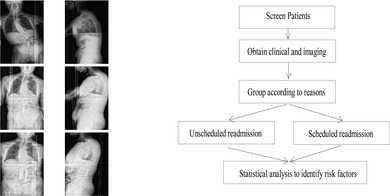
Methods: A retrospective analysis was conducted on patients who underwent LLIF at our institution from March 2016 to February 2023. Instances of unscheduled hospital readmission after LLIF were meticulously recorded, including baseline demographics, characteristics of spine pathology, surgical interventions, duration between two hospitalizations, and hospitalization costs and duration. Reasons for readmission were categorized based on their etiology. A case-control methodology was employed to compare unscheduled hospital readmission patients against planned readmission patients due to staged surgery. Parametric data were analyzed with a two-tailed T-test, nonparametric data with the Wilcoxon rank-sum test, and categorical data with the χ 2 test.
Results: A total of 1521 patients who received LLIF at our institution were included in the study. A total of 59 patients (3.88%) were unscheduled readmitted due to adjacent segment disease (ASD), cage subsidence, the original surgical segments remaining narrow, spondylodiscitis, and pain. 51 patients (3.35%) experienced reoperation, predominantly attributable to ASD. Compared to planned readmission patients, unscheduled readmission patients tended to be younger, had a lower likelihood of having scoliosis, and were more likely to have short-segment surgery and higher initial hospitalization costs. Among unscheduled readmission patients, patients receiving short-segment surgery, as well as those who paid less during the initial hospitalization, demonstrated a higher likelihood of a 90-day readmission rate.
Conclusion: Our findings indicated the heightened risks of unscheduled hospital readmission after LLIF. Taking targeted measures against these risk factors is expected to reduce the healthcare burden caused by unplanned readmissions in the future.
期刊介绍:
Orthopaedic Surgery (OS) is the official journal of the Chinese Orthopaedic Association, focusing on all aspects of orthopaedic technique and surgery.
The journal publishes peer-reviewed articles in the following categories: Original Articles, Clinical Articles, Review Articles, Guidelines, Editorials, Commentaries, Surgical Techniques, Case Reports and Meeting Reports.





 京公网安备 11010802042870号
京ICP备2023020795号-1
京公网安备 11010802042870号
京ICP备2023020795号-1

 分享
分享
 求助内容:
求助内容: 应助结果提醒方式:
 扫码关注我们
