Longliang Qiao, Lingxue Niu, Zhihao Wang, Zhenqiang Deng, Dai Di, Xiaoding Ma, Yang Zhou, Deqiang Kong, Qilin Wang, Jianli Yin, Lingli Jin, Jing Sun, Bo Feng, Weiqiang Lu, Fengfeng Cai, Ningzi Guan, Haifeng Ye
{"title":"Engineered bacteria for near-infrared light-inducible expression of cancer therapeutics","authors":"Longliang Qiao, Lingxue Niu, Zhihao Wang, Zhenqiang Deng, Dai Di, Xiaoding Ma, Yang Zhou, Deqiang Kong, Qilin Wang, Jianli Yin, Lingli Jin, Jing Sun, Bo Feng, Weiqiang Lu, Fengfeng Cai, Ningzi Guan, Haifeng Ye","doi":"10.1038/s43018-025-00932-3","DOIUrl":null,"url":null,"abstract":"Bacteria-based therapies hold great promise for cancer treatment due to their selective tumor colonization and proliferation. However, clinical application is hindered by the need for safe, precise control systems to regulate local therapeutic payload expression and release. Here we developed a near-infrared (NIR) light-mediated PadC-based photoswitch (NETMAP) system based on a chimeric phytochrome-activated diguanylyl cyclase (PadC) and a cyclic diguanylate monophosphate-dependent transcriptional activator (MrkH). The NETMAP-engineered bacteria exhibited antitumor performance in mouse tumor models with different levels of immunogenicity. Specifically, in immunogenic lymphoma tumors, NIR-induced PD-L1 and CTLA-4 nanobodies enhanced the activation of adaptive immunity. In low-immunogenic tumors—including mouse-derived colon cancer models, an orthotopic human breast cancer cell line-derived xenograft model and a colorectal cancer patient-derived xenograft model—NIR-induced azurin and cytolysin A predominantly led to tumor inhibition. Our study identifies an NIR light-mediated therapeutic platform for engineered bacteria-based therapies with customizable outputs and precise dosage control. Qiao et al. report the design and characterization of an optogenetic platform for the dynamic control of protein expression and secretion by engineered bacteria, with implications for cancer therapy.","PeriodicalId":18885,"journal":{"name":"Nature cancer","volume":"6 4","pages":"612-628"},"PeriodicalIF":28.5000,"publicationDate":"2025-03-17","publicationTypes":"Journal Article","fieldsOfStudy":null,"isOpenAccess":false,"openAccessPdf":"","citationCount":"0","resultStr":null,"platform":"Semanticscholar","paperid":null,"PeriodicalName":"Nature cancer","FirstCategoryId":"3","ListUrlMain":"https://www.nature.com/articles/s43018-025-00932-3","RegionNum":1,"RegionCategory":"医学","ArticlePicture":[],"TitleCN":null,"AbstractTextCN":null,"PMCID":null,"EPubDate":"","PubModel":"","JCR":"Q1","JCRName":"ONCOLOGY","Score":null,"Total":0}
引用次数: 0
Abstract
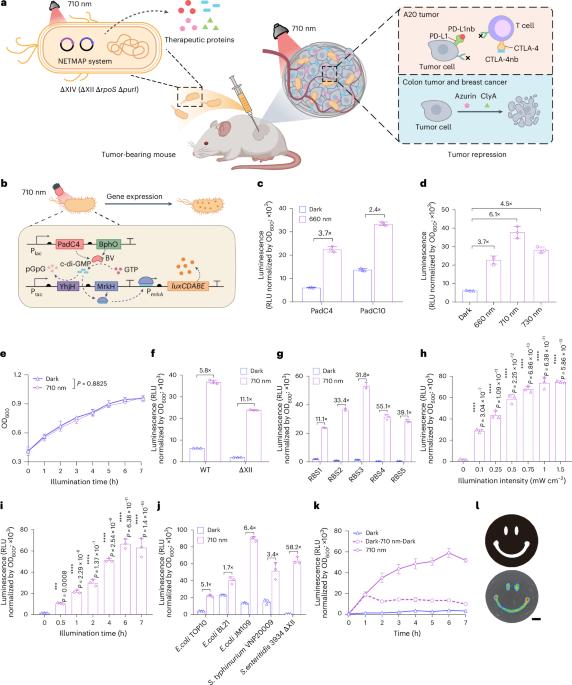
Bacteria-based therapies hold great promise for cancer treatment due to their selective tumor colonization and proliferation. However, clinical application is hindered by the need for safe, precise control systems to regulate local therapeutic payload expression and release. Here we developed a near-infrared (NIR) light-mediated PadC-based photoswitch (NETMAP) system based on a chimeric phytochrome-activated diguanylyl cyclase (PadC) and a cyclic diguanylate monophosphate-dependent transcriptional activator (MrkH). The NETMAP-engineered bacteria exhibited antitumor performance in mouse tumor models with different levels of immunogenicity. Specifically, in immunogenic lymphoma tumors, NIR-induced PD-L1 and CTLA-4 nanobodies enhanced the activation of adaptive immunity. In low-immunogenic tumors—including mouse-derived colon cancer models, an orthotopic human breast cancer cell line-derived xenograft model and a colorectal cancer patient-derived xenograft model—NIR-induced azurin and cytolysin A predominantly led to tumor inhibition. Our study identifies an NIR light-mediated therapeutic platform for engineered bacteria-based therapies with customizable outputs and precise dosage control. Qiao et al. report the design and characterization of an optogenetic platform for the dynamic control of protein expression and secretion by engineered bacteria, with implications for cancer therapy.
期刊介绍:
Cancer is a devastating disease responsible for millions of deaths worldwide. However, many of these deaths could be prevented with improved prevention and treatment strategies. To achieve this, it is crucial to focus on accurate diagnosis, effective treatment methods, and understanding the socioeconomic factors that influence cancer rates.
Nature Cancer aims to serve as a unique platform for sharing the latest advancements in cancer research across various scientific fields, encompassing life sciences, physical sciences, applied sciences, and social sciences. The journal is particularly interested in fundamental research that enhances our understanding of tumor development and progression, as well as research that translates this knowledge into clinical applications through innovative diagnostic and therapeutic approaches. Additionally, Nature Cancer welcomes clinical studies that inform cancer diagnosis, treatment, and prevention, along with contributions exploring the societal impact of cancer on a global scale.
In addition to publishing original research, Nature Cancer will feature Comments, Reviews, News & Views, Features, and Correspondence that hold significant value for the diverse field of cancer research.



 京公网安备 11010802042870号
京ICP备2023020795号-1
京公网安备 11010802042870号
京ICP备2023020795号-1

 分享
分享
 求助内容:
求助内容: 应助结果提醒方式:
 扫码关注我们
