Marjan Biria, Paula Banca, Isaac Jarratt Barnham, Aleya A Marzuki, Nuria Segarra, Engin Keser, Akeem Sule, Marija Farrugia, Qiang Luo, Naomi Fineberg, Emilio Fernandez-Egea, Trevor W Robbins
{"title":"Clozapine-induced obsessive-compulsive symptoms in schizophrenia: Clinical and cognitive determinants of dysfunctional checking.","authors":"Marjan Biria, Paula Banca, Isaac Jarratt Barnham, Aleya A Marzuki, Nuria Segarra, Engin Keser, Akeem Sule, Marija Farrugia, Qiang Luo, Naomi Fineberg, Emilio Fernandez-Egea, Trevor W Robbins","doi":"10.1017/S0033291724003350","DOIUrl":null,"url":null,"abstract":"<p><strong>Background: </strong>Obsessive-compulsive symptoms (OCS) emerge in a significant proportion of clozapine-treated schizophrenia patients, affecting social functioning and increasing depressive symptoms. This study investigates the underexplored cognitive mechanisms of clozapine-induced OCS, particularly focusing on dysfunctional checking behavior.</p><p><strong>Methods: </strong>Clinical and cognitive profiles of OCS and their relationship to dysfunctional checking were investigated using a novel checking paradigm (image verification task or IVT) in four groups: clozapine-treated schizophrenia patients with clozapine-induced OCS (SCZ-OCS, n = 21) and without (SCZ-only, n = 15), patients with obsessive-compulsive disorder (OCD, n = 32) and IQ-matched healthy volunteers (HV, n = 30).</p><p><strong>Results: </strong>Only SCZ-OCS patients showed a distinctive pattern of dysfunctional checking on the IVT. Compared with SCZ-OCS, SCZ-only patients exhibited functional checking while having equivalent deficits in executive cognition, clozapine dose, and treatment duration, though with less severe positive and depressive symptoms. In SCZ-OCS, dysfunctional checking was positively correlated with clozapine dose and working memory performance. By contrast, OCD patients' checking was positively related to intolerance of uncertainty. Checking in the OCD and SCZ-OCS groups was positively correlated with YBOCS-compulsion.</p><p><strong>Conclusion: </strong>This study is the first to compare the distinct cognitive and clinical profiles of SCZ-OCS, SCZ-only, and OCD, with a focus on checking behavior, a major symptom in clozapine-treated patients. We introduced a novel and sensitive measure for checking, which showed dysfunctional checking only in SCZ-OCS patients treated with clozapine. These findings indicate that a subset of patients with schizophrenia with more severe positive symptoms and cognitive deficits are especially susceptible to OCD symptoms when treated with clozapine.</p>","PeriodicalId":20891,"journal":{"name":"Psychological Medicine","volume":"55 ","pages":"e87"},"PeriodicalIF":5.5000,"publicationDate":"2025-03-18","publicationTypes":"Journal Article","fieldsOfStudy":null,"isOpenAccess":false,"openAccessPdf":"https://www.ncbi.nlm.nih.gov/pmc/articles/PMC12080643/pdf/","citationCount":"0","resultStr":null,"platform":"Semanticscholar","paperid":null,"PeriodicalName":"Psychological Medicine","FirstCategoryId":"3","ListUrlMain":"https://doi.org/10.1017/S0033291724003350","RegionNum":2,"RegionCategory":"医学","ArticlePicture":[],"TitleCN":null,"AbstractTextCN":null,"PMCID":null,"EPubDate":"","PubModel":"","JCR":"Q1","JCRName":"PSYCHIATRY","Score":null,"Total":0}
引用次数: 0
Abstract
Background: Obsessive-compulsive symptoms (OCS) emerge in a significant proportion of clozapine-treated schizophrenia patients, affecting social functioning and increasing depressive symptoms. This study investigates the underexplored cognitive mechanisms of clozapine-induced OCS, particularly focusing on dysfunctional checking behavior.
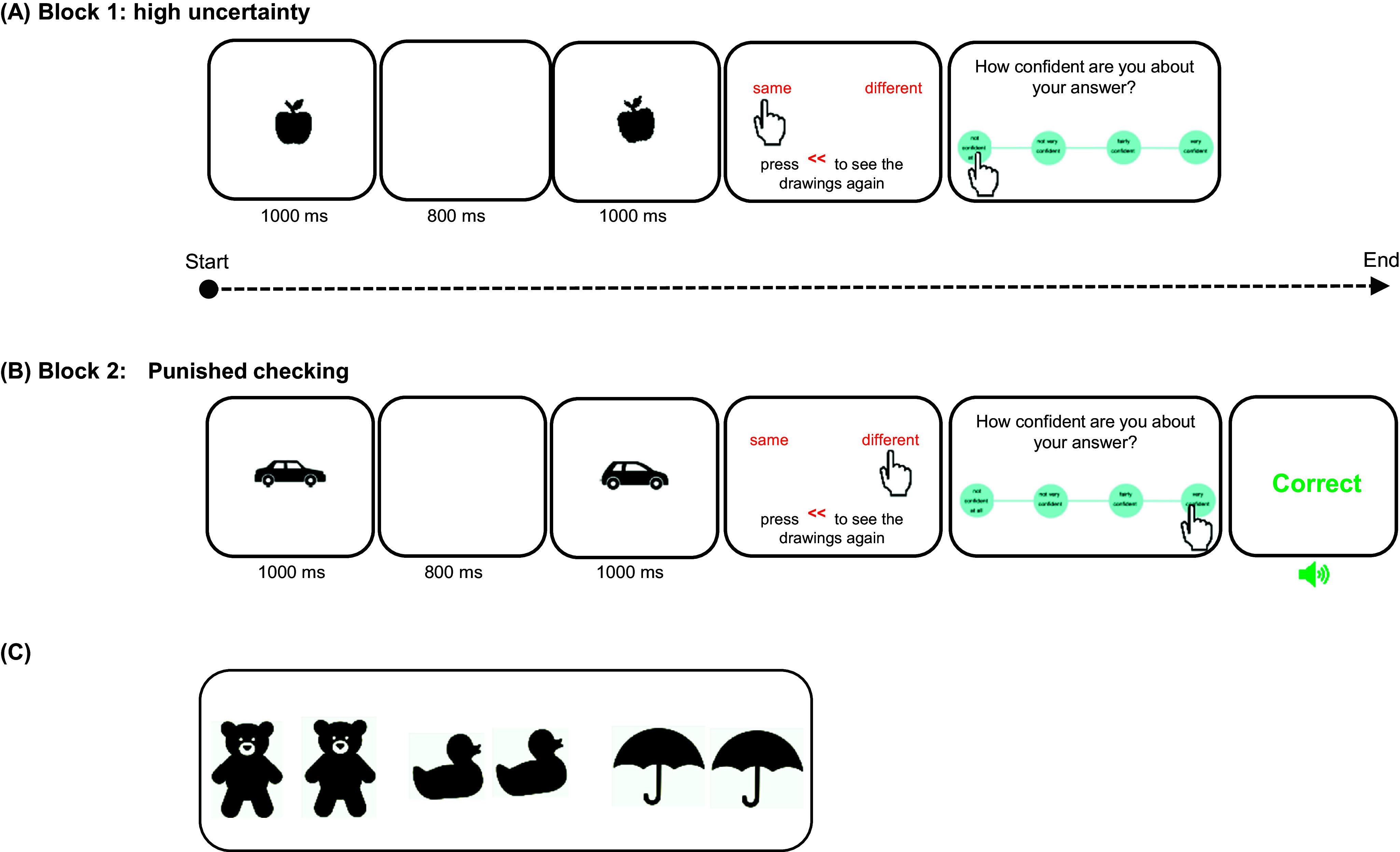
Methods: Clinical and cognitive profiles of OCS and their relationship to dysfunctional checking were investigated using a novel checking paradigm (image verification task or IVT) in four groups: clozapine-treated schizophrenia patients with clozapine-induced OCS (SCZ-OCS, n = 21) and without (SCZ-only, n = 15), patients with obsessive-compulsive disorder (OCD, n = 32) and IQ-matched healthy volunteers (HV, n = 30).
Results: Only SCZ-OCS patients showed a distinctive pattern of dysfunctional checking on the IVT. Compared with SCZ-OCS, SCZ-only patients exhibited functional checking while having equivalent deficits in executive cognition, clozapine dose, and treatment duration, though with less severe positive and depressive symptoms. In SCZ-OCS, dysfunctional checking was positively correlated with clozapine dose and working memory performance. By contrast, OCD patients' checking was positively related to intolerance of uncertainty. Checking in the OCD and SCZ-OCS groups was positively correlated with YBOCS-compulsion.
Conclusion: This study is the first to compare the distinct cognitive and clinical profiles of SCZ-OCS, SCZ-only, and OCD, with a focus on checking behavior, a major symptom in clozapine-treated patients. We introduced a novel and sensitive measure for checking, which showed dysfunctional checking only in SCZ-OCS patients treated with clozapine. These findings indicate that a subset of patients with schizophrenia with more severe positive symptoms and cognitive deficits are especially susceptible to OCD symptoms when treated with clozapine.
背景:强迫症(OCS)出现在氯氮平治疗的精神分裂症患者的显著比例,影响社会功能和增加抑郁症状。本研究探讨了氯氮平诱导OCS的认知机制,特别是关注功能失调的检查行为。方法:采用一种新的检查范式(图像验证任务或IVT)对氯氮平治疗的精神分裂症伴氯氮平诱发OCS患者(SCZ-OCS, n = 21)和非伴氯氮平诱发OCS (SCZ-OCS, n = 15)、强迫症患者(OCD, n = 32)和智商匹配的健康志愿者(HV, n = 30)进行OCS的临床和认知特征及其与功能障碍检查的关系进行研究。结果:只有SCZ-OCS患者在IVT检查中表现出独特的功能障碍模式。与SCZ-OCS相比,仅SCZ-OCS患者在执行认知、氯氮平剂量和治疗时间方面存在相当的缺陷,但阳性和抑郁症状较轻。在SCZ-OCS中,功能障碍检查与氯氮平剂量和工作记忆表现呈正相关。相比之下,强迫症患者的检查与不确定性耐受性呈正相关。强迫症组和SCZ-OCS组的检入与ybocs -强迫呈正相关。结论:本研究首次比较了SCZ-OCS、SCZ-only和OCD的不同认知和临床特征,重点关注了氯氮平治疗患者的主要症状——检查行为。我们介绍了一种新的、灵敏的检查方法,该方法仅在氯氮平治疗的SCZ-OCS患者中显示功能障碍检查。这些发现表明,一组有更严重阳性症状和认知缺陷的精神分裂症患者在接受氯氮平治疗时特别容易出现强迫症症状。
期刊介绍:
Now in its fifth decade of publication, Psychological Medicine is a leading international journal in the fields of psychiatry, related aspects of psychology and basic sciences. From 2014, there are 16 issues a year, each featuring original articles reporting key research being undertaken worldwide, together with shorter editorials by distinguished scholars and an important book review section. The journal''s success is clearly demonstrated by a consistently high impact factor.





 京公网安备 11010802042870号
京ICP备2023020795号-1
京公网安备 11010802042870号
京ICP备2023020795号-1

 分享
分享
 求助内容:
求助内容: 应助结果提醒方式:
 扫码关注我们
