Everton Ferreira de Souza, Rafael Antônio Vicente Lacerda, Janaína Aparecida Favero Desio, Camila Marciele Kammers, Silvana Henkes, Natasha Ferraz da Paixão Ribeiro, Monique Freitas de Sá, Driele Martins da Silva, Anna Carolina de Oliveira Resende Teixeira, Júlio César Claudino Dos Santos
{"title":"Screen use in children - two sides of the coin: a critical narrative review.","authors":"Everton Ferreira de Souza, Rafael Antônio Vicente Lacerda, Janaína Aparecida Favero Desio, Camila Marciele Kammers, Silvana Henkes, Natasha Ferraz da Paixão Ribeiro, Monique Freitas de Sá, Driele Martins da Silva, Anna Carolina de Oliveira Resende Teixeira, Júlio César Claudino Dos Santos","doi":"10.1590/1980-5764-DN-2024-0173","DOIUrl":null,"url":null,"abstract":"<p><p>Like a coin, the impacts of screens on children's development have two sides, as reflected in current scientific knowledge. This narrative review aimed to explore the dual-faceted state of the art regarding screen use, highlighting both positive and negative aspects on neurodevelopment, intervention proposals, and future perspectives for appropriate screen use. Recent scientific findings emphasize two central points: on the one hand, the benefits of appropriate use, such as co-viewing and the use of educational content; on the other hand, the negative impacts of excessive screen use, passive, and non-educational use on the development of neural networks. In this sense, with the advent of the digital age and in light of current scientific results, it is clear that eliminating screens from daily life is unrealistic. Therefore, implementing strategies to ensure a healthy balance between screen time and other activities important for child development is essential.</p>","PeriodicalId":39167,"journal":{"name":"Dementia e Neuropsychologia","volume":"19 ","pages":"e20240173"},"PeriodicalIF":0.0000,"publicationDate":"2025-03-17","publicationTypes":"Journal Article","fieldsOfStudy":null,"isOpenAccess":false,"openAccessPdf":"https://www.ncbi.nlm.nih.gov/pmc/articles/PMC11913343/pdf/","citationCount":"0","resultStr":null,"platform":"Semanticscholar","paperid":null,"PeriodicalName":"Dementia e Neuropsychologia","FirstCategoryId":"1085","ListUrlMain":"https://doi.org/10.1590/1980-5764-DN-2024-0173","RegionNum":0,"RegionCategory":null,"ArticlePicture":[],"TitleCN":null,"AbstractTextCN":null,"PMCID":null,"EPubDate":"2025/1/1 0:00:00","PubModel":"eCollection","JCR":"Q3","JCRName":"Medicine","Score":null,"Total":0}
引用次数: 0
Abstract
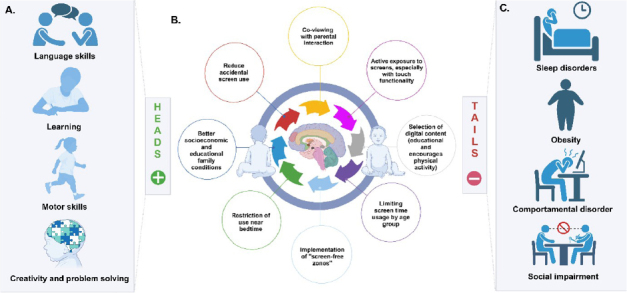
Like a coin, the impacts of screens on children's development have two sides, as reflected in current scientific knowledge. This narrative review aimed to explore the dual-faceted state of the art regarding screen use, highlighting both positive and negative aspects on neurodevelopment, intervention proposals, and future perspectives for appropriate screen use. Recent scientific findings emphasize two central points: on the one hand, the benefits of appropriate use, such as co-viewing and the use of educational content; on the other hand, the negative impacts of excessive screen use, passive, and non-educational use on the development of neural networks. In this sense, with the advent of the digital age and in light of current scientific results, it is clear that eliminating screens from daily life is unrealistic. Therefore, implementing strategies to ensure a healthy balance between screen time and other activities important for child development is essential.
期刊介绍:
Dementia top Neuropsychologia the official scientific journal of the Cognitive Neurology and Ageing Department of the Brazilian Academy of Neurology and of the Brazilian Association of Geriatric Neuropsychiatry, is published by the "Associação Neurologia Cognitiva e do Comportamento", a nonprofit Brazilian association. Regularly published on March, June, September, and December since 2007.





 京公网安备 11010802042870号
京ICP备2023020795号-1
京公网安备 11010802042870号
京ICP备2023020795号-1

 分享
分享
 求助内容:
求助内容: 应助结果提醒方式:
 扫码关注我们
