{"title":"Efficient Electrochemical-Enzymatic Conversion of PET to Formate Coupled with Nitrate Reduction Over Ru-Doped Co3O4 Catalysts","authors":"Jiadi Jiang, Leting Zhang, Guanzheng Wu, Jianrui Zhang, Yidong Yang, Wenhui He, Jun Zhu, Jian Zhang, Qing Qin","doi":"10.1002/anie.202421240","DOIUrl":null,"url":null,"abstract":"<p>Electrochemical reforming presents a sustainable route for the conversion of nitrate (NO<sub>3</sub><sup>−</sup>) and polyethylene terephthalate (PET) into value-added chemicals, such as ammonia (NH<sub>3</sub>) and formic acid (HCOOH). However, its widespread application has been constrained by low selectivity due to the complexity of reduction processes and thus energy scaling limitations. In this study, the atomically dispersed Ru sites in Co<sub>3</sub>O<sub>4</sub> synergistically interact with Co centers, facilitating the adsorption and activation of hydroxyl radicals (OH<sup>*</sup>) and ethylene glycol (EG), resulting in a remarkable HCOOH selectivity of 99% and a yield rate of 11.2 mmol h<sup>−1</sup> cm<sup>−2</sup> surpassing that of pristine Co<sub>3</sub>O<sub>4</sub> (55% and 3.8 mmol h<sup>−1</sup> cm<sup>−2</sup>). Furthermore, when applied as a bifunctional cathode catalyst, Ru-Co<sub>3</sub>O<sub>4</sub> achieves a remarkable Faradaic efficiency (FE) of 98.5% for NH<sub>3</sub> production (3.54 mmol h<sup>−1</sup> cm<sup>−2</sup>) at -0.3 V versus RHE. Additionally, we developed a prototype device powered by a commercial silicon photovoltaic cell, enabling on-site solar-driven production of formate and NH<sub>3</sub> through enzyme-catalyzed PET and NO<sub>3</sub><sup>−</sup> conversion. This study offers a viable approach for waste valorization and green chemical production, paving the way for sustainable energy applications.</p>","PeriodicalId":125,"journal":{"name":"Angewandte Chemie International Edition","volume":"64 22","pages":""},"PeriodicalIF":16.9000,"publicationDate":"2025-03-19","publicationTypes":"Journal Article","fieldsOfStudy":null,"isOpenAccess":false,"openAccessPdf":"","citationCount":"0","resultStr":null,"platform":"Semanticscholar","paperid":null,"PeriodicalName":"Angewandte Chemie International Edition","FirstCategoryId":"92","ListUrlMain":"https://onlinelibrary.wiley.com/doi/10.1002/anie.202421240","RegionNum":1,"RegionCategory":"化学","ArticlePicture":[],"TitleCN":null,"AbstractTextCN":null,"PMCID":null,"EPubDate":"","PubModel":"","JCR":"Q1","JCRName":"CHEMISTRY, MULTIDISCIPLINARY","Score":null,"Total":0}
引用次数: 0
Abstract
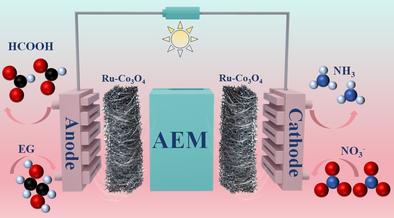
Electrochemical reforming presents a sustainable route for the conversion of nitrate (NO3−) and polyethylene terephthalate (PET) into value-added chemicals, such as ammonia (NH3) and formic acid (HCOOH). However, its widespread application has been constrained by low selectivity due to the complexity of reduction processes and thus energy scaling limitations. In this study, the atomically dispersed Ru sites in Co3O4 synergistically interact with Co centers, facilitating the adsorption and activation of hydroxyl radicals (OH*) and ethylene glycol (EG), resulting in a remarkable HCOOH selectivity of 99% and a yield rate of 11.2 mmol h−1 cm−2 surpassing that of pristine Co3O4 (55% and 3.8 mmol h−1 cm−2). Furthermore, when applied as a bifunctional cathode catalyst, Ru-Co3O4 achieves a remarkable Faradaic efficiency (FE) of 98.5% for NH3 production (3.54 mmol h−1 cm−2) at -0.3 V versus RHE. Additionally, we developed a prototype device powered by a commercial silicon photovoltaic cell, enabling on-site solar-driven production of formate and NH3 through enzyme-catalyzed PET and NO3− conversion. This study offers a viable approach for waste valorization and green chemical production, paving the way for sustainable energy applications.
期刊介绍:
Angewandte Chemie, a journal of the German Chemical Society (GDCh), maintains a leading position among scholarly journals in general chemistry with an impressive Impact Factor of 16.6 (2022 Journal Citation Reports, Clarivate, 2023). Published weekly in a reader-friendly format, it features new articles almost every day. Established in 1887, Angewandte Chemie is a prominent chemistry journal, offering a dynamic blend of Review-type articles, Highlights, Communications, and Research Articles on a weekly basis, making it unique in the field.



 京公网安备 11010802042870号
京ICP备2023020795号-1
京公网安备 11010802042870号
京ICP备2023020795号-1

 分享
分享
 求助内容:
求助内容: 应助结果提醒方式:
 扫码关注我们
