Toshiki Koga*, Yoshinori Takano, Nanako O. Ogawa, Emily H. Hollingsworth, Yasuhiro Oba and Naohiko Ohkouchi,
{"title":"Compound-Specific Carbon and Nitrogen Isotopic Analyses of Underivatized Pyrimidine and Purine Nucleobases","authors":"Toshiki Koga*, Yoshinori Takano, Nanako O. Ogawa, Emily H. Hollingsworth, Yasuhiro Oba and Naohiko Ohkouchi, ","doi":"10.1021/acsearthspacechem.4c00110","DOIUrl":null,"url":null,"abstract":"<p >We report on a newly developed method for compound-specific isotopic analysis (CSIA) of carbon (δ<sup>13</sup>C) and nitrogen (δ<sup>15</sup>N) in underivatized pyrimidine (cytosine, uracil, and thymine) and purine (adenine, guanine, hypoxanthine, and xanthine) nucleobases. The nucleobases are isolated by multistep purification using high-performance liquid chromatography (HPLC). HPLC separation and its wet chemical pretreatments were optimized to isolate these nucleobases without the need for chemical derivatization. Subsequently, the carbon and nitrogen isotopic compositions of these underivatized nucleobases were analyzed by nanoscale elemental analysis/isotope-ratio mass spectrometry (nano-EA/IRMS). The δ<sup>13</sup>C and δ<sup>15</sup>N measurements of isolated standard nucleobases indicated minimal isotopic fractionation during the two-step HPLC purification. This HPLC × nano-EA/IMS methodology was utilized to determine the isotopic composition of nucleobases in spinach (δ<sup>13</sup>C: −27.0 to −19.8‰, δ<sup>15</sup>N: +2.8 to +6.7‰) and coastal sediment (δ<sup>13</sup>C: −14.9 to −9.2 ‰, δ<sup>15</sup>N: +4.5 to +9.0‰) samples. The CSIA of nucleobases can provide insight into how living organisms modulate their biochemical pathways in response to environmental and metabolic variations.</p>","PeriodicalId":15,"journal":{"name":"ACS Earth and Space Chemistry","volume":"9 3","pages":"424–432 424–432"},"PeriodicalIF":2.9000,"publicationDate":"2025-03-03","publicationTypes":"Journal Article","fieldsOfStudy":null,"isOpenAccess":false,"openAccessPdf":"","citationCount":"0","resultStr":null,"platform":"Semanticscholar","paperid":null,"PeriodicalName":"ACS Earth and Space Chemistry","FirstCategoryId":"92","ListUrlMain":"https://pubs.acs.org/doi/10.1021/acsearthspacechem.4c00110","RegionNum":3,"RegionCategory":"化学","ArticlePicture":[],"TitleCN":null,"AbstractTextCN":null,"PMCID":null,"EPubDate":"","PubModel":"","JCR":"Q2","JCRName":"CHEMISTRY, MULTIDISCIPLINARY","Score":null,"Total":0}
引用次数: 0
Abstract
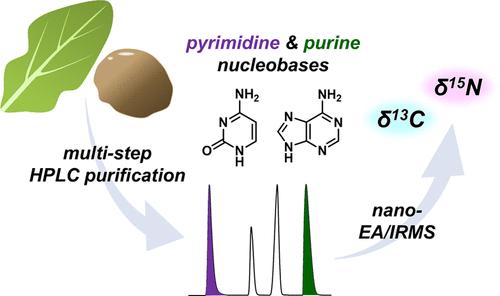
We report on a newly developed method for compound-specific isotopic analysis (CSIA) of carbon (δ13C) and nitrogen (δ15N) in underivatized pyrimidine (cytosine, uracil, and thymine) and purine (adenine, guanine, hypoxanthine, and xanthine) nucleobases. The nucleobases are isolated by multistep purification using high-performance liquid chromatography (HPLC). HPLC separation and its wet chemical pretreatments were optimized to isolate these nucleobases without the need for chemical derivatization. Subsequently, the carbon and nitrogen isotopic compositions of these underivatized nucleobases were analyzed by nanoscale elemental analysis/isotope-ratio mass spectrometry (nano-EA/IRMS). The δ13C and δ15N measurements of isolated standard nucleobases indicated minimal isotopic fractionation during the two-step HPLC purification. This HPLC × nano-EA/IMS methodology was utilized to determine the isotopic composition of nucleobases in spinach (δ13C: −27.0 to −19.8‰, δ15N: +2.8 to +6.7‰) and coastal sediment (δ13C: −14.9 to −9.2 ‰, δ15N: +4.5 to +9.0‰) samples. The CSIA of nucleobases can provide insight into how living organisms modulate their biochemical pathways in response to environmental and metabolic variations.
期刊介绍:
The scope of ACS Earth and Space Chemistry includes the application of analytical, experimental and theoretical chemistry to investigate research questions relevant to the Earth and Space. The journal encompasses the highly interdisciplinary nature of research in this area, while emphasizing chemistry and chemical research tools as the unifying theme. The journal publishes broadly in the domains of high- and low-temperature geochemistry, atmospheric chemistry, marine chemistry, planetary chemistry, astrochemistry, and analytical geochemistry. ACS Earth and Space Chemistry publishes Articles, Letters, Reviews, and Features to provide flexible formats to readily communicate all aspects of research in these fields.




 京公网安备 11010802042870号
京ICP备2023020795号-1
京公网安备 11010802042870号
京ICP备2023020795号-1

 分享
分享
 求助内容:
求助内容: 应助结果提醒方式:
 扫码关注我们
