Zhiwei Sun , Lanhua Liu , Hui Zhang , Mingzhu Zhang , Boyang Xu , Yousheng Wang , Xingjiang Li , Dongdong Mu , Xuefeng Wu
{"title":"High-resolution mass spectrometry-based assessment of chemical composition's effect on the honey color","authors":"Zhiwei Sun , Lanhua Liu , Hui Zhang , Mingzhu Zhang , Boyang Xu , Yousheng Wang , Xingjiang Li , Dongdong Mu , Xuefeng Wu","doi":"10.1016/j.chroma.2025.465880","DOIUrl":null,"url":null,"abstract":"<div><div>Honey is a nutrient-rich natural functional food, with its color being considered as a key indicator of quality and consumer acceptance. Although various secondary metabolites are closely related to the color of honey, the specific substances and their exact effects on honey color remain unclear. In this study, the chemical composition, such as organic acids, polyphenols and vitamins, in different colored honey (<em>Acacia, buckwheat, linden, vitex, lychee</em> and <em>jujube</em> honey) were quantitatively analyzed using liquid chromatography-high resolution mass spectrometry (LC<img>HRMS). The correlations between the chemical composition and the honey color were established by the mantel test. The results showed that quinic acid, ascorbic acid, and other composition were identified as significantly related with honey color. The validation experiments indicated that adding these significantly related substances to honey samples could multiplicatively deepen the honey color, and the value of the deepening color was positively correlated with that of the initial color. The study developed a practical and systematic LC<img>HRMS method for analyzing chemical composition in honey. The results provided valuable scientific insights into the relationship between chemical composition and honey color. Additionally, it introduced a novel and feasible approach for investigating the effects of substances on the color of complex mixture systems.</div></div>","PeriodicalId":347,"journal":{"name":"Journal of Chromatography A","volume":"1748 ","pages":"Article 465880"},"PeriodicalIF":4.0000,"publicationDate":"2025-05-10","publicationTypes":"Journal Article","fieldsOfStudy":null,"isOpenAccess":false,"openAccessPdf":"","citationCount":"0","resultStr":null,"platform":"Semanticscholar","paperid":null,"PeriodicalName":"Journal of Chromatography A","FirstCategoryId":"1","ListUrlMain":"https://www.sciencedirect.com/science/article/pii/S0021967325002286","RegionNum":2,"RegionCategory":"化学","ArticlePicture":[],"TitleCN":null,"AbstractTextCN":null,"PMCID":null,"EPubDate":"2025/3/15 0:00:00","PubModel":"Epub","JCR":"Q1","JCRName":"BIOCHEMICAL RESEARCH METHODS","Score":null,"Total":0}
引用次数: 0
Abstract
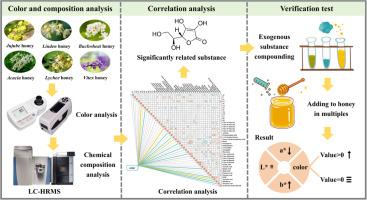
Honey is a nutrient-rich natural functional food, with its color being considered as a key indicator of quality and consumer acceptance. Although various secondary metabolites are closely related to the color of honey, the specific substances and their exact effects on honey color remain unclear. In this study, the chemical composition, such as organic acids, polyphenols and vitamins, in different colored honey (Acacia, buckwheat, linden, vitex, lychee and jujube honey) were quantitatively analyzed using liquid chromatography-high resolution mass spectrometry (LCHRMS). The correlations between the chemical composition and the honey color were established by the mantel test. The results showed that quinic acid, ascorbic acid, and other composition were identified as significantly related with honey color. The validation experiments indicated that adding these significantly related substances to honey samples could multiplicatively deepen the honey color, and the value of the deepening color was positively correlated with that of the initial color. The study developed a practical and systematic LCHRMS method for analyzing chemical composition in honey. The results provided valuable scientific insights into the relationship between chemical composition and honey color. Additionally, it introduced a novel and feasible approach for investigating the effects of substances on the color of complex mixture systems.
期刊介绍:
The Journal of Chromatography A provides a forum for the publication of original research and critical reviews on all aspects of fundamental and applied separation science. The scope of the journal includes chromatography and related techniques, electromigration techniques (e.g. electrophoresis, electrochromatography), hyphenated and other multi-dimensional techniques, sample preparation, and detection methods such as mass spectrometry. Contributions consist mainly of research papers dealing with the theory of separation methods, instrumental developments and analytical and preparative applications of general interest.



 京公网安备 11010802042870号
京ICP备2023020795号-1
京公网安备 11010802042870号
京ICP备2023020795号-1

 分享
分享
 求助内容:
求助内容: 应助结果提醒方式:
 扫码关注我们
