{"title":"Generalized entropy theory investigation of the relatively high segmental fragility of many glass-forming polymers†","authors":"Xiaolei Xu, Jack F. Douglas and Wen-Sheng Xu","doi":"10.1039/D5SM00021A","DOIUrl":null,"url":null,"abstract":"<p >We utilize the generalized entropy theory (GET) of glass formation to address one of the most singular and least understood properties of polymer glass-forming liquids in comparison to atomic and small molecule liquids—the often relatively high fragility of the polymer dynamics on a segmental scale, <em>m</em><small><sub>s</sub></small>. Based on this highly predictive framework of both the thermodynamics and segmental dynamics in terms of molecular structure, polymer backbone and side-group rigidities, and intermolecular interaction strength, we first analyze the relation between <em>m</em><small><sub>s</sub></small> and the ratio, <img>, where <em>S</em><small><sub>c</sub></small> is the configurational entropy density of the polymer fluid, <img> equals <em>S</em><small><sub>c</sub></small> at the onset temperature <em>T</em><small><sub>A</sub></small> for non-Arrhenius relaxation, and <em>T</em><small><sub>g</sub></small> is the glass transition temperature at which the structural relaxation time <em>τ</em><small><sub><em>α</em></sub></small> equals 100 s. While the reduced activation energy estimated from an Arrhenius plot (<em>i.e.</em>, differential activation energy) normalized by <em>k</em><small><sub>B</sub></small><em>T</em><small><sub>g</sub></small> is determined to be not equal to the actual activation energy, we do find that an apparently general nonlinear relation between <em>m</em><small><sub>s</sub></small> and <img> holds to a good approximation for a large class of polymer models, <img>. The predicted ranges of <em>m</em><small><sub>s</sub></small> and <img> are consistent with experimental estimates for high molecular-mass polymer, oligomeric, small molecule, and atomic glass-forming liquids. In particular, relatively high values of <em>m</em><small><sub>s</sub></small> are found for polymers having complex monomer structures and significant chain stiffness. The variation of <em>m</em><small><sub>s</sub></small> with molecular mass, chain stiffness, and intermolecular interaction strength can be traced to the variation of <img>, which is shown to provide a measure of packing frustration defined in terms of the dimensionless thermal expansion coefficient and isothermal compressibility. The often relatively high fragility and large extent of cooperative motion are found in the GET to derive from the often relatively large packing frustration in this class of polymer glass-forming liquids. Finally, we also develop a tentative model of the “dynamical segmental relaxation time” based on the GET, in which the polymers on a coarse-grained scale are modeled as strings of structureless “beads”, as assumed in the Rouse and reptation models of polymer dynamics.</p>","PeriodicalId":103,"journal":{"name":"Soft Matter","volume":" 14","pages":" 2664-2685"},"PeriodicalIF":2.8000,"publicationDate":"2025-03-11","publicationTypes":"Journal Article","fieldsOfStudy":null,"isOpenAccess":false,"openAccessPdf":"","citationCount":"0","resultStr":null,"platform":"Semanticscholar","paperid":null,"PeriodicalName":"Soft Matter","FirstCategoryId":"92","ListUrlMain":"https://pubs.rsc.org/en/content/articlelanding/2025/sm/d5sm00021a","RegionNum":3,"RegionCategory":"化学","ArticlePicture":[],"TitleCN":null,"AbstractTextCN":null,"PMCID":null,"EPubDate":"","PubModel":"","JCR":"Q3","JCRName":"CHEMISTRY, PHYSICAL","Score":null,"Total":0}
引用次数: 0
Abstract
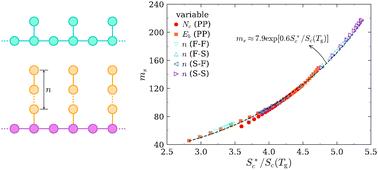
We utilize the generalized entropy theory (GET) of glass formation to address one of the most singular and least understood properties of polymer glass-forming liquids in comparison to atomic and small molecule liquids—the often relatively high fragility of the polymer dynamics on a segmental scale, ms. Based on this highly predictive framework of both the thermodynamics and segmental dynamics in terms of molecular structure, polymer backbone and side-group rigidities, and intermolecular interaction strength, we first analyze the relation between ms and the ratio, , where Sc is the configurational entropy density of the polymer fluid, equals Sc at the onset temperature TA for non-Arrhenius relaxation, and Tg is the glass transition temperature at which the structural relaxation time τα equals 100 s. While the reduced activation energy estimated from an Arrhenius plot (i.e., differential activation energy) normalized by kBTg is determined to be not equal to the actual activation energy, we do find that an apparently general nonlinear relation between ms and holds to a good approximation for a large class of polymer models, . The predicted ranges of ms and are consistent with experimental estimates for high molecular-mass polymer, oligomeric, small molecule, and atomic glass-forming liquids. In particular, relatively high values of ms are found for polymers having complex monomer structures and significant chain stiffness. The variation of ms with molecular mass, chain stiffness, and intermolecular interaction strength can be traced to the variation of , which is shown to provide a measure of packing frustration defined in terms of the dimensionless thermal expansion coefficient and isothermal compressibility. The often relatively high fragility and large extent of cooperative motion are found in the GET to derive from the often relatively large packing frustration in this class of polymer glass-forming liquids. Finally, we also develop a tentative model of the “dynamical segmental relaxation time” based on the GET, in which the polymers on a coarse-grained scale are modeled as strings of structureless “beads”, as assumed in the Rouse and reptation models of polymer dynamics.
期刊介绍:
Soft Matter is an international journal published by the Royal Society of Chemistry using Engineering-Materials Science: A Synthesis as its research focus. It publishes original research articles, review articles, and synthesis articles related to this field, reporting the latest discoveries in the relevant theoretical, practical, and applied disciplines in a timely manner, and aims to promote the rapid exchange of scientific information in this subject area. The journal is an open access journal. The journal is an open access journal and has not been placed on the alert list in the last three years.




 京公网安备 11010802042870号
京ICP备2023020795号-1
京公网安备 11010802042870号
京ICP备2023020795号-1

 分享
分享
 求助内容:
求助内容: 应助结果提醒方式:
 扫码关注我们
