Mohammed Naji Almutairi, Abdullrahman M Alshehri, Abdulrahman Y Alhoumaily, Osamah Alnahdi, Mohammed A Taha, Shiji Gangadharan
{"title":"Meta-analysis: clinical outcomes of laser-assisted in situ keratomileusis (LASIK) and photorefractive keratectomy (PRK) in hyperopia.","authors":"Mohammed Naji Almutairi, Abdullrahman M Alshehri, Abdulrahman Y Alhoumaily, Osamah Alnahdi, Mohammed A Taha, Shiji Gangadharan","doi":"10.1186/s12886-025-03956-6","DOIUrl":null,"url":null,"abstract":"<p><strong>Background: </strong>To evaluate differences in clinical outcome, safety, and efficacy of photorefractive keratectomy (PRK) and laser-assisted in situ keratomileusis (LASIK) in the correction of hyperopic refractive errors.</p><p><strong>Methods: </strong>We have adhered to PRISMA criteria in this systematic review, which is registered with PROSPERO (CRD42023469543). Our search with studies comparing PRK and LASIK for hyperopia was conducted through the databases PubMed, EMBASE, Web of Science, and the Cochrane Library. We used the Cochrane method to assess bias and evaluated variables like uncorrected distance visual acuity and mean spherical equivalent. Using fixed- or random-effects models, a meta-analysis was performed using RevMan 5.4 for evaluating heterogeneity and significance. Sensitivity analysis addressed the causes of heterogeneity to assure stability.</p><p><strong>Results: </strong>We included 6 articles (419 participants, 585 eyes) in this review five were retrospective and 1 case-series. The final mean refractive SE (WMD, -0.05; 95% confidence interval [CI], 0.42 to 0.31; P = 0.06). patients achieving uncorrected distance visual acuity (UDVA) of 20/20 or better (OR, 0.58; 95% CI, 0.39-0.78; P = 0.33). final UDVA of 20/40 or better (OR, 1.40; 95% CI, 0.65-3.02; P = 0.81) were analyzed.</p><p><strong>Conclusions: </strong>In this meta-analysis, LASIK had no significant benefits over PRK in relation to clinical outcomes. Less corneal haze was observed in LASIK-treated eyes at 1 to 3 months after surgery.</p>","PeriodicalId":9058,"journal":{"name":"BMC Ophthalmology","volume":"25 1","pages":"140"},"PeriodicalIF":1.7000,"publicationDate":"2025-03-18","publicationTypes":"Journal Article","fieldsOfStudy":null,"isOpenAccess":false,"openAccessPdf":"https://www.ncbi.nlm.nih.gov/pmc/articles/PMC11917003/pdf/","citationCount":"0","resultStr":null,"platform":"Semanticscholar","paperid":null,"PeriodicalName":"BMC Ophthalmology","FirstCategoryId":"3","ListUrlMain":"https://doi.org/10.1186/s12886-025-03956-6","RegionNum":4,"RegionCategory":"医学","ArticlePicture":[],"TitleCN":null,"AbstractTextCN":null,"PMCID":null,"EPubDate":"","PubModel":"","JCR":"Q3","JCRName":"OPHTHALMOLOGY","Score":null,"Total":0}
引用次数: 0
Abstract
Background: To evaluate differences in clinical outcome, safety, and efficacy of photorefractive keratectomy (PRK) and laser-assisted in situ keratomileusis (LASIK) in the correction of hyperopic refractive errors.
Methods: We have adhered to PRISMA criteria in this systematic review, which is registered with PROSPERO (CRD42023469543). Our search with studies comparing PRK and LASIK for hyperopia was conducted through the databases PubMed, EMBASE, Web of Science, and the Cochrane Library. We used the Cochrane method to assess bias and evaluated variables like uncorrected distance visual acuity and mean spherical equivalent. Using fixed- or random-effects models, a meta-analysis was performed using RevMan 5.4 for evaluating heterogeneity and significance. Sensitivity analysis addressed the causes of heterogeneity to assure stability.
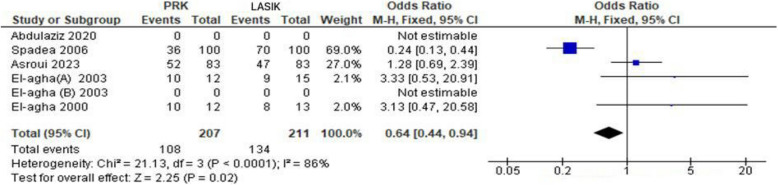
Results: We included 6 articles (419 participants, 585 eyes) in this review five were retrospective and 1 case-series. The final mean refractive SE (WMD, -0.05; 95% confidence interval [CI], 0.42 to 0.31; P = 0.06). patients achieving uncorrected distance visual acuity (UDVA) of 20/20 or better (OR, 0.58; 95% CI, 0.39-0.78; P = 0.33). final UDVA of 20/40 or better (OR, 1.40; 95% CI, 0.65-3.02; P = 0.81) were analyzed.
Conclusions: In this meta-analysis, LASIK had no significant benefits over PRK in relation to clinical outcomes. Less corneal haze was observed in LASIK-treated eyes at 1 to 3 months after surgery.
期刊介绍:
BMC Ophthalmology is an open access, peer-reviewed journal that considers articles on all aspects of the prevention, diagnosis and management of eye disorders, as well as related molecular genetics, pathophysiology, and epidemiology.





 京公网安备 11010802042870号
京ICP备2023020795号-1
京公网安备 11010802042870号
京ICP备2023020795号-1

 分享
分享
 求助内容:
求助内容: 应助结果提醒方式:
 扫码关注我们
