Yanghe Liu, Hao Zhang, Feifan Lang, Mei Li, Jiandong Pang, Xian-He Bu
{"title":"Enzyme-Photocoupled Catalytic Systems Based on Zirconium-Metal-Organic Frameworks","authors":"Yanghe Liu, Hao Zhang, Feifan Lang, Mei Li, Jiandong Pang, Xian-He Bu","doi":"10.1002/cssc.202402760","DOIUrl":null,"url":null,"abstract":"<p>Green, low-carbon, and efficient chemical conversions are crucial for the sustainable development of modern society. Enzyme-photocoupled catalytic systems (EPCS), which mimic natural photosynthesis, utilize solar energy to drive biochemical reactions, providing emergent opportunities to address the limitations of traditional photocatalytic systems. However, the integration and compatibility of photocatalysis and biocatalysis present challenges in designing highly efficient and stable EPCS. Zirconium-based metal-organic frameworks (Zr-MOFs) with outstanding chemical and thermal stability, large surface area, and tunable pore size are ideal candidates for supporting enzymes and enhancing photocatalytic processes. This review aims to integrate Zr-MOFs with EPCS to further promote the development of EPCS. First, an overview of the basic components and design principles of EPCS is provided, highlighting the importance of the unique properties of Zr-MOFs. After that, three different strategies for combining enzymes with Zr-MOFs are summarized and their respective advantages are evaluated. Finally, the development opportunities and some problems to be solved in this field are proposed.</p>","PeriodicalId":149,"journal":{"name":"ChemSusChem","volume":"18 12","pages":""},"PeriodicalIF":6.6000,"publicationDate":"2025-03-19","publicationTypes":"Journal Article","fieldsOfStudy":null,"isOpenAccess":false,"openAccessPdf":"","citationCount":"0","resultStr":null,"platform":"Semanticscholar","paperid":null,"PeriodicalName":"ChemSusChem","FirstCategoryId":"92","ListUrlMain":"https://chemistry-europe.onlinelibrary.wiley.com/doi/10.1002/cssc.202402760","RegionNum":2,"RegionCategory":"化学","ArticlePicture":[],"TitleCN":null,"AbstractTextCN":null,"PMCID":null,"EPubDate":"","PubModel":"","JCR":"Q1","JCRName":"CHEMISTRY, MULTIDISCIPLINARY","Score":null,"Total":0}
引用次数: 0
Abstract
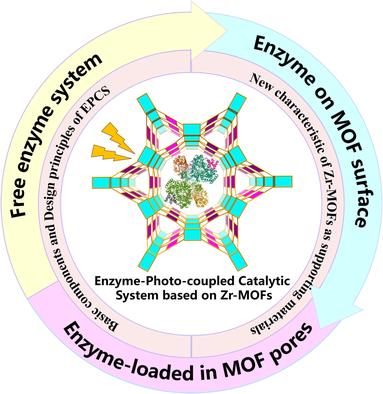
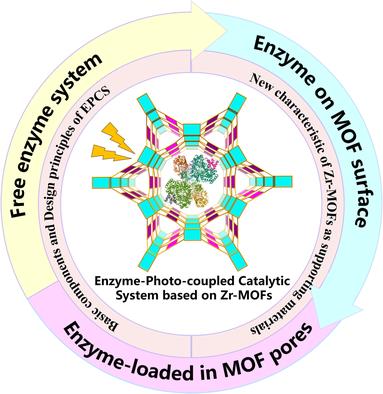
Green, low-carbon, and efficient chemical conversions are crucial for the sustainable development of modern society. Enzyme-photocoupled catalytic systems (EPCS), which mimic natural photosynthesis, utilize solar energy to drive biochemical reactions, providing emergent opportunities to address the limitations of traditional photocatalytic systems. However, the integration and compatibility of photocatalysis and biocatalysis present challenges in designing highly efficient and stable EPCS. Zirconium-based metal-organic frameworks (Zr-MOFs) with outstanding chemical and thermal stability, large surface area, and tunable pore size are ideal candidates for supporting enzymes and enhancing photocatalytic processes. This review aims to integrate Zr-MOFs with EPCS to further promote the development of EPCS. First, an overview of the basic components and design principles of EPCS is provided, highlighting the importance of the unique properties of Zr-MOFs. After that, three different strategies for combining enzymes with Zr-MOFs are summarized and their respective advantages are evaluated. Finally, the development opportunities and some problems to be solved in this field are proposed.
期刊介绍:
ChemSusChem
Impact Factor (2016): 7.226
Scope:
Interdisciplinary journal
Focuses on research at the interface of chemistry and sustainability
Features the best research on sustainability and energy
Areas Covered:
Chemistry
Materials Science
Chemical Engineering
Biotechnology





 京公网安备 11010802042870号
京ICP备2023020795号-1
京公网安备 11010802042870号
京ICP备2023020795号-1

 分享
分享
 求助内容:
求助内容: 应助结果提醒方式:
 扫码关注我们
