Min Tan, Jinjin Zhao, Yushun Tao, Uroosa Sehar, Yan Yan, Qian Zou, Qing Liu, Long Xu, Zeyang Xia, Lijuan Feng, Jing Xiong
{"title":"Utilizing machine learning algorithms for predicting Anxiety-Depression Comorbidity Syndrome in Gastroenterology Inpatients (ADCS-GI).","authors":"Min Tan, Jinjin Zhao, Yushun Tao, Uroosa Sehar, Yan Yan, Qian Zou, Qing Liu, Long Xu, Zeyang Xia, Lijuan Feng, Jing Xiong","doi":"10.1186/s12888-025-06666-x","DOIUrl":null,"url":null,"abstract":"<p><strong>Background: </strong>Accurately diagnosing Anxiety-Depression Comorbidity Syndrome in Gastroenterology Inpatients (ADCS-GI) shows significant challenges as traditional diagnostic methods fail to meet expectations due to patient hesitance and non-psychiatric healthcare professionals' limitations. Therefore, the need for objective diagnostics highlights the potential of machine learning in identifying and treating ADCS-GI.</p><p><strong>Methods: </strong>A total of 1186 ADCS patients were recruited for this study. We conducted extensive studies for the dataset, including data quantification, equilibrium, and correlation analysis. Eight machine learning models, including Gaussian Naive Bayes (NB), Support Vector Classifier (SVC), K-Neighbors Classifier, RandomForest, XGB, CatBoost, Cascade Forest, and Decision Tree, were utilized to compare prediction efficacy, with an effort to minimize the dependency on subjective questionnaires.</p><p><strong>Results: </strong>Among eight machine learning algorithms, the Decision Tree and K-nearest neighbors models demonstrated an accuracy exceeding 81% and a sensitivity in the same range for detecting ADCS in patients. Notably, when identifying moderate and severe cases, the models achieved an accuracy above 88% and a sensitivity of 90%. Furthermore, the models trained without reliance on subjective questionnaires showed promising performance, indicating the feasibility of developing questionnaire-free early detection applications.</p><p><strong>Conclusion: </strong>Machine learning algorithms can be used to identify ADCS among gastroenterology patients. This can help facilitate the early detection and intervention of psychological disorders in gastroenterology patients' care.</p>","PeriodicalId":9029,"journal":{"name":"BMC Psychiatry","volume":"25 1","pages":"253"},"PeriodicalIF":3.4000,"publicationDate":"2025-03-18","publicationTypes":"Journal Article","fieldsOfStudy":null,"isOpenAccess":false,"openAccessPdf":"https://www.ncbi.nlm.nih.gov/pmc/articles/PMC11921569/pdf/","citationCount":"0","resultStr":null,"platform":"Semanticscholar","paperid":null,"PeriodicalName":"BMC Psychiatry","FirstCategoryId":"3","ListUrlMain":"https://doi.org/10.1186/s12888-025-06666-x","RegionNum":2,"RegionCategory":"医学","ArticlePicture":[],"TitleCN":null,"AbstractTextCN":null,"PMCID":null,"EPubDate":"","PubModel":"","JCR":"Q2","JCRName":"PSYCHIATRY","Score":null,"Total":0}
引用次数: 0
Abstract
Background: Accurately diagnosing Anxiety-Depression Comorbidity Syndrome in Gastroenterology Inpatients (ADCS-GI) shows significant challenges as traditional diagnostic methods fail to meet expectations due to patient hesitance and non-psychiatric healthcare professionals' limitations. Therefore, the need for objective diagnostics highlights the potential of machine learning in identifying and treating ADCS-GI.
Methods: A total of 1186 ADCS patients were recruited for this study. We conducted extensive studies for the dataset, including data quantification, equilibrium, and correlation analysis. Eight machine learning models, including Gaussian Naive Bayes (NB), Support Vector Classifier (SVC), K-Neighbors Classifier, RandomForest, XGB, CatBoost, Cascade Forest, and Decision Tree, were utilized to compare prediction efficacy, with an effort to minimize the dependency on subjective questionnaires.
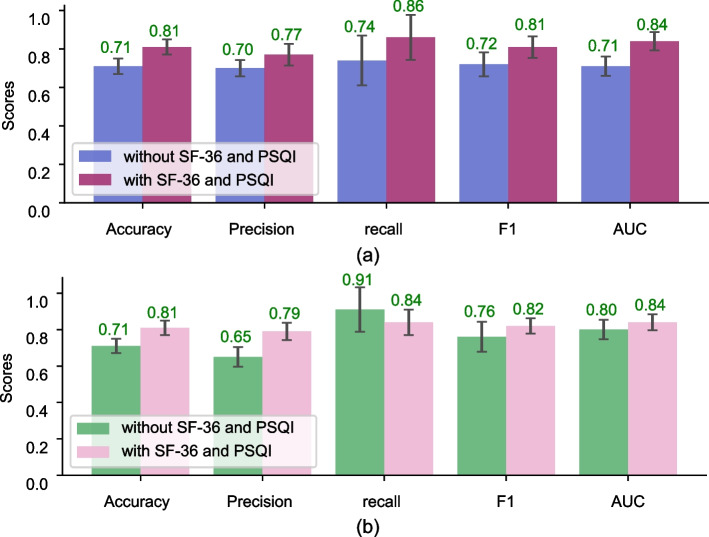
Results: Among eight machine learning algorithms, the Decision Tree and K-nearest neighbors models demonstrated an accuracy exceeding 81% and a sensitivity in the same range for detecting ADCS in patients. Notably, when identifying moderate and severe cases, the models achieved an accuracy above 88% and a sensitivity of 90%. Furthermore, the models trained without reliance on subjective questionnaires showed promising performance, indicating the feasibility of developing questionnaire-free early detection applications.
Conclusion: Machine learning algorithms can be used to identify ADCS among gastroenterology patients. This can help facilitate the early detection and intervention of psychological disorders in gastroenterology patients' care.
期刊介绍:
BMC Psychiatry is an open access, peer-reviewed journal that considers articles on all aspects of the prevention, diagnosis and management of psychiatric disorders, as well as related molecular genetics, pathophysiology, and epidemiology.





 京公网安备 11010802042870号
京ICP备2023020795号-1
京公网安备 11010802042870号
京ICP备2023020795号-1

 分享
分享
 求助内容:
求助内容: 应助结果提醒方式:
 扫码关注我们
