Xiaoxue Zhang, Shiliang Li, Xiantao Ma, Wajeehullahi Akilu, Cai Cheng
{"title":"Balloon-expandable stent and self-expandable stent combined to treat coarctation of the aorta with descending aortic aneurysm: a case report.","authors":"Xiaoxue Zhang, Shiliang Li, Xiantao Ma, Wajeehullahi Akilu, Cai Cheng","doi":"10.1093/ehjcr/ytaf094","DOIUrl":null,"url":null,"abstract":"<p><strong>Background: </strong>Coarctation of the aorta is often associated with aortic dilatation, presenting a complex challenge for stent-based interventions. To address this, we have developed a novel combination of stent treatments to manage this dual pathology effectively.</p><p><strong>Case summary: </strong>A 29-year-old hypertensive patient with a coarctation of the aorta and a descending thoracic aortic aneurysm was evaluated for treatment. Contrast-enhanced computed tomography angiography (CTA) revealed significant narrowing at the aortic arch (Zone 2, proximal to the left subclavian artery) with a diameter of 5.04 mm. Additionally, the descending aorta had an aneurysmal dilation measuring 29.65 mm. We applied an innovative approach combining a balloon-expandable stent (BES) with a self-expandable stent (SES). Post-procedure CTA demonstrated favourable aortic remodelling, with the narrowest point of the aorta expanding from 5.04 to 15.95 mm.</p><p><strong>Discussion: </strong>This novel technique of implanting a BES within an SES effectively addresses both the aortic coarctation and the descending aortic aneurysm. By tripling the diameter of the coarctation, the approach maximizes aortic expansion while protecting the aorta. Moreover, the combination of these stents enhances overall stability, reducing the risk of stent migration or displacement.</p>","PeriodicalId":11910,"journal":{"name":"European Heart Journal: Case Reports","volume":"9 3","pages":"ytaf094"},"PeriodicalIF":0.8000,"publicationDate":"2025-03-18","publicationTypes":"Journal Article","fieldsOfStudy":null,"isOpenAccess":false,"openAccessPdf":"https://www.ncbi.nlm.nih.gov/pmc/articles/PMC11914319/pdf/","citationCount":"0","resultStr":null,"platform":"Semanticscholar","paperid":null,"PeriodicalName":"European Heart Journal: Case Reports","FirstCategoryId":"1085","ListUrlMain":"https://doi.org/10.1093/ehjcr/ytaf094","RegionNum":0,"RegionCategory":null,"ArticlePicture":[],"TitleCN":null,"AbstractTextCN":null,"PMCID":null,"EPubDate":"2025/3/1 0:00:00","PubModel":"eCollection","JCR":"Q4","JCRName":"CARDIAC & CARDIOVASCULAR SYSTEMS","Score":null,"Total":0}
引用次数: 0
Abstract
Background: Coarctation of the aorta is often associated with aortic dilatation, presenting a complex challenge for stent-based interventions. To address this, we have developed a novel combination of stent treatments to manage this dual pathology effectively.
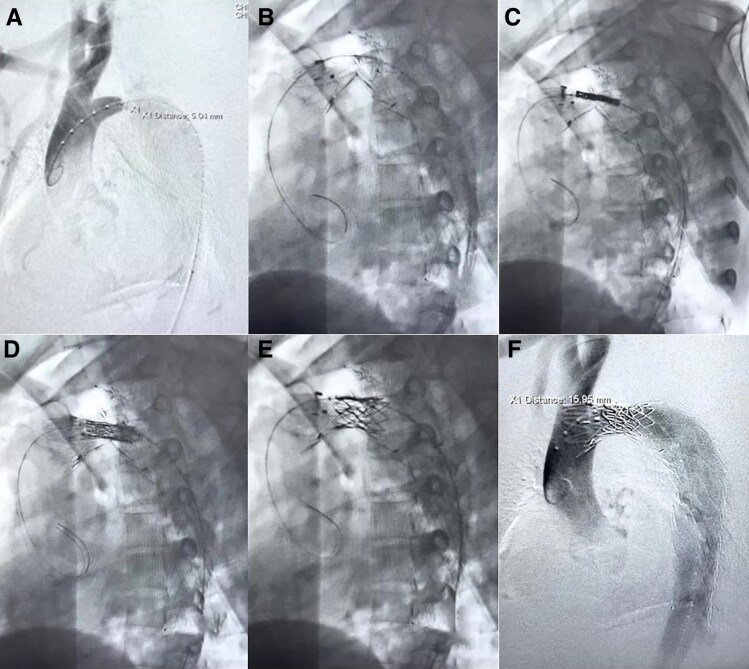
Case summary: A 29-year-old hypertensive patient with a coarctation of the aorta and a descending thoracic aortic aneurysm was evaluated for treatment. Contrast-enhanced computed tomography angiography (CTA) revealed significant narrowing at the aortic arch (Zone 2, proximal to the left subclavian artery) with a diameter of 5.04 mm. Additionally, the descending aorta had an aneurysmal dilation measuring 29.65 mm. We applied an innovative approach combining a balloon-expandable stent (BES) with a self-expandable stent (SES). Post-procedure CTA demonstrated favourable aortic remodelling, with the narrowest point of the aorta expanding from 5.04 to 15.95 mm.
Discussion: This novel technique of implanting a BES within an SES effectively addresses both the aortic coarctation and the descending aortic aneurysm. By tripling the diameter of the coarctation, the approach maximizes aortic expansion while protecting the aorta. Moreover, the combination of these stents enhances overall stability, reducing the risk of stent migration or displacement.





 京公网安备 11010802042870号
京ICP备2023020795号-1
京公网安备 11010802042870号
京ICP备2023020795号-1

 分享
分享
 求助内容:
求助内容: 应助结果提醒方式:
 扫码关注我们
