{"title":"Preventing Premature Family Maladjustment: Protocol for a Multidisciplinary eHealth Study on Preterm Parents' Well-Being.","authors":"Alessandra Decataldo, Federico Paleardi, Giacomo Lauritano, Maria Francesca Figlino, Concetta Russo, Mino Novello, Brunella Fiore, Giulia Ciuffo, Chiara Ionio","doi":"10.2196/63483","DOIUrl":null,"url":null,"abstract":"<p><strong>Background: </strong>The consequences of preterm birth extend beyond the clinical conditions of the newborn, profoundly impacting the functioning and well-being of families. Parents of preterm infants often describe the experience of preterm birth and subsequent admission to the neonatal intensive care unit (NICU) as a disruptive event in their lives, triggering feelings of guilt, helplessness, and fear. Although various research examines changes in parents' well-being and perception of self-efficacy during the stay in the NICU, there is a lack of research analyzing what happens in the transition phase at home after the baby's discharge. Recently, scholars have advocated for the use of web-based support programs to monitor and prevent preterm family maladjustment and assist parents.</p><p><strong>Objective: </strong>This interdisciplinary research will develop a sociopsychological model focused on assessing the well-being of parents of premature infants during and after their stay in a NICU. Specifically, the study aims to (1) monitor the mental health of parents of premature infants both at the time of the child's discharge from the NICU and in the first 6 months after discharge to prevent family maladjustment, (2) deepen our understanding of the role of digital tools in monitoring and supporting preterm parents' well-being, and (3) study the potential impact of the relationship with health care professionals on the overall well-being of parents.</p><p><strong>Methods: </strong>This project combines mixed methods of social research and psychological support with an eHealth approach. The well-being of parents of premature infants will be assessed using validated scales administered through a questionnaire to parents of preterm infants within 6 NICUs at the time of the child's discharge. Subsequently, a follow-up assessment of parental well-being will be implemented through the administration of the validated scales in a web application. In addition, an ethnographic phase will be conducted in the NICUs involving observation of the interaction between health care professionals and parents as well as narrative interviews with health care staff. Finally, interactions within the digital environment of the web application will be analyzed using a netnographic approach. We expect to shed light on the determinants of well-being among parents of premature infants in relation to varying levels of prematurity severity; sociodemographic characteristics such as gender, age, and socioeconomic status; and parental involvement in NICU care practices. With the follow-up phase via web application, this project also aims to prevent family maladjustment by providing psychological support and using an eHealth tool.</p><p><strong>Results: </strong>The results are expected by October 2025, the expiration date of the Project of Relevant National Interest.</p><p><strong>Conclusions: </strong>The eHealth Study on Preterm Parents' Well-Being aims to improve preterm parents' well-being and, indirectly, children's health by reducing social costs. Furthermore, it promotes standardized neonatal care protocols, reducing regional disparities and strengthening collaboration between parents and health care staff.</p><p><strong>International registered report identifier (irrid): </strong>PRR1-10.2196/63483.</p>","PeriodicalId":14755,"journal":{"name":"JMIR Research Protocols","volume":"14 ","pages":"e63483"},"PeriodicalIF":1.5000,"publicationDate":"2025-03-18","publicationTypes":"Journal Article","fieldsOfStudy":null,"isOpenAccess":false,"openAccessPdf":"https://www.ncbi.nlm.nih.gov/pmc/articles/PMC11962333/pdf/","citationCount":"0","resultStr":null,"platform":"Semanticscholar","paperid":null,"PeriodicalName":"JMIR Research Protocols","FirstCategoryId":"1085","ListUrlMain":"https://doi.org/10.2196/63483","RegionNum":0,"RegionCategory":null,"ArticlePicture":[],"TitleCN":null,"AbstractTextCN":null,"PMCID":null,"EPubDate":"","PubModel":"","JCR":"Q3","JCRName":"HEALTH CARE SCIENCES & SERVICES","Score":null,"Total":0}
引用次数: 0
Abstract
Background: The consequences of preterm birth extend beyond the clinical conditions of the newborn, profoundly impacting the functioning and well-being of families. Parents of preterm infants often describe the experience of preterm birth and subsequent admission to the neonatal intensive care unit (NICU) as a disruptive event in their lives, triggering feelings of guilt, helplessness, and fear. Although various research examines changes in parents' well-being and perception of self-efficacy during the stay in the NICU, there is a lack of research analyzing what happens in the transition phase at home after the baby's discharge. Recently, scholars have advocated for the use of web-based support programs to monitor and prevent preterm family maladjustment and assist parents.
Objective: This interdisciplinary research will develop a sociopsychological model focused on assessing the well-being of parents of premature infants during and after their stay in a NICU. Specifically, the study aims to (1) monitor the mental health of parents of premature infants both at the time of the child's discharge from the NICU and in the first 6 months after discharge to prevent family maladjustment, (2) deepen our understanding of the role of digital tools in monitoring and supporting preterm parents' well-being, and (3) study the potential impact of the relationship with health care professionals on the overall well-being of parents.
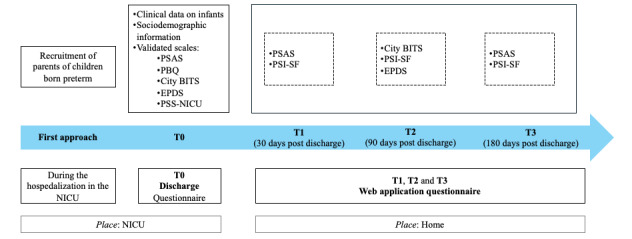
Methods: This project combines mixed methods of social research and psychological support with an eHealth approach. The well-being of parents of premature infants will be assessed using validated scales administered through a questionnaire to parents of preterm infants within 6 NICUs at the time of the child's discharge. Subsequently, a follow-up assessment of parental well-being will be implemented through the administration of the validated scales in a web application. In addition, an ethnographic phase will be conducted in the NICUs involving observation of the interaction between health care professionals and parents as well as narrative interviews with health care staff. Finally, interactions within the digital environment of the web application will be analyzed using a netnographic approach. We expect to shed light on the determinants of well-being among parents of premature infants in relation to varying levels of prematurity severity; sociodemographic characteristics such as gender, age, and socioeconomic status; and parental involvement in NICU care practices. With the follow-up phase via web application, this project also aims to prevent family maladjustment by providing psychological support and using an eHealth tool.
Results: The results are expected by October 2025, the expiration date of the Project of Relevant National Interest.
Conclusions: The eHealth Study on Preterm Parents' Well-Being aims to improve preterm parents' well-being and, indirectly, children's health by reducing social costs. Furthermore, it promotes standardized neonatal care protocols, reducing regional disparities and strengthening collaboration between parents and health care staff.
International registered report identifier (irrid): PRR1-10.2196/63483.





 京公网安备 11010802042870号
京ICP备2023020795号-1
京公网安备 11010802042870号
京ICP备2023020795号-1

 分享
分享
 求助内容:
求助内容: 应助结果提醒方式:
 扫码关注我们
