
To analyze the impact of various surface treatments on color stability and surface properties of a 3D printed and two veneering composite resins.
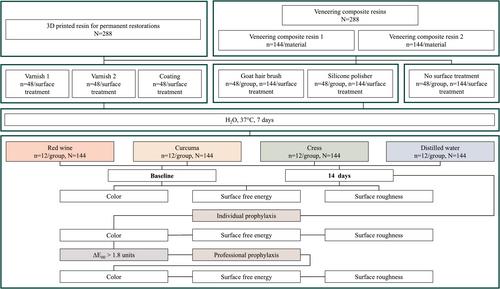
Specimens were manufactured from a 3D printed (VarseoSmile CrownPlus) or two veneering composite resins (GRADIA PLUS; VITA VM LC flow) and underwent varnishing (OPTIGLAZE; VITA AKZENT LC), coating, polishing (goat hair brush; silicone polisher) or remained untreated. For 14 days, specimens were stored in red wine, curcuma, cress, or water. Individual and, for ΔE 00 > 1.8, professional prophylaxis was performed. Color (ΔE 00), surface free energy (SFE), and surface roughness (SR) were measured longitudinally. Mann–Whitney U, Kruskal–Wallis, Friedman, and Wilcoxon tests were computed (α = 0.05).
For the 3D printed resin, varnishing, coating, or goat hair brushing minimized discoloration, while untreated surfaces showed the highest discoloration. Veneering composite resins benefited from goat hair brushing. Individual and professional prophylaxis improved surface properties and partially reversed discolorations. Solely goat hair brushed veneering composite resins achieved surface roughness values ≤ 0.2 μm.
To prevent discoloration, varnishing and goat hair brushing can be recommended for all materials. Individual prophylaxis was most effective for veneering composite resin 1, whereas professional prophylaxis significantly reduced discoloration on 3D printed resin. Only veneering composite resins treated with goat hair brushing achieved surface roughness values of ≤ 0.2 μm.
As 3D printed resins tend to discolor easily, it is important to understand how different surface treatments may impact their color stability. Applying treatments such as varnishing, coating, and polishing can improve the color stability and surface properties, ensuring better esthetic results over time.



 京公网安备 11010802042870号
京ICP备2023020795号-1
京公网安备 11010802042870号
京ICP备2023020795号-1

 分享
分享
 求助内容:
求助内容: 应助结果提醒方式:
 扫码关注我们
