Yuanping Liao, Xiao Wang, Xiaotao Shi, Guorui Cao, Honglue Tan
{"title":"The effect of surgery for multipleligament knee injuries on patellar position and patellofemoral function: a retrospective study.","authors":"Yuanping Liao, Xiao Wang, Xiaotao Shi, Guorui Cao, Honglue Tan","doi":"10.1186/s13018-025-05652-z","DOIUrl":null,"url":null,"abstract":"<p><strong>Background: </strong>Patients who undergo reconstruction for multiligament knee injuries (MLKIs) often exhibit knee instability and poor overall knee function during postoperative follow-up. This may be related to the changes in patellar position and decline in patellofemoral function after surgery.</p><p><strong>Objective: </strong>To evaluate the outcomes following reconstruction of MLKIs through the assessment of: (1) changes in patellar height; (2) anatomical changes in patellofemoral alignment, such as tilt or displacement; and (3) functional outcomes of the patellofemoral joint.</p><p><strong>Methods: </strong>This retrospective study included 45 patients who underwent reconstruction for MLKIs at our hospital between November 2015 and September 2022, with complete data and meeting the inclusion criteria. These patients formed the case group. An additional 20 outpatients without ligament injuries or patellar dislocation were selected as the normal control group. Patellar height changes in the case group were assessed preoperatively and postoperatively using the Caton-Deschamps (CD) and Insall-Salvati (IS) indices on lateral X-rays. Magnetic resonance imaging (MRI) was used to measure patellofemoral alignment parameters in both groups, including the sulcus angle (SA), patellar tilt angle (PTA), lateral patellofemoral angle (LPA), congruence angle (CA), and patellofemoral index (PI), to evaluate patellofemoral positioning. Additionally, the Kujala score questionnaire was used to assess the stability function of the patellofemoral joint.</p><p><strong>Results: </strong>Preoperative patellar height in the case group, measured by the CD and IS indices, was (1.07 ± 0.10, 1.10 ± 0.09), showing a statistically significant difference when compared to postoperative measurements (0.96 ± 0.13, 1.05 ± 0.10) (P < 0.05). However, postoperative patellofemoral alignment parameters, including SA, PTA, LPA, CA, and PI, in the case group showed no statistically significant differences compared to the control group (P > 0.05). At the latest follow-up, the patellofemoral function score in the case group was (89.0 ± 5.3), which was not significantly different from the control group (91.0 ± 2.9) (P > 0.05).</p><p><strong>Conclusion: </strong>After reconstruction of MLKIs, patellar height decreased but remained within the normal range. Patellofemoral alignment was well-maintained, and patellofemoral function was maintained.</p>","PeriodicalId":16629,"journal":{"name":"Journal of Orthopaedic Surgery and Research","volume":"20 1","pages":"291"},"PeriodicalIF":2.8000,"publicationDate":"2025-03-18","publicationTypes":"Journal Article","fieldsOfStudy":null,"isOpenAccess":false,"openAccessPdf":"https://www.ncbi.nlm.nih.gov/pmc/articles/PMC11916915/pdf/","citationCount":"0","resultStr":null,"platform":"Semanticscholar","paperid":null,"PeriodicalName":"Journal of Orthopaedic Surgery and Research","FirstCategoryId":"3","ListUrlMain":"https://doi.org/10.1186/s13018-025-05652-z","RegionNum":3,"RegionCategory":"医学","ArticlePicture":[],"TitleCN":null,"AbstractTextCN":null,"PMCID":null,"EPubDate":"","PubModel":"","JCR":"Q1","JCRName":"ORTHOPEDICS","Score":null,"Total":0}
引用次数: 0
Abstract
Background: Patients who undergo reconstruction for multiligament knee injuries (MLKIs) often exhibit knee instability and poor overall knee function during postoperative follow-up. This may be related to the changes in patellar position and decline in patellofemoral function after surgery.
Objective: To evaluate the outcomes following reconstruction of MLKIs through the assessment of: (1) changes in patellar height; (2) anatomical changes in patellofemoral alignment, such as tilt or displacement; and (3) functional outcomes of the patellofemoral joint.
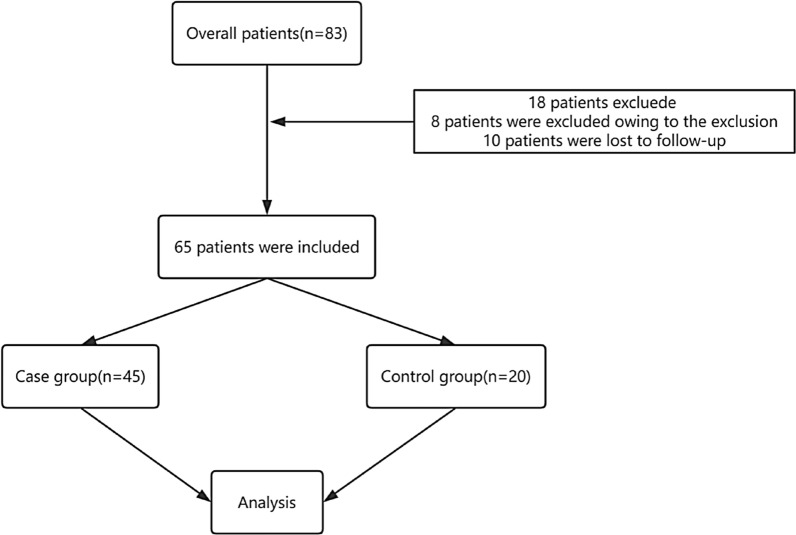
Methods: This retrospective study included 45 patients who underwent reconstruction for MLKIs at our hospital between November 2015 and September 2022, with complete data and meeting the inclusion criteria. These patients formed the case group. An additional 20 outpatients without ligament injuries or patellar dislocation were selected as the normal control group. Patellar height changes in the case group were assessed preoperatively and postoperatively using the Caton-Deschamps (CD) and Insall-Salvati (IS) indices on lateral X-rays. Magnetic resonance imaging (MRI) was used to measure patellofemoral alignment parameters in both groups, including the sulcus angle (SA), patellar tilt angle (PTA), lateral patellofemoral angle (LPA), congruence angle (CA), and patellofemoral index (PI), to evaluate patellofemoral positioning. Additionally, the Kujala score questionnaire was used to assess the stability function of the patellofemoral joint.
Results: Preoperative patellar height in the case group, measured by the CD and IS indices, was (1.07 ± 0.10, 1.10 ± 0.09), showing a statistically significant difference when compared to postoperative measurements (0.96 ± 0.13, 1.05 ± 0.10) (P < 0.05). However, postoperative patellofemoral alignment parameters, including SA, PTA, LPA, CA, and PI, in the case group showed no statistically significant differences compared to the control group (P > 0.05). At the latest follow-up, the patellofemoral function score in the case group was (89.0 ± 5.3), which was not significantly different from the control group (91.0 ± 2.9) (P > 0.05).
Conclusion: After reconstruction of MLKIs, patellar height decreased but remained within the normal range. Patellofemoral alignment was well-maintained, and patellofemoral function was maintained.
期刊介绍:
Journal of Orthopaedic Surgery and Research is an open access journal that encompasses all aspects of clinical and basic research studies related to musculoskeletal issues.
Orthopaedic research is conducted at clinical and basic science levels. With the advancement of new technologies and the increasing expectation and demand from doctors and patients, we are witnessing an enormous growth in clinical orthopaedic research, particularly in the fields of traumatology, spinal surgery, joint replacement, sports medicine, musculoskeletal tumour management, hand microsurgery, foot and ankle surgery, paediatric orthopaedic, and orthopaedic rehabilitation. The involvement of basic science ranges from molecular, cellular, structural and functional perspectives to tissue engineering, gait analysis, automation and robotic surgery. Implant and biomaterial designs are new disciplines that complement clinical applications.
JOSR encourages the publication of multidisciplinary research with collaboration amongst clinicians and scientists from different disciplines, which will be the trend in the coming decades.





 京公网安备 11010802042870号
京ICP备2023020795号-1
京公网安备 11010802042870号
京ICP备2023020795号-1

 分享
分享
 求助内容:
求助内容: 应助结果提醒方式:
 扫码关注我们
