{"title":"Clinicopathological characteristics and long-term prognosis of peritoneal and retroperitoneal gastrointestinal stromal tumors.","authors":"Yunfu Feng, Luojie Liu","doi":"10.1007/s00464-025-11600-z","DOIUrl":null,"url":null,"abstract":"<p><strong>Background: </strong>Peritoneal and retroperitoneal gastrointestinal stromal tumors (PRGISTs) are exceedingly uncommon, and their clinicopathological characteristics and long-term prognosis remain unreported. Therefore, our objective is to analyze these aspects of patients with PRGISTs using the Surveillance, Epidemiology, and End Results (SEER) database.</p><p><strong>Methods: </strong>Patients diagnosed with PRGISTs and small intestine stromal tumors (SISTs) between 2000 and 2019 were included in the study. Differences between groups were compared using Chi-square tests. Kaplan-Meier analysis and Cox proportional hazards models were used to evaluate overall survival (OS) and cancer-specific survival (CSS).</p><p><strong>Results: </strong>A total of 3817 patients were enrolled, with 3513 diagnosed with SISTs and 304 with PRGISTs. Compared to SISTs, PRGISTs patients were older, with larger tumors, higher mitotic rates, and greater risk of lymph node (5.3%) and distant (30.6%) metastasis (P < 0.001). Multivariate analysis identified N stage and mitotic rate as risk factors for distant metastasis in PRGISTs. In comparison to SISTs, PRGISTs patients exhibited a significantly worse OS (hazard ratio [HR] 1.83, 95% confidence interval [CI] 1.57-2.15, P < 0.001) and CSS (HR 2.11, 95% CI 1.73-2.58, P < 0.001). Subgroup analyses by age, sex, surgical status, chemotherapy, and marital status consistently demonstrated poorer OS and CSS for PRGISTs patients compared to SISTs patients (P < 0.05). The 1-, 3-, 5-, and 10-year OS rates for PRGISTs patients were 77.9%, 61.6%, 51.6%, and 32.8%, respectively, with corresponding CSS rates of 84.5%, 71.7%, 63.3%, and 49.0%. Multivariate Cox regression analysis identified age, race, surgical status, and mitotic rate as risk factors influencing OS, while race, surgical status, and mitotic rate were identified as risk factors affecting CSS.</p><p><strong>Conclusions: </strong>In comparison to SISTs, PRGISTs patients exhibit distinct clinicopathological features and have a worse prognosis. However, surgical intervention can improve the prognosis of PRGISTs patients.</p>","PeriodicalId":22174,"journal":{"name":"Surgical Endoscopy And Other Interventional Techniques","volume":" ","pages":"2911-2924"},"PeriodicalIF":2.7000,"publicationDate":"2025-05-01","publicationTypes":"Journal Article","fieldsOfStudy":null,"isOpenAccess":false,"openAccessPdf":"https://www.ncbi.nlm.nih.gov/pmc/articles/PMC12040990/pdf/","citationCount":"0","resultStr":null,"platform":"Semanticscholar","paperid":null,"PeriodicalName":"Surgical Endoscopy And Other Interventional Techniques","FirstCategoryId":"3","ListUrlMain":"https://doi.org/10.1007/s00464-025-11600-z","RegionNum":2,"RegionCategory":"医学","ArticlePicture":[],"TitleCN":null,"AbstractTextCN":null,"PMCID":null,"EPubDate":"2025/3/18 0:00:00","PubModel":"Epub","JCR":"Q2","JCRName":"SURGERY","Score":null,"Total":0}
引用次数: 0
Abstract
Background: Peritoneal and retroperitoneal gastrointestinal stromal tumors (PRGISTs) are exceedingly uncommon, and their clinicopathological characteristics and long-term prognosis remain unreported. Therefore, our objective is to analyze these aspects of patients with PRGISTs using the Surveillance, Epidemiology, and End Results (SEER) database.
Methods: Patients diagnosed with PRGISTs and small intestine stromal tumors (SISTs) between 2000 and 2019 were included in the study. Differences between groups were compared using Chi-square tests. Kaplan-Meier analysis and Cox proportional hazards models were used to evaluate overall survival (OS) and cancer-specific survival (CSS).
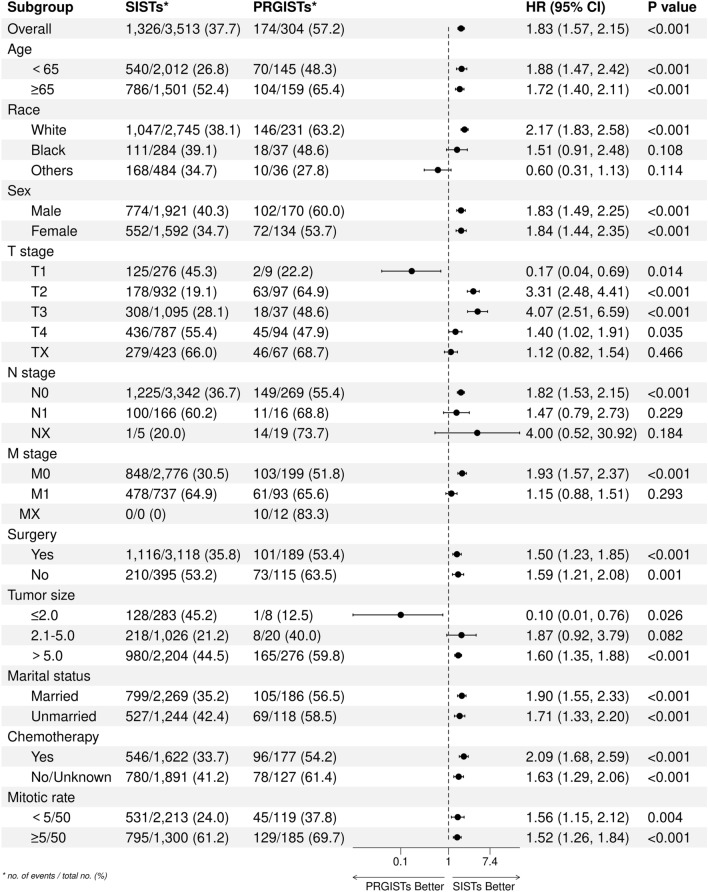
Results: A total of 3817 patients were enrolled, with 3513 diagnosed with SISTs and 304 with PRGISTs. Compared to SISTs, PRGISTs patients were older, with larger tumors, higher mitotic rates, and greater risk of lymph node (5.3%) and distant (30.6%) metastasis (P < 0.001). Multivariate analysis identified N stage and mitotic rate as risk factors for distant metastasis in PRGISTs. In comparison to SISTs, PRGISTs patients exhibited a significantly worse OS (hazard ratio [HR] 1.83, 95% confidence interval [CI] 1.57-2.15, P < 0.001) and CSS (HR 2.11, 95% CI 1.73-2.58, P < 0.001). Subgroup analyses by age, sex, surgical status, chemotherapy, and marital status consistently demonstrated poorer OS and CSS for PRGISTs patients compared to SISTs patients (P < 0.05). The 1-, 3-, 5-, and 10-year OS rates for PRGISTs patients were 77.9%, 61.6%, 51.6%, and 32.8%, respectively, with corresponding CSS rates of 84.5%, 71.7%, 63.3%, and 49.0%. Multivariate Cox regression analysis identified age, race, surgical status, and mitotic rate as risk factors influencing OS, while race, surgical status, and mitotic rate were identified as risk factors affecting CSS.
Conclusions: In comparison to SISTs, PRGISTs patients exhibit distinct clinicopathological features and have a worse prognosis. However, surgical intervention can improve the prognosis of PRGISTs patients.
期刊介绍:
Uniquely positioned at the interface between various medical and surgical disciplines, Surgical Endoscopy serves as a focal point for the international surgical community to exchange information on practice, theory, and research.
Topics covered in the journal include:
-Surgical aspects of:
Interventional endoscopy,
Ultrasound,
Other techniques in the fields of gastroenterology, obstetrics, gynecology, and urology,
-Gastroenterologic surgery
-Thoracic surgery
-Traumatic surgery
-Orthopedic surgery
-Pediatric surgery





 京公网安备 11010802042870号
京ICP备2023020795号-1
京公网安备 11010802042870号
京ICP备2023020795号-1

 分享
分享
 求助内容:
求助内容: 应助结果提醒方式:
 扫码关注我们
