Adalberto Batalha Megale, Nelson Wolosker, Vitoria Magliari Kalil, João Mário Nigro, Carolina Sciammarella Wakisaka, Bianca Oberhuber Dias, Marcelo Passos Teivelis, Marcelo Assis Rocha, Cynthia de Almeida Mendes
{"title":"Aortic calcium score predicts early outcomes in aortoiliac revascularization.","authors":"Adalberto Batalha Megale, Nelson Wolosker, Vitoria Magliari Kalil, João Mário Nigro, Carolina Sciammarella Wakisaka, Bianca Oberhuber Dias, Marcelo Passos Teivelis, Marcelo Assis Rocha, Cynthia de Almeida Mendes","doi":"10.31744/einstein_journal/2025AO0527","DOIUrl":null,"url":null,"abstract":"<p><strong>Background: </strong>Calcium scores were evaluated in the lower limbs of patients with clinical limb ischemia after aortoiliac revascularization. The aortic calcium score was related to the short-term outcomes of amputation and subsequent revascularization. Similarly, the calcium score in below-the-knee arteries was associated with revascularization and amputation at 12 months. ■ The calcium score can be calculated using computed tomography angiography. ■ The aortic calcium score was associated with amputation and subsequent revascularization within 30 days. ■ The calcium score in below-the-knee arteries was higher in the patients who underwent subsequent revascularization and amputation at 12 months.</p><p><strong>Objective: </strong>To evaluate the association between lower limb artery calcium scores in preoperative computed tomography angiography and outcomes of patients with critical limb ischemia who underwent revascularization procedures in the aortoiliac segment.</p><p><strong>Methods: </strong>We retrospectively reviewed 14 interventions performed on 11 patients. The calcium score was calculated in segments of the aorta, iliac, femoropopliteal, and below-the-knee arteries. The evaluated outcomes included amputation, patency, death, subsequent revascularization, and readmission. Major adverse limb events were defined as amputation, subsequent revascularization, or readmission. The patients were followed through a 12-month period.</p><p><strong>Results: </strong>Higher aortic calcium scores were associated with amputation within 30 days (5,767.6 versus 805.3; p=0.02). Amputation during the first year correlated with a higher below-the-knee arteries calcium score (672.4 versus 163.25; p=0.04). Subsequent revascularization within 30 days was associated with a higher aortic calcium score (3,686.8 versus 645.2; p=0.008), while below-the-knee arteries calcium scores were associated with revascularization within 30 days (155.5 versus 817; p=0.05) and 12 months (158.875 versus 679.4; p=0.019). Readmissions within 1 year were more prevalent with higher below-the-knee arteries calcium scores (882.4 versus 32; p=0.011). Major adverse limb events were related to below-the-knee arteries calcium scores at 30 days (158.875 versus 679.4; p=0.019) and 1 year (12.3 versus 910.1; p=0.002).</p><p><strong>Conclusion: </strong>Below-the-knee arteries calcium score is a predictor of long-term revascularization, amputation, readmission, and major adverse limb events. The aortic calcium score was associated with amputation and subsequent revascularization within the first 30 days.</p>","PeriodicalId":47359,"journal":{"name":"Einstein-Sao Paulo","volume":"23 ","pages":"eAO0527"},"PeriodicalIF":0.9000,"publicationDate":"2025-03-17","publicationTypes":"Journal Article","fieldsOfStudy":null,"isOpenAccess":false,"openAccessPdf":"https://www.ncbi.nlm.nih.gov/pmc/articles/PMC11908746/pdf/","citationCount":"0","resultStr":null,"platform":"Semanticscholar","paperid":null,"PeriodicalName":"Einstein-Sao Paulo","FirstCategoryId":"1085","ListUrlMain":"https://doi.org/10.31744/einstein_journal/2025AO0527","RegionNum":0,"RegionCategory":null,"ArticlePicture":[],"TitleCN":null,"AbstractTextCN":null,"PMCID":null,"EPubDate":"2025/1/1 0:00:00","PubModel":"eCollection","JCR":"Q2","JCRName":"MEDICINE, GENERAL & INTERNAL","Score":null,"Total":0}
引用次数: 0
Abstract
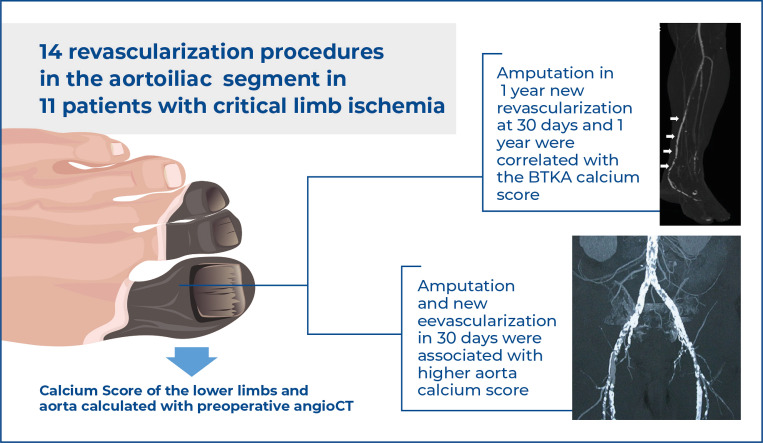
Background: Calcium scores were evaluated in the lower limbs of patients with clinical limb ischemia after aortoiliac revascularization. The aortic calcium score was related to the short-term outcomes of amputation and subsequent revascularization. Similarly, the calcium score in below-the-knee arteries was associated with revascularization and amputation at 12 months. ■ The calcium score can be calculated using computed tomography angiography. ■ The aortic calcium score was associated with amputation and subsequent revascularization within 30 days. ■ The calcium score in below-the-knee arteries was higher in the patients who underwent subsequent revascularization and amputation at 12 months.
Objective: To evaluate the association between lower limb artery calcium scores in preoperative computed tomography angiography and outcomes of patients with critical limb ischemia who underwent revascularization procedures in the aortoiliac segment.
Methods: We retrospectively reviewed 14 interventions performed on 11 patients. The calcium score was calculated in segments of the aorta, iliac, femoropopliteal, and below-the-knee arteries. The evaluated outcomes included amputation, patency, death, subsequent revascularization, and readmission. Major adverse limb events were defined as amputation, subsequent revascularization, or readmission. The patients were followed through a 12-month period.
Results: Higher aortic calcium scores were associated with amputation within 30 days (5,767.6 versus 805.3; p=0.02). Amputation during the first year correlated with a higher below-the-knee arteries calcium score (672.4 versus 163.25; p=0.04). Subsequent revascularization within 30 days was associated with a higher aortic calcium score (3,686.8 versus 645.2; p=0.008), while below-the-knee arteries calcium scores were associated with revascularization within 30 days (155.5 versus 817; p=0.05) and 12 months (158.875 versus 679.4; p=0.019). Readmissions within 1 year were more prevalent with higher below-the-knee arteries calcium scores (882.4 versus 32; p=0.011). Major adverse limb events were related to below-the-knee arteries calcium scores at 30 days (158.875 versus 679.4; p=0.019) and 1 year (12.3 versus 910.1; p=0.002).
Conclusion: Below-the-knee arteries calcium score is a predictor of long-term revascularization, amputation, readmission, and major adverse limb events. The aortic calcium score was associated with amputation and subsequent revascularization within the first 30 days.





 京公网安备 11010802042870号
京ICP备2023020795号-1
京公网安备 11010802042870号
京ICP备2023020795号-1

 分享
分享
 求助内容:
求助内容: 应助结果提醒方式:
 扫码关注我们
