Md Anwer Hossain, Shimlin Jahan Khanam, Md Nuruzzaman Khan, John Oldroyd, Rakibul M Islam
{"title":"Barriers to cervical cancer screening among refugee women: A systematic review.","authors":"Md Anwer Hossain, Shimlin Jahan Khanam, Md Nuruzzaman Khan, John Oldroyd, Rakibul M Islam","doi":"10.1371/journal.pgph.0004225","DOIUrl":null,"url":null,"abstract":"<p><p>Cervical cancer disproportionately affects vulnerable populations including refugee women. Understanding the barriers to cervical cancer screening uptake in this group is crucial to inform targeted interventions and improve health outcomes. This review aimed to identify barriers hindering their access to cervical cancer screening. Five databases - Ovid MEDLINE, EMBASE, PsycINFO, CINAHL, and SCOPUS - were searched in December 2024. The inclusion criteria included studies - a) targeting healthy refugee women, b) conducted in community or hospital/clinic settings, c) reporting barriers to cervical cancer screening from the women's perspective, and d) published in English. Thematic analysis was performed to identify the barriers. The review followed the updated Preferred Reporting Items for Systematic Reviews and Meta-Analyses (PRISMA) guidelines. Eleven studies, seven from the USA, one from each of the UK, Australia, South Korea and Jordan, were included in this review. Of these, six were qualitative, three were quantitative and two were mixed methods studies. There was a consistent pattern of lack of knowledge about cervical cancer and cancer screening in refugee women. A unique barrier was women's negative experiences in refugee camps. Four interconnected themes emerged including 1) individual level barriers, 2) cultural and religious barriers, 3) social and structural barriers, and 4) healthcare system barriers. Ninety percent of included studies were assessed as medium or high quality. The findings underscore the urgent need for targeted interventions to address the diverse challenges faced by refugee women globally which hinder their access to cervical cancer screening. Strategies should include culturally sensitive awareness campaigns, active engagement of healthcare professionals, and structural reforms within healthcare systems to enhance cervical cancer screening uptake among refugee women.</p>","PeriodicalId":74466,"journal":{"name":"PLOS global public health","volume":"5 3","pages":"e0004225"},"PeriodicalIF":2.5000,"publicationDate":"2025-03-18","publicationTypes":"Journal Article","fieldsOfStudy":null,"isOpenAccess":false,"openAccessPdf":"https://www.ncbi.nlm.nih.gov/pmc/articles/PMC11918313/pdf/","citationCount":"0","resultStr":null,"platform":"Semanticscholar","paperid":null,"PeriodicalName":"PLOS global public health","FirstCategoryId":"1085","ListUrlMain":"https://doi.org/10.1371/journal.pgph.0004225","RegionNum":0,"RegionCategory":null,"ArticlePicture":[],"TitleCN":null,"AbstractTextCN":null,"PMCID":null,"EPubDate":"2025/1/1 0:00:00","PubModel":"eCollection","JCR":"","JCRName":"","Score":null,"Total":0}
引用次数: 0
Abstract
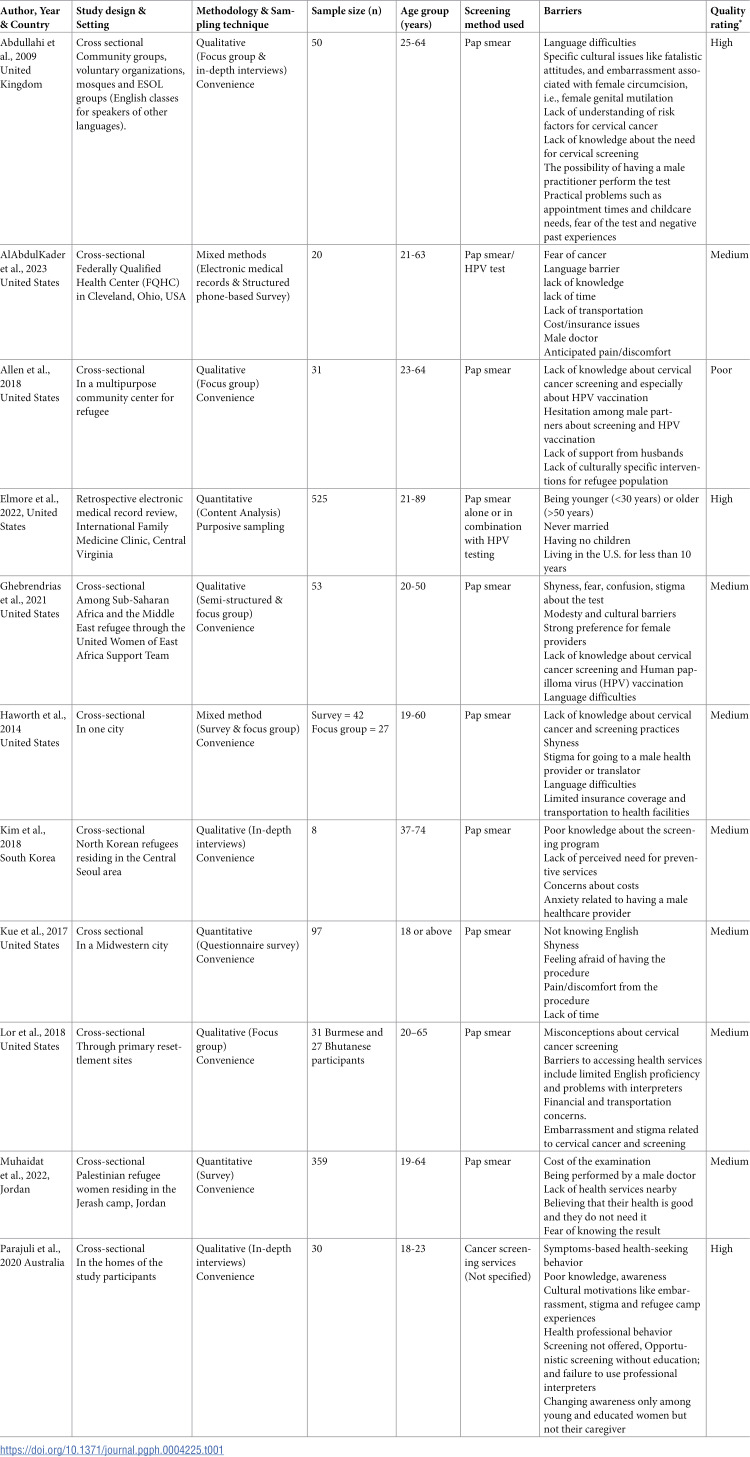
Cervical cancer disproportionately affects vulnerable populations including refugee women. Understanding the barriers to cervical cancer screening uptake in this group is crucial to inform targeted interventions and improve health outcomes. This review aimed to identify barriers hindering their access to cervical cancer screening. Five databases - Ovid MEDLINE, EMBASE, PsycINFO, CINAHL, and SCOPUS - were searched in December 2024. The inclusion criteria included studies - a) targeting healthy refugee women, b) conducted in community or hospital/clinic settings, c) reporting barriers to cervical cancer screening from the women's perspective, and d) published in English. Thematic analysis was performed to identify the barriers. The review followed the updated Preferred Reporting Items for Systematic Reviews and Meta-Analyses (PRISMA) guidelines. Eleven studies, seven from the USA, one from each of the UK, Australia, South Korea and Jordan, were included in this review. Of these, six were qualitative, three were quantitative and two were mixed methods studies. There was a consistent pattern of lack of knowledge about cervical cancer and cancer screening in refugee women. A unique barrier was women's negative experiences in refugee camps. Four interconnected themes emerged including 1) individual level barriers, 2) cultural and religious barriers, 3) social and structural barriers, and 4) healthcare system barriers. Ninety percent of included studies were assessed as medium or high quality. The findings underscore the urgent need for targeted interventions to address the diverse challenges faced by refugee women globally which hinder their access to cervical cancer screening. Strategies should include culturally sensitive awareness campaigns, active engagement of healthcare professionals, and structural reforms within healthcare systems to enhance cervical cancer screening uptake among refugee women.





 京公网安备 11010802042870号
京ICP备2023020795号-1
京公网安备 11010802042870号
京ICP备2023020795号-1

 分享
分享

 求助内容:
求助内容: 应助结果提醒方式:
 扫码关注我们
