Nished Rijal, Behnoush Ahranjani, Padma Hitan, Sian Fitzgerald
{"title":"Understanding the roots: Local stakeholders' insights on the causes and challenges in combating child marriage in mountainous Karnali, Nepal.","authors":"Nished Rijal, Behnoush Ahranjani, Padma Hitan, Sian Fitzgerald","doi":"10.1371/journal.pgph.0004323","DOIUrl":null,"url":null,"abstract":"<p><p>Child marriage remains a pressing issue in Nepal despite a decreasing trend in recent decades. The Nepal constitution prohibits child marriage, and the local governments have implemented various strategies to combat it. Nevertheless, child marriage practice continues, particularly in remote and mountainous regions, posing a challenge to the effectiveness and sustainability of interventions. This study aimed to gather insights from key community stakeholders on the consequences and perceived causes of child marriage, which can serve as a foundation for developing culturally appropriate interventions in Karnali province. Eleven Focus Group Discussions and 13 Key Informant Interviews were conducted with a total of 121 participants, with adult and adolescent participants' mean ages of 35.2 and 15.2 years, respectively. The participants were asked about the significance of child marriage in their community, its consequences, and perceived causes. Discussions were transcribed verbatim in Nepali, and a thematic approach was used for data analysis. There was agreement that child marriage has been declining in the community but continues to be a substantial public health issue. Clear comprehension of the consequences of child marriage, both immediate and long-term, was evident. Child marriage was identified to be influenced by a complex interplay of factors across individual, interpersonal, community, and policy levels. Cultural and gender norms and socioeconomic determinants emerged as interconnected and primary causes. An additional theme highlighted the inequity in accessing information and services, particularly for women and girls. The significance of recognizing the agency of individuals and community groups in their ability to change was also underscored. These findings suggest the stakeholders' awareness of child marriage in their community is significant. To develop and implement effective and sustainable interventions, it is crucial for diverse stakeholder groups to take ownership and actively participate in the planning and execution of interventions led by local government initiatives.</p>","PeriodicalId":74466,"journal":{"name":"PLOS global public health","volume":"5 3","pages":"e0004323"},"PeriodicalIF":2.5000,"publicationDate":"2025-03-18","publicationTypes":"Journal Article","fieldsOfStudy":null,"isOpenAccess":false,"openAccessPdf":"https://www.ncbi.nlm.nih.gov/pmc/articles/PMC11918358/pdf/","citationCount":"0","resultStr":null,"platform":"Semanticscholar","paperid":null,"PeriodicalName":"PLOS global public health","FirstCategoryId":"1085","ListUrlMain":"https://doi.org/10.1371/journal.pgph.0004323","RegionNum":0,"RegionCategory":null,"ArticlePicture":[],"TitleCN":null,"AbstractTextCN":null,"PMCID":null,"EPubDate":"2025/1/1 0:00:00","PubModel":"eCollection","JCR":"","JCRName":"","Score":null,"Total":0}
引用次数: 0
Abstract
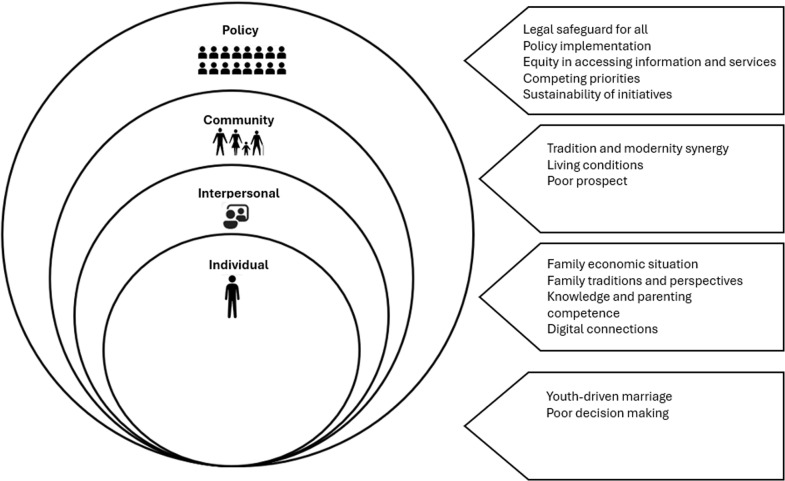
Child marriage remains a pressing issue in Nepal despite a decreasing trend in recent decades. The Nepal constitution prohibits child marriage, and the local governments have implemented various strategies to combat it. Nevertheless, child marriage practice continues, particularly in remote and mountainous regions, posing a challenge to the effectiveness and sustainability of interventions. This study aimed to gather insights from key community stakeholders on the consequences and perceived causes of child marriage, which can serve as a foundation for developing culturally appropriate interventions in Karnali province. Eleven Focus Group Discussions and 13 Key Informant Interviews were conducted with a total of 121 participants, with adult and adolescent participants' mean ages of 35.2 and 15.2 years, respectively. The participants were asked about the significance of child marriage in their community, its consequences, and perceived causes. Discussions were transcribed verbatim in Nepali, and a thematic approach was used for data analysis. There was agreement that child marriage has been declining in the community but continues to be a substantial public health issue. Clear comprehension of the consequences of child marriage, both immediate and long-term, was evident. Child marriage was identified to be influenced by a complex interplay of factors across individual, interpersonal, community, and policy levels. Cultural and gender norms and socioeconomic determinants emerged as interconnected and primary causes. An additional theme highlighted the inequity in accessing information and services, particularly for women and girls. The significance of recognizing the agency of individuals and community groups in their ability to change was also underscored. These findings suggest the stakeholders' awareness of child marriage in their community is significant. To develop and implement effective and sustainable interventions, it is crucial for diverse stakeholder groups to take ownership and actively participate in the planning and execution of interventions led by local government initiatives.




 京公网安备 11010802042870号
京ICP备2023020795号-1
京公网安备 11010802042870号
京ICP备2023020795号-1

 分享
分享

 求助内容:
求助内容: 应助结果提醒方式:
 扫码关注我们
