{"title":"The utility of nonhuman primate models for understanding acute HIV-1 infection.","authors":"Matthew S Parsons, Diane L Bolton","doi":"10.1097/COH.0000000000000920","DOIUrl":null,"url":null,"abstract":"<p><strong>Purpose of review: </strong>Nonhuman primate (NHP) models of HIV-1 infection provide complementary experimental pathways for assessing aspects of acute HIV-1 infection (AHI) that cannot be addressed in humans. This article reviews acute infection studies in SIV-infected or SHIV-infected macaque species over the previous 18 months.</p><p><strong>Recent findings: </strong>Reviewed studies examined the dynamics of replication-competent viral reservoir establishment during early infection, reservoir maintenance throughout therapy, and factors influencing viral rebound after treatment cessation. Also discussed are acute infection events in the central nervous system and liver and potential links between these events and manifestations of comorbidities during chronic infection. Additional studies addressed how occurrences during acute infection impact the development of natural viral control or posttreatment control. Another report evaluated treatment during acute infection with broadly neutralizing antibodies with enhanced ability to engage innate immune cells, highlighting the ability of this early intervention to shape innate and adaptive antiviral responses.</p><p><strong>Summary: </strong>NHP models of HIV-1 infection are a fundamental research tool for investigating AHI events. These models enable detailed pathogenesis characterization and the testing of hypothesis-driven strategies for altering disease courses through interventions during AHI, including targeting viral persistence and comorbidities that persist throughout chronic infection.</p>","PeriodicalId":93966,"journal":{"name":"Current opinion in HIV and AIDS","volume":" ","pages":"218-227"},"PeriodicalIF":4.0000,"publicationDate":"2025-05-01","publicationTypes":"Journal Article","fieldsOfStudy":null,"isOpenAccess":false,"openAccessPdf":"https://www.ncbi.nlm.nih.gov/pmc/articles/PMC11970610/pdf/","citationCount":"0","resultStr":null,"platform":"Semanticscholar","paperid":null,"PeriodicalName":"Current opinion in HIV and AIDS","FirstCategoryId":"1085","ListUrlMain":"https://doi.org/10.1097/COH.0000000000000920","RegionNum":0,"RegionCategory":null,"ArticlePicture":[],"TitleCN":null,"AbstractTextCN":null,"PMCID":null,"EPubDate":"2025/3/27 0:00:00","PubModel":"Epub","JCR":"","JCRName":"","Score":null,"Total":0}
引用次数: 0
Abstract
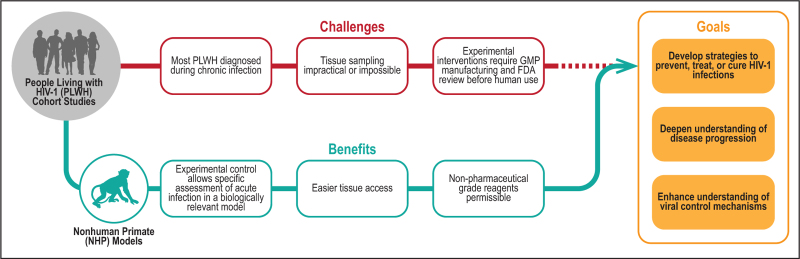
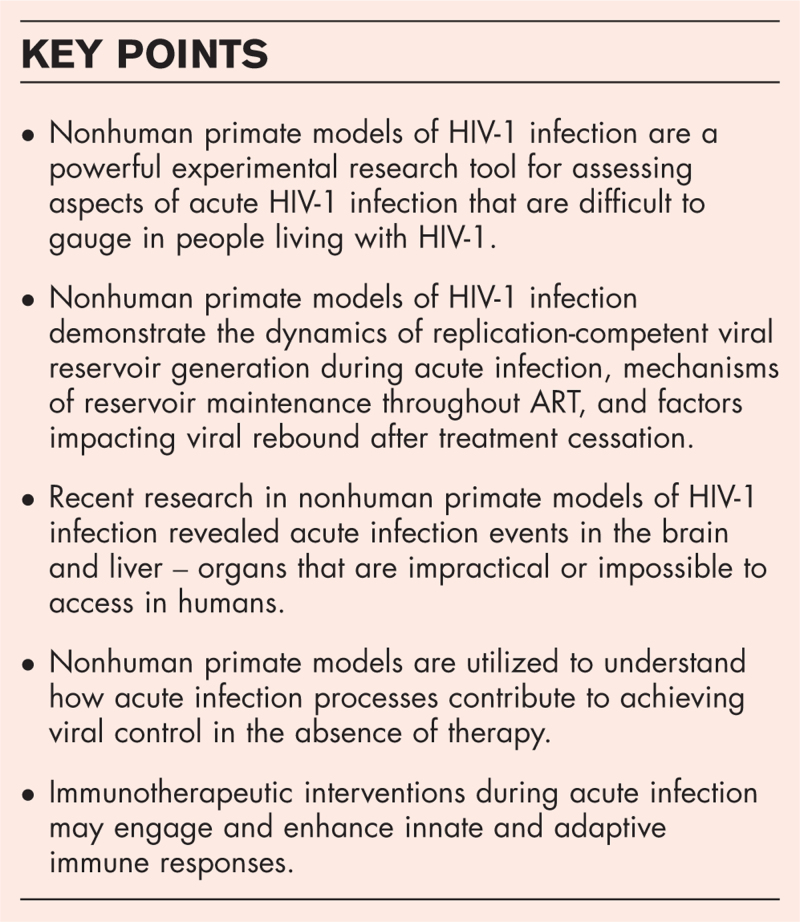
Purpose of review: Nonhuman primate (NHP) models of HIV-1 infection provide complementary experimental pathways for assessing aspects of acute HIV-1 infection (AHI) that cannot be addressed in humans. This article reviews acute infection studies in SIV-infected or SHIV-infected macaque species over the previous 18 months.
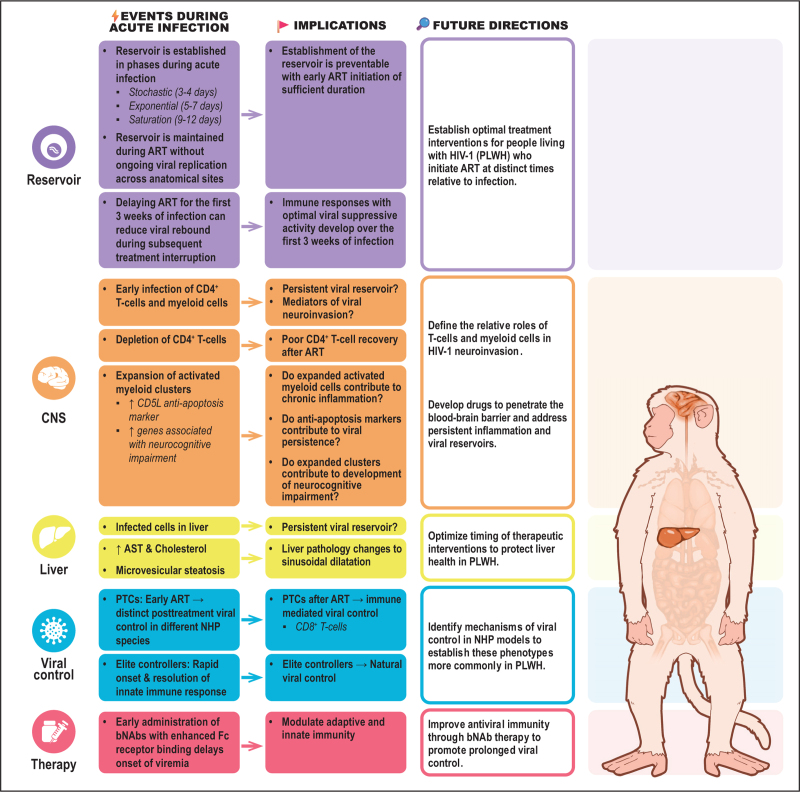
Recent findings: Reviewed studies examined the dynamics of replication-competent viral reservoir establishment during early infection, reservoir maintenance throughout therapy, and factors influencing viral rebound after treatment cessation. Also discussed are acute infection events in the central nervous system and liver and potential links between these events and manifestations of comorbidities during chronic infection. Additional studies addressed how occurrences during acute infection impact the development of natural viral control or posttreatment control. Another report evaluated treatment during acute infection with broadly neutralizing antibodies with enhanced ability to engage innate immune cells, highlighting the ability of this early intervention to shape innate and adaptive antiviral responses.
Summary: NHP models of HIV-1 infection are a fundamental research tool for investigating AHI events. These models enable detailed pathogenesis characterization and the testing of hypothesis-driven strategies for altering disease courses through interventions during AHI, including targeting viral persistence and comorbidities that persist throughout chronic infection.



 京公网安备 11010802042870号
京ICP备2023020795号-1
京公网安备 11010802042870号
京ICP备2023020795号-1

 分享
分享

 求助内容:
求助内容: 应助结果提醒方式:
 扫码关注我们
