Daria Stoia, Enza Fazio, Carmelo Corsaro, Andreea Campu, Olga Soritau, Ana Maria Craciun, Gabriela Chereches, Monica Focsan, Giulia Neri and Anna Piperno
{"title":"A graphene–poly(methacrylic acid)–gold bipyramid hybrid plasmonic nanocomposite for in vitro bioimaging and photothermal therapy†","authors":"Daria Stoia, Enza Fazio, Carmelo Corsaro, Andreea Campu, Olga Soritau, Ana Maria Craciun, Gabriela Chereches, Monica Focsan, Giulia Neri and Anna Piperno","doi":"10.1039/D5TB00097A","DOIUrl":null,"url":null,"abstract":"<p >This study presents two new hybrid nanosystems (G–PMA(1 : 1)@AuBPs and G–PMA(1 : 3)@AuBPs), constructed from amine graphene (G-NH<small><sub>2</sub></small>) functionalized with poly(methacrylic acid) (PMA) and gold nanoparticles with a bipyramidal shape (AuBPs). These nanoplatforms behave like efficient photothermal agents, making them suitable for effective <em>in vitro</em> photothermal therapy and for bioimaging applications simultaneously. The nanosystems were synthesized by combining covalent and supramolecular approaches and characterized by several techniques including XPS, Raman spectroscopy, UV-vis spectroscopy, XRD, and STEM. It was observed that G–PMA@AuBP systems demonstrate remarkable light-to-heat conversion efficiency under near-infrared irradiation at 785 and 808 nm. Both systems showed an enhancement of the photothermal properties compared to the individual materials. Particularly, a photothermal conversion efficiency exceeding 70% was estimated for the G–PMA(1 : 3)@AuBP sample under 808 nm irradiation. Beyond their photothermal capabilities, G–PMA@AuBP systems can be effective as label-free bioimaging probes. G–PMA(1 : 1)@AuBP has been successfully visualized within B16F10 melanoma cells using FLIM, conventional fluorescence, and dark-field microscopy techniques, with localization observed in the perinuclear region. Cytotoxicity assays confirmed the biocompatibility of both nanosystems. Finally, the <em>in vitro</em> phototherapeutic efficacy was validated under 808 nm laser irradiation, showing promising results for melanoma cell treatment through photothermal therapy.</p>","PeriodicalId":83,"journal":{"name":"Journal of Materials Chemistry B","volume":" 14","pages":" 4433-4446"},"PeriodicalIF":6.1000,"publicationDate":"2025-03-05","publicationTypes":"Journal Article","fieldsOfStudy":null,"isOpenAccess":false,"openAccessPdf":"https://pubs.rsc.org/en/content/articlepdf/2025/tb/d5tb00097a?page=search","citationCount":"0","resultStr":null,"platform":"Semanticscholar","paperid":null,"PeriodicalName":"Journal of Materials Chemistry B","FirstCategoryId":"1","ListUrlMain":"https://pubs.rsc.org/en/content/articlelanding/2025/tb/d5tb00097a","RegionNum":3,"RegionCategory":"医学","ArticlePicture":[],"TitleCN":null,"AbstractTextCN":null,"PMCID":null,"EPubDate":"","PubModel":"","JCR":"Q1","JCRName":"MATERIALS SCIENCE, BIOMATERIALS","Score":null,"Total":0}
引用次数: 0
Abstract
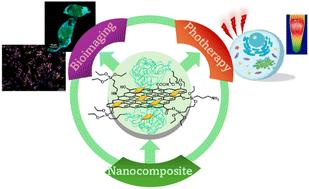
This study presents two new hybrid nanosystems (G–PMA(1 : 1)@AuBPs and G–PMA(1 : 3)@AuBPs), constructed from amine graphene (G-NH2) functionalized with poly(methacrylic acid) (PMA) and gold nanoparticles with a bipyramidal shape (AuBPs). These nanoplatforms behave like efficient photothermal agents, making them suitable for effective in vitro photothermal therapy and for bioimaging applications simultaneously. The nanosystems were synthesized by combining covalent and supramolecular approaches and characterized by several techniques including XPS, Raman spectroscopy, UV-vis spectroscopy, XRD, and STEM. It was observed that G–PMA@AuBP systems demonstrate remarkable light-to-heat conversion efficiency under near-infrared irradiation at 785 and 808 nm. Both systems showed an enhancement of the photothermal properties compared to the individual materials. Particularly, a photothermal conversion efficiency exceeding 70% was estimated for the G–PMA(1 : 3)@AuBP sample under 808 nm irradiation. Beyond their photothermal capabilities, G–PMA@AuBP systems can be effective as label-free bioimaging probes. G–PMA(1 : 1)@AuBP has been successfully visualized within B16F10 melanoma cells using FLIM, conventional fluorescence, and dark-field microscopy techniques, with localization observed in the perinuclear region. Cytotoxicity assays confirmed the biocompatibility of both nanosystems. Finally, the in vitro phototherapeutic efficacy was validated under 808 nm laser irradiation, showing promising results for melanoma cell treatment through photothermal therapy.
期刊介绍:
Journal of Materials Chemistry A, B & C cover high quality studies across all fields of materials chemistry. The journals focus on those theoretical or experimental studies that report new understanding, applications, properties and synthesis of materials. Journal of Materials Chemistry A, B & C are separated by the intended application of the material studied. Broadly, applications in energy and sustainability are of interest to Journal of Materials Chemistry A, applications in biology and medicine are of interest to Journal of Materials Chemistry B, and applications in optical, magnetic and electronic devices are of interest to Journal of Materials Chemistry C.Journal of Materials Chemistry B is a Transformative Journal and Plan S compliant. Example topic areas within the scope of Journal of Materials Chemistry B are listed below. This list is neither exhaustive nor exclusive:
Antifouling coatings
Biocompatible materials
Bioelectronics
Bioimaging
Biomimetics
Biomineralisation
Bionics
Biosensors
Diagnostics
Drug delivery
Gene delivery
Immunobiology
Nanomedicine
Regenerative medicine & Tissue engineering
Scaffolds
Soft robotics
Stem cells
Therapeutic devices



 京公网安备 11010802042870号
京ICP备2023020795号-1
京公网安备 11010802042870号
京ICP备2023020795号-1

 分享
分享
 求助内容:
求助内容: 应助结果提醒方式:
 扫码关注我们
