Insights into nano-ZrO2 reinforced self-antibacterial Ti–3Cu composites via laser metal deposition: content-optimized bioactive nano-ZrO2 integrated for wear resistance, in vitro antibacterial and biological properties
Ming-Chun Zhao, Zhiyong Shi, Xin Li, Chaochun Zhao, Wenze Wang, Dengfeng Yin and Andrej Atrens
{"title":"Insights into nano-ZrO2 reinforced self-antibacterial Ti–3Cu composites via laser metal deposition: content-optimized bioactive nano-ZrO2 integrated for wear resistance, in vitro antibacterial and biological properties","authors":"Ming-Chun Zhao, Zhiyong Shi, Xin Li, Chaochun Zhao, Wenze Wang, Dengfeng Yin and Andrej Atrens","doi":"10.1039/D5TB00143A","DOIUrl":null,"url":null,"abstract":"<p >Ti alloys are sensitive to fretting wear, which leads to early failure of their implants. Wear is a major factor in determining the long-term clinical performance. This work explored the increase of wear resistance in antibacterial Ti–Cu alloys, by incorporating biocompatible nano-ZrO<small><sub>2</sub></small> using laser metal deposition (LMD). The content of the reinforcing nano-ZrO<small><sub>2</sub></small> played a crucial role in performance. There was good densification quality for ≤3 wt%. The densification quality declined and there were macrocracks for ≥5 wt%. Both the prior β grains and the α grains initially decreased in size followed by coarsening as the ZrO<small><sub>2</sub></small> content increased, with the minimum at 3 wt%. The yield strength increased with increasing ZrO<small><sub>2</sub></small> content, and the elastic modulus increased from 5 wt%. The wear rate decreased initially and then increased with increasing ZrO<small><sub>2</sub></small> contents, reaching the lowest wear rate at 3 wt%. The corrosion resistance in body fluid was a minimum between 3 and 5 wt%, with less or more leading to a decrease in corrosion resistance. <em>In vitro</em> antibacterial tests and <em>MC3T3-E1</em> cell culture assays indicated that ZrO<small><sub>2</sub></small> contents of up to 10 wt% achieved good antibacterial effects while maintaining good biocompatibility. The comprehensive test results allowed screening and optimization of the processability and wear-related performance. 3 wt% ZrO<small><sub>2</sub></small> contents provided the best overall performance. The mechanisms for various content bioactive nano-ZrO<small><sub>2</sub></small> integrated for wear resistance, <em>in vitro</em> antibacterial and biological properties were explored. This work aimed to understand how ZrO<small><sub>2</sub></small> concentrations influenced the overall performance and to identify the optimal content for wear resistance and related biofunctionality.</p>","PeriodicalId":83,"journal":{"name":"Journal of Materials Chemistry B","volume":" 14","pages":" 4353-4373"},"PeriodicalIF":6.1000,"publicationDate":"2025-03-19","publicationTypes":"Journal Article","fieldsOfStudy":null,"isOpenAccess":false,"openAccessPdf":"","citationCount":"0","resultStr":null,"platform":"Semanticscholar","paperid":null,"PeriodicalName":"Journal of Materials Chemistry B","FirstCategoryId":"1","ListUrlMain":"https://pubs.rsc.org/en/content/articlelanding/2025/tb/d5tb00143a","RegionNum":3,"RegionCategory":"医学","ArticlePicture":[],"TitleCN":null,"AbstractTextCN":null,"PMCID":null,"EPubDate":"","PubModel":"","JCR":"Q1","JCRName":"MATERIALS SCIENCE, BIOMATERIALS","Score":null,"Total":0}
引用次数: 0
Abstract
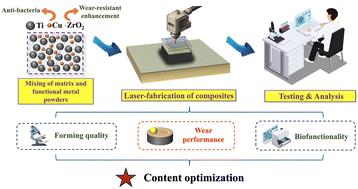
Ti alloys are sensitive to fretting wear, which leads to early failure of their implants. Wear is a major factor in determining the long-term clinical performance. This work explored the increase of wear resistance in antibacterial Ti–Cu alloys, by incorporating biocompatible nano-ZrO2 using laser metal deposition (LMD). The content of the reinforcing nano-ZrO2 played a crucial role in performance. There was good densification quality for ≤3 wt%. The densification quality declined and there were macrocracks for ≥5 wt%. Both the prior β grains and the α grains initially decreased in size followed by coarsening as the ZrO2 content increased, with the minimum at 3 wt%. The yield strength increased with increasing ZrO2 content, and the elastic modulus increased from 5 wt%. The wear rate decreased initially and then increased with increasing ZrO2 contents, reaching the lowest wear rate at 3 wt%. The corrosion resistance in body fluid was a minimum between 3 and 5 wt%, with less or more leading to a decrease in corrosion resistance. In vitro antibacterial tests and MC3T3-E1 cell culture assays indicated that ZrO2 contents of up to 10 wt% achieved good antibacterial effects while maintaining good biocompatibility. The comprehensive test results allowed screening and optimization of the processability and wear-related performance. 3 wt% ZrO2 contents provided the best overall performance. The mechanisms for various content bioactive nano-ZrO2 integrated for wear resistance, in vitro antibacterial and biological properties were explored. This work aimed to understand how ZrO2 concentrations influenced the overall performance and to identify the optimal content for wear resistance and related biofunctionality.
期刊介绍:
Journal of Materials Chemistry A, B & C cover high quality studies across all fields of materials chemistry. The journals focus on those theoretical or experimental studies that report new understanding, applications, properties and synthesis of materials. Journal of Materials Chemistry A, B & C are separated by the intended application of the material studied. Broadly, applications in energy and sustainability are of interest to Journal of Materials Chemistry A, applications in biology and medicine are of interest to Journal of Materials Chemistry B, and applications in optical, magnetic and electronic devices are of interest to Journal of Materials Chemistry C.Journal of Materials Chemistry B is a Transformative Journal and Plan S compliant. Example topic areas within the scope of Journal of Materials Chemistry B are listed below. This list is neither exhaustive nor exclusive:
Antifouling coatings
Biocompatible materials
Bioelectronics
Bioimaging
Biomimetics
Biomineralisation
Bionics
Biosensors
Diagnostics
Drug delivery
Gene delivery
Immunobiology
Nanomedicine
Regenerative medicine & Tissue engineering
Scaffolds
Soft robotics
Stem cells
Therapeutic devices



 京公网安备 11010802042870号
京ICP备2023020795号-1
京公网安备 11010802042870号
京ICP备2023020795号-1

 分享
分享
 求助内容:
求助内容: 应助结果提醒方式:
 扫码关注我们
