Ana M. Toader, Maria C. Buta, Ionel Humelnicu, Werner Urland, Markus Suta, Dumitru-Claudiu Sergentu, Fanica Cimpoesu
{"title":"Ab Initio Modeling of the Photoluminescence of SrCl2:Eu2+─Direct Comparison between Density Functional and Wave Function Theory-Based Approaches","authors":"Ana M. Toader, Maria C. Buta, Ionel Humelnicu, Werner Urland, Markus Suta, Dumitru-Claudiu Sergentu, Fanica Cimpoesu","doi":"10.1021/acs.inorgchem.4c05073","DOIUrl":null,"url":null,"abstract":"Accurate <i>ab initio</i> quantum chemical approaches for the description of two-open-shell centers in periodic systems, such as lanthanoid ions in inorganic host matrices, remain a challenging topic in computational chemistry. In contrast, experimental high-quality spectroscopic data on selected lanthanoid-activated inorganic phosphors are widely available and offer a perfect ground to test new theoretical developments. One particular benchmark of computational methods in the field of 4f<sup><i>n</i>-1</sup>5d<sup>1</sup> → 4f<sup><i>n</i></sup>-based broad-band emitting lanthanoid ions such as Ce<sup>3+</sup> (<i>n</i> = 1) or Eu<sup>2+</sup> (<i>n</i> = 7) is the shrinkage of the metal–ligand bond length in the lowest excited 4f<sup><i>n</i>-1</sup>5d<sup>1</sup> state. In this work, we use the model system SrCl<sub>2</sub>:Eu<sup>2+</sup>, which crystallizes in a fluorite-type structure with cubically coordinated Sr sites, as a case study for bond length contraction upon excitation─a behavior contrary to the usual bond-length increase (or breaking) encountered in most excited states with antibonding character. We performed a series of calculations on model systems ranging from realistic periodic models to idealized molecular clusters. We compare wavefunction theory- to density functional theory-based approaches, offering guidelines on how to evaluate these methodologies for their suitability as predictive tools for the photoluminescence properties of lanthanoid-activated phosphors.","PeriodicalId":40,"journal":{"name":"Inorganic Chemistry","volume":"9 1","pages":""},"PeriodicalIF":4.7000,"publicationDate":"2025-03-20","publicationTypes":"Journal Article","fieldsOfStudy":null,"isOpenAccess":false,"openAccessPdf":"","citationCount":"0","resultStr":null,"platform":"Semanticscholar","paperid":null,"PeriodicalName":"Inorganic Chemistry","FirstCategoryId":"92","ListUrlMain":"https://doi.org/10.1021/acs.inorgchem.4c05073","RegionNum":2,"RegionCategory":"化学","ArticlePicture":[],"TitleCN":null,"AbstractTextCN":null,"PMCID":null,"EPubDate":"","PubModel":"","JCR":"Q1","JCRName":"CHEMISTRY, INORGANIC & NUCLEAR","Score":null,"Total":0}
引用次数: 0
Abstract
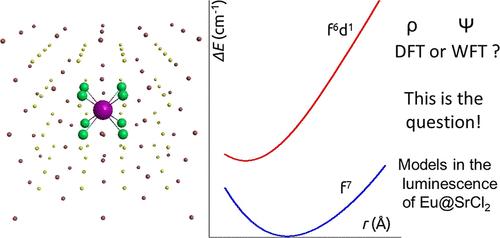
Accurate ab initio quantum chemical approaches for the description of two-open-shell centers in periodic systems, such as lanthanoid ions in inorganic host matrices, remain a challenging topic in computational chemistry. In contrast, experimental high-quality spectroscopic data on selected lanthanoid-activated inorganic phosphors are widely available and offer a perfect ground to test new theoretical developments. One particular benchmark of computational methods in the field of 4fn-15d1 → 4fn-based broad-band emitting lanthanoid ions such as Ce3+ (n = 1) or Eu2+ (n = 7) is the shrinkage of the metal–ligand bond length in the lowest excited 4fn-15d1 state. In this work, we use the model system SrCl2:Eu2+, which crystallizes in a fluorite-type structure with cubically coordinated Sr sites, as a case study for bond length contraction upon excitation─a behavior contrary to the usual bond-length increase (or breaking) encountered in most excited states with antibonding character. We performed a series of calculations on model systems ranging from realistic periodic models to idealized molecular clusters. We compare wavefunction theory- to density functional theory-based approaches, offering guidelines on how to evaluate these methodologies for their suitability as predictive tools for the photoluminescence properties of lanthanoid-activated phosphors.
期刊介绍:
Inorganic Chemistry publishes fundamental studies in all phases of inorganic chemistry. Coverage includes experimental and theoretical reports on quantitative studies of structure and thermodynamics, kinetics, mechanisms of inorganic reactions, bioinorganic chemistry, and relevant aspects of organometallic chemistry, solid-state phenomena, and chemical bonding theory. Emphasis is placed on the synthesis, structure, thermodynamics, reactivity, spectroscopy, and bonding properties of significant new and known compounds.



 京公网安备 11010802042870号
京ICP备2023020795号-1
京公网安备 11010802042870号
京ICP备2023020795号-1

 分享
分享
 求助内容:
求助内容: 应助结果提醒方式:
 扫码关注我们
