Yi-Ming Di, Yu-Ping Song, Shu-Quan Zhang, Mei-Jin Lin
{"title":"Anion–π(–π) Interactions in Donor–Acceptor Hybrid Materials to Control Photochromism and Room-Temperature Phosphorescence","authors":"Yi-Ming Di, Yu-Ping Song, Shu-Quan Zhang, Mei-Jin Lin","doi":"10.1021/acs.inorgchem.4c05562","DOIUrl":null,"url":null,"abstract":"Photochromic materials and room-temperature phosphorescence (RTP) are essential for applications in optoelectronics and bioimaging. Organic–inorganic hybrid materials, particularly those exhibiting donor–acceptor (D–A) characteristics through supramolecular interactions, have shown significant potential to integrate both photochromic and RTP properties. Among them, the anion–π and π–π interactions have been extensively studied; however, the role of anion–π–π interactions in hybrid materials remains largely unexplored. This study investigated three naphthalenediimide-polyoxometalate (NDI-POM) hybrids: (H<sub>2</sub>DMAP-NDI)·(HPW<sub>12</sub>O<sub>40</sub>)·(NMP)<sub>2</sub> (<b>1</b>), (HDMAP-NDI)<sub>2</sub>·(HPW<sub>12</sub>O<sub>40</sub>)·(NMP)<sub>2</sub> (<b>2</b>), and (HDMAP-NDI)<sub>2</sub>·(HPW<sub>12</sub>O<sub>40</sub>)·(NMP)<sub>7</sub> (<b>3</b>), focusing on the impact of anion–π–π interactions on their photochromic and RTP properties. The results indicate that hybrid <b>1</b> exhibits the fastest photoresponse and highest RTP quantum yield, primarily driven by anion–π interactions. Hybrid <b>2</b>, which involves anion–π–π interactions, shows slower photochromism and lower RTP yield due to exciton localization and nonradiative decay paths resulting from π–π stacking. Hybrid <b>3</b>, characterized by excessively strong interactions, is unstable and nonemissive. This study provides valuable insights into the role of anion–π–π interactions in hybrid materials and offers a framework for designing advanced photoresponsive materials with tunable properties for diverse applications.","PeriodicalId":40,"journal":{"name":"Inorganic Chemistry","volume":"306 1","pages":""},"PeriodicalIF":4.7000,"publicationDate":"2025-03-20","publicationTypes":"Journal Article","fieldsOfStudy":null,"isOpenAccess":false,"openAccessPdf":"","citationCount":"0","resultStr":null,"platform":"Semanticscholar","paperid":null,"PeriodicalName":"Inorganic Chemistry","FirstCategoryId":"92","ListUrlMain":"https://doi.org/10.1021/acs.inorgchem.4c05562","RegionNum":2,"RegionCategory":"化学","ArticlePicture":[],"TitleCN":null,"AbstractTextCN":null,"PMCID":null,"EPubDate":"","PubModel":"","JCR":"Q1","JCRName":"CHEMISTRY, INORGANIC & NUCLEAR","Score":null,"Total":0}
引用次数: 0
Abstract
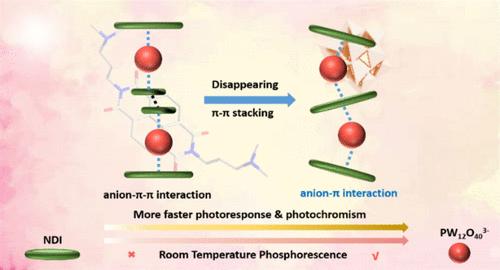
Photochromic materials and room-temperature phosphorescence (RTP) are essential for applications in optoelectronics and bioimaging. Organic–inorganic hybrid materials, particularly those exhibiting donor–acceptor (D–A) characteristics through supramolecular interactions, have shown significant potential to integrate both photochromic and RTP properties. Among them, the anion–π and π–π interactions have been extensively studied; however, the role of anion–π–π interactions in hybrid materials remains largely unexplored. This study investigated three naphthalenediimide-polyoxometalate (NDI-POM) hybrids: (H2DMAP-NDI)·(HPW12O40)·(NMP)2 (1), (HDMAP-NDI)2·(HPW12O40)·(NMP)2 (2), and (HDMAP-NDI)2·(HPW12O40)·(NMP)7 (3), focusing on the impact of anion–π–π interactions on their photochromic and RTP properties. The results indicate that hybrid 1 exhibits the fastest photoresponse and highest RTP quantum yield, primarily driven by anion–π interactions. Hybrid 2, which involves anion–π–π interactions, shows slower photochromism and lower RTP yield due to exciton localization and nonradiative decay paths resulting from π–π stacking. Hybrid 3, characterized by excessively strong interactions, is unstable and nonemissive. This study provides valuable insights into the role of anion–π–π interactions in hybrid materials and offers a framework for designing advanced photoresponsive materials with tunable properties for diverse applications.
期刊介绍:
Inorganic Chemistry publishes fundamental studies in all phases of inorganic chemistry. Coverage includes experimental and theoretical reports on quantitative studies of structure and thermodynamics, kinetics, mechanisms of inorganic reactions, bioinorganic chemistry, and relevant aspects of organometallic chemistry, solid-state phenomena, and chemical bonding theory. Emphasis is placed on the synthesis, structure, thermodynamics, reactivity, spectroscopy, and bonding properties of significant new and known compounds.



 京公网安备 11010802042870号
京ICP备2023020795号-1
京公网安备 11010802042870号
京ICP备2023020795号-1

 分享
分享
 求助内容:
求助内容: 应助结果提醒方式:
 扫码关注我们
