Songbo Ye, Fangzhou Liu, Fangxin She, Jiaxiang Chen, Di Zhang, Akichika Kumatani, Hitoshi Shiku, Li Wei, Hao Li
{"title":"Hydrogen Binding Energy Is Insufficient for Describing Hydrogen Evolution on Single-Atom Catalysts","authors":"Songbo Ye, Fangzhou Liu, Fangxin She, Jiaxiang Chen, Di Zhang, Akichika Kumatani, Hitoshi Shiku, Li Wei, Hao Li","doi":"10.1002/anie.202425402","DOIUrl":null,"url":null,"abstract":"<p>The design principles for metal–nitrogen–carbon (M-N-C) single-atom catalysts (SACs) in the hydrogen evolution reaction (HER) have been extensively studied. Yet, consensus remains elusive, hindering advancements in hydrogen energy technologies. Although the hydrogen binding energy (Δ<i>G</i><sub>H*</sub>) has long been used as a key HER descriptor during the past two decades, originating from the activity volcano of metallic surfaces, its applicability to HER SACs has been met with significant controversy. Herein, we investigate the effects of HO*/O* poisoning and H* coverage on SACs with varied metal centers and coordination environments using pH-dependent surface Pourbaix diagrams at the reversible hydrogen electrode (RHE) scale and microkinetic modeling. Our findings reveal that HO* poisoning, realistic H* adsorption strengths at active metal sites, and the potential HER activity at the coordinating N-sites are crucial factors that should be considered for accurate descriptor development. Experimental validation using a series of M-phthalocyanine/CNT catalysts (M = Co, Ni, Cu) confirms the theoretical predictions, with excellent agreement in exchange current densities and the role of N-sites in Ni/Cu-phthalocyanine/CNT catalysts. This work provides answers to a long-lasting debate on HER descriptors by establishing Δ<i>G</i><sub>H*</sub> and Δ<i>G</i><sub>HO*</sub> as a combined HER descriptor for SACs, offering new guidelines for catalyst design.</p>","PeriodicalId":125,"journal":{"name":"Angewandte Chemie International Edition","volume":"64 23","pages":""},"PeriodicalIF":16.9000,"publicationDate":"2025-03-20","publicationTypes":"Journal Article","fieldsOfStudy":null,"isOpenAccess":false,"openAccessPdf":"https://onlinelibrary.wiley.com/doi/epdf/10.1002/anie.202425402","citationCount":"0","resultStr":null,"platform":"Semanticscholar","paperid":null,"PeriodicalName":"Angewandte Chemie International Edition","FirstCategoryId":"92","ListUrlMain":"https://onlinelibrary.wiley.com/doi/10.1002/anie.202425402","RegionNum":1,"RegionCategory":"化学","ArticlePicture":[],"TitleCN":null,"AbstractTextCN":null,"PMCID":null,"EPubDate":"","PubModel":"","JCR":"Q1","JCRName":"CHEMISTRY, MULTIDISCIPLINARY","Score":null,"Total":0}
引用次数: 0
Abstract
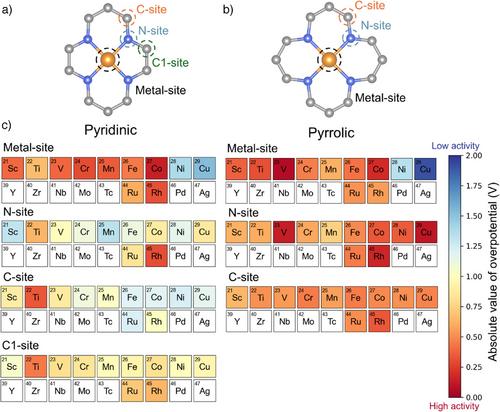
The design principles for metal–nitrogen–carbon (M-N-C) single-atom catalysts (SACs) in the hydrogen evolution reaction (HER) have been extensively studied. Yet, consensus remains elusive, hindering advancements in hydrogen energy technologies. Although the hydrogen binding energy (ΔGH*) has long been used as a key HER descriptor during the past two decades, originating from the activity volcano of metallic surfaces, its applicability to HER SACs has been met with significant controversy. Herein, we investigate the effects of HO*/O* poisoning and H* coverage on SACs with varied metal centers and coordination environments using pH-dependent surface Pourbaix diagrams at the reversible hydrogen electrode (RHE) scale and microkinetic modeling. Our findings reveal that HO* poisoning, realistic H* adsorption strengths at active metal sites, and the potential HER activity at the coordinating N-sites are crucial factors that should be considered for accurate descriptor development. Experimental validation using a series of M-phthalocyanine/CNT catalysts (M = Co, Ni, Cu) confirms the theoretical predictions, with excellent agreement in exchange current densities and the role of N-sites in Ni/Cu-phthalocyanine/CNT catalysts. This work provides answers to a long-lasting debate on HER descriptors by establishing ΔGH* and ΔGHO* as a combined HER descriptor for SACs, offering new guidelines for catalyst design.
期刊介绍:
Angewandte Chemie, a journal of the German Chemical Society (GDCh), maintains a leading position among scholarly journals in general chemistry with an impressive Impact Factor of 16.6 (2022 Journal Citation Reports, Clarivate, 2023). Published weekly in a reader-friendly format, it features new articles almost every day. Established in 1887, Angewandte Chemie is a prominent chemistry journal, offering a dynamic blend of Review-type articles, Highlights, Communications, and Research Articles on a weekly basis, making it unique in the field.



 京公网安备 11010802042870号
京ICP备2023020795号-1
京公网安备 11010802042870号
京ICP备2023020795号-1

 分享
分享
 求助内容:
求助内容: 应助结果提醒方式:
 扫码关注我们
