Engineering Proton-Coupled Electron Transfer to Break Activity-Stability Trade-Off of Oxygen Electroreduction Catalysts for Temperature-Adaptive Zn–Air Battery
{"title":"Engineering Proton-Coupled Electron Transfer to Break Activity-Stability Trade-Off of Oxygen Electroreduction Catalysts for Temperature-Adaptive Zn–Air Battery","authors":"Yonggan Wu, Yuqin Zhang, Liansheng Lan, Ting Hu, Shaobin Tang, Dirk Lützenkirchen-Hecht, Kai Yuan, Yiwang Chen","doi":"10.1002/anie.202502019","DOIUrl":null,"url":null,"abstract":"<p>Single-atom catalysts (SACs) are regarded as effective electrocatalysts for oxygen reduction reaction (ORR). However, integrating high active and long-term durability on SACs is still challenging due to the severe limitations of the activity-stability trade-off. Herein, we report an integrative electrocatalyst combining isolated Fe sites and MoC nanoparticles (MoC/Fe─NC). MoC nanoparticles accelerate ORR kinetics via the proton-feeding effect and optimize Fe site microstructure. Thus, MoC/Fe─NC exhibits a high alkaline ORR activity with half-wave potential (<i>E</i><sub>1/2</sub>) of 0.916 V versus the reversible hydrogen electrode, and exceptional durability of 50k cycles with 5 mV <i>E</i><sub>1/2</sub> loss. The observed ORR performance is further verified in a zinc–air battery (ZAB) with a high peak power density of 316 mW cm<sup>−2</sup> and operational stability over 1000 h. Moreover, the fabricated temperature-adaptive quasi-solid-state ZAB can cycle stably for 150 h under alternating temperatures. Theoretical calculations and experiment characterizations, involving scanning electrochemical microscopy techniques and distribution of relaxation times analysis, reveal that the excellent capabilities of MoC/Fe─NC arise from accelerated proton-coupled electron transfer, weakened *OH adsorption, and strengthened Fe─N bonds fueled by MoC nanoparticles. This work sheds light on breaking the activity-stability trade-off barrier of SACs for energy-conversion applications.</p>","PeriodicalId":125,"journal":{"name":"Angewandte Chemie International Edition","volume":"64 22","pages":""},"PeriodicalIF":16.9000,"publicationDate":"2025-03-19","publicationTypes":"Journal Article","fieldsOfStudy":null,"isOpenAccess":false,"openAccessPdf":"","citationCount":"0","resultStr":null,"platform":"Semanticscholar","paperid":null,"PeriodicalName":"Angewandte Chemie International Edition","FirstCategoryId":"92","ListUrlMain":"https://onlinelibrary.wiley.com/doi/10.1002/anie.202502019","RegionNum":1,"RegionCategory":"化学","ArticlePicture":[],"TitleCN":null,"AbstractTextCN":null,"PMCID":null,"EPubDate":"","PubModel":"","JCR":"Q1","JCRName":"CHEMISTRY, MULTIDISCIPLINARY","Score":null,"Total":0}
引用次数: 0
Abstract
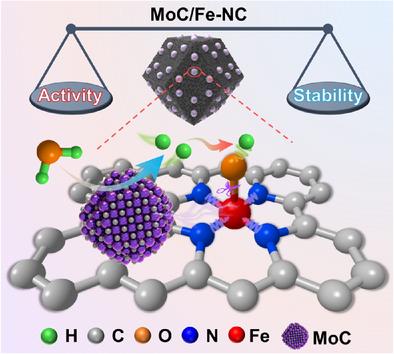
Single-atom catalysts (SACs) are regarded as effective electrocatalysts for oxygen reduction reaction (ORR). However, integrating high active and long-term durability on SACs is still challenging due to the severe limitations of the activity-stability trade-off. Herein, we report an integrative electrocatalyst combining isolated Fe sites and MoC nanoparticles (MoC/Fe─NC). MoC nanoparticles accelerate ORR kinetics via the proton-feeding effect and optimize Fe site microstructure. Thus, MoC/Fe─NC exhibits a high alkaline ORR activity with half-wave potential (E1/2) of 0.916 V versus the reversible hydrogen electrode, and exceptional durability of 50k cycles with 5 mV E1/2 loss. The observed ORR performance is further verified in a zinc–air battery (ZAB) with a high peak power density of 316 mW cm−2 and operational stability over 1000 h. Moreover, the fabricated temperature-adaptive quasi-solid-state ZAB can cycle stably for 150 h under alternating temperatures. Theoretical calculations and experiment characterizations, involving scanning electrochemical microscopy techniques and distribution of relaxation times analysis, reveal that the excellent capabilities of MoC/Fe─NC arise from accelerated proton-coupled electron transfer, weakened *OH adsorption, and strengthened Fe─N bonds fueled by MoC nanoparticles. This work sheds light on breaking the activity-stability trade-off barrier of SACs for energy-conversion applications.
期刊介绍:
Angewandte Chemie, a journal of the German Chemical Society (GDCh), maintains a leading position among scholarly journals in general chemistry with an impressive Impact Factor of 16.6 (2022 Journal Citation Reports, Clarivate, 2023). Published weekly in a reader-friendly format, it features new articles almost every day. Established in 1887, Angewandte Chemie is a prominent chemistry journal, offering a dynamic blend of Review-type articles, Highlights, Communications, and Research Articles on a weekly basis, making it unique in the field.



 京公网安备 11010802042870号
京ICP备2023020795号-1
京公网安备 11010802042870号
京ICP备2023020795号-1

 分享
分享
 求助内容:
求助内容: 应助结果提醒方式:
 扫码关注我们
