Hui-Jun Li, Chaofan Huang, Futao Wang, Yi Shen, Lin Jin, Qi Feng, Xiangyudi Chen, Qiaobo Liao, Minfang Zhu, Ding Wang, Xumin Hou, Bin He
{"title":"Photo-Nanozyme-Integrated Photoelectrochemical-Electrochemical Dual-Mode Biosensor: Enabling Amplification-Free Detection of miRNA-133a in Acute Myocardial Infarction","authors":"Hui-Jun Li, Chaofan Huang, Futao Wang, Yi Shen, Lin Jin, Qi Feng, Xiangyudi Chen, Qiaobo Liao, Minfang Zhu, Ding Wang, Xumin Hou, Bin He","doi":"10.1021/acs.analchem.4c06761","DOIUrl":null,"url":null,"abstract":"Acute myocardial infarction (AMI) is a leading cause of death and disability worldwide. MicroRNA-133a (miRNA-133a) serves as a valuable biomarker for AMI, offering specificity and stability for an early diagnosis. However, existing miRNA biosensors faced challenges in detecting low concentrations, ensuring accuracy, and maintaining immunity to interference. This study presents a novel 1<i>D</i>/2D bismuth vanadium oxide (BiVO<sub>4</sub>) and copper-tetraphenylporphyrin (Cu-TCPP) metal–organic framework heterojunction, constructed via a simple electrodeposition method, which enabled the development of an amplification-free photoelectrochemical/electrochemical (PEC-EC) dual-mode sensor. The S-type heterojunction formed between Cu-TCPP and BiVO<sub>4</sub> significantly improved the separation efficiency of the photogenerated carriers. Furthermore, the peroxidase-like catalytic activity of Cu-TCPP facilitated signal amplification through a photonanozyme mechanism. Experimental results demonstrated that the sensor achieved high sensitivity with extremely low detection limits as low as 0.003 fM for PEC and 0.02 fM for EC, along with excellent selectivity, stability, and reproducibility. This study provides an efficient detection platform for miRNA-133a, highlighting its potential for early diagnosis and monitoring of diseases linked to miRNA biomarkers.","PeriodicalId":27,"journal":{"name":"Analytical Chemistry","volume":"43 1","pages":""},"PeriodicalIF":7.3000,"publicationDate":"2025-03-20","publicationTypes":"Journal Article","fieldsOfStudy":null,"isOpenAccess":false,"openAccessPdf":"","citationCount":"0","resultStr":null,"platform":"Semanticscholar","paperid":null,"PeriodicalName":"Analytical Chemistry","FirstCategoryId":"92","ListUrlMain":"https://doi.org/10.1021/acs.analchem.4c06761","RegionNum":1,"RegionCategory":"化学","ArticlePicture":[],"TitleCN":null,"AbstractTextCN":null,"PMCID":null,"EPubDate":"","PubModel":"","JCR":"Q1","JCRName":"CHEMISTRY, ANALYTICAL","Score":null,"Total":0}
引用次数: 0
Abstract
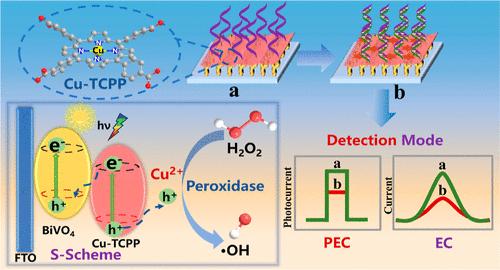
Acute myocardial infarction (AMI) is a leading cause of death and disability worldwide. MicroRNA-133a (miRNA-133a) serves as a valuable biomarker for AMI, offering specificity and stability for an early diagnosis. However, existing miRNA biosensors faced challenges in detecting low concentrations, ensuring accuracy, and maintaining immunity to interference. This study presents a novel 1D/2D bismuth vanadium oxide (BiVO4) and copper-tetraphenylporphyrin (Cu-TCPP) metal–organic framework heterojunction, constructed via a simple electrodeposition method, which enabled the development of an amplification-free photoelectrochemical/electrochemical (PEC-EC) dual-mode sensor. The S-type heterojunction formed between Cu-TCPP and BiVO4 significantly improved the separation efficiency of the photogenerated carriers. Furthermore, the peroxidase-like catalytic activity of Cu-TCPP facilitated signal amplification through a photonanozyme mechanism. Experimental results demonstrated that the sensor achieved high sensitivity with extremely low detection limits as low as 0.003 fM for PEC and 0.02 fM for EC, along with excellent selectivity, stability, and reproducibility. This study provides an efficient detection platform for miRNA-133a, highlighting its potential for early diagnosis and monitoring of diseases linked to miRNA biomarkers.
期刊介绍:
Analytical Chemistry, a peer-reviewed research journal, focuses on disseminating new and original knowledge across all branches of analytical chemistry. Fundamental articles may explore general principles of chemical measurement science and need not directly address existing or potential analytical methodology. They can be entirely theoretical or report experimental results. Contributions may cover various phases of analytical operations, including sampling, bioanalysis, electrochemistry, mass spectrometry, microscale and nanoscale systems, environmental analysis, separations, spectroscopy, chemical reactions and selectivity, instrumentation, imaging, surface analysis, and data processing. Papers discussing known analytical methods should present a significant, original application of the method, a notable improvement, or results on an important analyte.




 京公网安备 11010802042870号
京ICP备2023020795号-1
京公网安备 11010802042870号
京ICP备2023020795号-1

 分享
分享
 求助内容:
求助内容: 应助结果提醒方式:
 扫码关注我们
