Lei Chen, Fei Jin, Qinggen Luo, Yongxiang Luo, Qingqing Zhang, Ruixi Li, Ting Liu, Yan Li, Bin He
{"title":"Novel Cyclopropene Probes as Chemical Reporters for Bioorthogonal Metabolic Labeling of Benzoylated Post-Translational Modification","authors":"Lei Chen, Fei Jin, Qinggen Luo, Yongxiang Luo, Qingqing Zhang, Ruixi Li, Ting Liu, Yan Li, Bin He","doi":"10.1021/acs.analchem.4c04707","DOIUrl":null,"url":null,"abstract":"Lysine benzoylation (Kbz) is a recently identified post-translational modification on a histone that plays a crucial role in regulating cellular processes. Current detection methods primarily rely on mass spectrometry, which limits the ability to dynamically track lysine benzoylation within living cells. Although azide/alkyne small-sized probes have enabled <i>in vitro</i> labeling of various protein acylated modifications, their use in dynamic tracking in cellular levels is limited. Herein, we report a novel 1-methylcyclopropene chemical reporter that undergoes an IEDDA reaction with <i>S</i>-tetrazine-BODIPY <b>8</b>, which was evaluated for its optical properties, kinetic constants, and bio-orthogonality, revealing it to be the most efficient benzoic acid probe <b>2</b>. In addition, when SIRT2 acts on the peptides labeled with probe <b>2</b>, the kinetic parameters of these peptides are comparable to those of endogenously benzoylated peptides. Finally, the metabolic labeling of lysine benzoylation was successfully validated in RAW and HepG2 cells using probe <b>2</b>. Furthermore, by using a SIRT2 inhibitor, it was confirmed that this metabolic labeling can be applied to dynamically detect changes in lysine benzoylation levels in cells. These findings provide a solid foundation for the development of novel metabolic labeling strategies for dynamically tracking post-translational modifications, particularly in live cells.","PeriodicalId":27,"journal":{"name":"Analytical Chemistry","volume":"56 1","pages":""},"PeriodicalIF":6.7000,"publicationDate":"2025-03-19","publicationTypes":"Journal Article","fieldsOfStudy":null,"isOpenAccess":false,"openAccessPdf":"","citationCount":"0","resultStr":null,"platform":"Semanticscholar","paperid":null,"PeriodicalName":"Analytical Chemistry","FirstCategoryId":"92","ListUrlMain":"https://doi.org/10.1021/acs.analchem.4c04707","RegionNum":1,"RegionCategory":"化学","ArticlePicture":[],"TitleCN":null,"AbstractTextCN":null,"PMCID":null,"EPubDate":"","PubModel":"","JCR":"Q1","JCRName":"CHEMISTRY, ANALYTICAL","Score":null,"Total":0}
引用次数: 0
Abstract
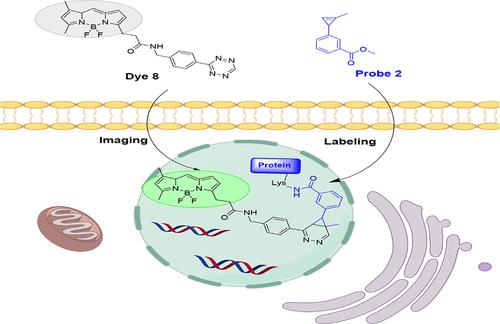
Lysine benzoylation (Kbz) is a recently identified post-translational modification on a histone that plays a crucial role in regulating cellular processes. Current detection methods primarily rely on mass spectrometry, which limits the ability to dynamically track lysine benzoylation within living cells. Although azide/alkyne small-sized probes have enabled in vitro labeling of various protein acylated modifications, their use in dynamic tracking in cellular levels is limited. Herein, we report a novel 1-methylcyclopropene chemical reporter that undergoes an IEDDA reaction with S-tetrazine-BODIPY 8, which was evaluated for its optical properties, kinetic constants, and bio-orthogonality, revealing it to be the most efficient benzoic acid probe 2. In addition, when SIRT2 acts on the peptides labeled with probe 2, the kinetic parameters of these peptides are comparable to those of endogenously benzoylated peptides. Finally, the metabolic labeling of lysine benzoylation was successfully validated in RAW and HepG2 cells using probe 2. Furthermore, by using a SIRT2 inhibitor, it was confirmed that this metabolic labeling can be applied to dynamically detect changes in lysine benzoylation levels in cells. These findings provide a solid foundation for the development of novel metabolic labeling strategies for dynamically tracking post-translational modifications, particularly in live cells.
期刊介绍:
Analytical Chemistry, a peer-reviewed research journal, focuses on disseminating new and original knowledge across all branches of analytical chemistry. Fundamental articles may explore general principles of chemical measurement science and need not directly address existing or potential analytical methodology. They can be entirely theoretical or report experimental results. Contributions may cover various phases of analytical operations, including sampling, bioanalysis, electrochemistry, mass spectrometry, microscale and nanoscale systems, environmental analysis, separations, spectroscopy, chemical reactions and selectivity, instrumentation, imaging, surface analysis, and data processing. Papers discussing known analytical methods should present a significant, original application of the method, a notable improvement, or results on an important analyte.




 京公网安备 11010802042870号
京ICP备2023020795号-1
京公网安备 11010802042870号
京ICP备2023020795号-1

 分享
分享
 求助内容:
求助内容: 应助结果提醒方式:
 扫码关注我们
