{"title":"Fabrication of spinel NiCo2O4 nanoflowers by simple hydrothermal method for effective electrochemical detection of NO2− in processed food sample","authors":"Ramesh Madhaiyan , Devabharathi Vijayaraghavan , Srinithi Shankar , Umamatheswari Seeman , Nagoor Meeran Mohamed Ibrahim , Sankar Chinnusamy","doi":"10.1016/j.foodchem.2025.143964","DOIUrl":null,"url":null,"abstract":"<div><div>This study introduces a novel, cost-effective, highly sensitive electrochemical sensor for detecting nitrite (NO<sub>2</sub><sup>−</sup>) in processed food samples. The sensor was developed by fabricating spinel NiCo<sub>2</sub>O<sub>4</sub> nanoflowers (NCO) using a hydrothermal method. Various characterization techniques, including XRD, FT-IR, XPS, HR-SEM, EDX, and HR-TEM, were used to analyze the structure and morphology of NCO. The obtained NCO exhibited a particle size of ∼16 nm and a flowered shape. Electrochemical impedance spectroscopy (EIS) was used to assess the electron-transfer properties. Cyclic voltammetry (CV) and chronoamperometry (CA) were employed to explore the electrocatalytic performance, revealing a high surface area and remarkable activity. The NCO electrode exhibited a remarkable sensitivity 44.16 μA mM<sup>−1</sup> cm<sup>−2</sup> at low concentrations and 33.51 μA mM<sup>−1</sup> cm<sup>−2</sup> at higher concentrations and a low detection limit of 0.99 μM. It is worth noting that the sensor displayed excellent reproducibility and repeatability, with relative standard deviation (RSD) values of 1.06 % and 1.37 %, respectively. Furthermore, the fabricated sensor was successfully applied for the detection of NO<sub>2</sub><sup>−</sup> in milk, oranges, apple juice, wastewater, and processed foods such as chicken and sausage. The obtained results indicate that the proposed sensor is a promising candidate for practical NO<sub>2</sub><sup>−</sup> detection applications.</div></div>","PeriodicalId":318,"journal":{"name":"Food Chemistry","volume":"480 ","pages":"Article 143964"},"PeriodicalIF":9.8000,"publicationDate":"2025-07-15","publicationTypes":"Journal Article","fieldsOfStudy":null,"isOpenAccess":false,"openAccessPdf":"","citationCount":"0","resultStr":null,"platform":"Semanticscholar","paperid":null,"PeriodicalName":"Food Chemistry","FirstCategoryId":"97","ListUrlMain":"https://www.sciencedirect.com/science/article/pii/S0308814625012154","RegionNum":1,"RegionCategory":"农林科学","ArticlePicture":[],"TitleCN":null,"AbstractTextCN":null,"PMCID":null,"EPubDate":"2025/3/19 0:00:00","PubModel":"Epub","JCR":"Q1","JCRName":"CHEMISTRY, APPLIED","Score":null,"Total":0}
引用次数: 0
Abstract
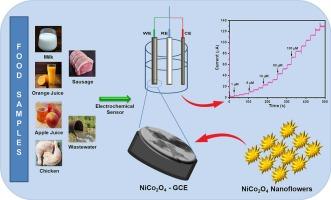
This study introduces a novel, cost-effective, highly sensitive electrochemical sensor for detecting nitrite (NO2−) in processed food samples. The sensor was developed by fabricating spinel NiCo2O4 nanoflowers (NCO) using a hydrothermal method. Various characterization techniques, including XRD, FT-IR, XPS, HR-SEM, EDX, and HR-TEM, were used to analyze the structure and morphology of NCO. The obtained NCO exhibited a particle size of ∼16 nm and a flowered shape. Electrochemical impedance spectroscopy (EIS) was used to assess the electron-transfer properties. Cyclic voltammetry (CV) and chronoamperometry (CA) were employed to explore the electrocatalytic performance, revealing a high surface area and remarkable activity. The NCO electrode exhibited a remarkable sensitivity 44.16 μA mM−1 cm−2 at low concentrations and 33.51 μA mM−1 cm−2 at higher concentrations and a low detection limit of 0.99 μM. It is worth noting that the sensor displayed excellent reproducibility and repeatability, with relative standard deviation (RSD) values of 1.06 % and 1.37 %, respectively. Furthermore, the fabricated sensor was successfully applied for the detection of NO2− in milk, oranges, apple juice, wastewater, and processed foods such as chicken and sausage. The obtained results indicate that the proposed sensor is a promising candidate for practical NO2− detection applications.
期刊介绍:
Food Chemistry publishes original research papers dealing with the advancement of the chemistry and biochemistry of foods or the analytical methods/ approach used. All papers should focus on the novelty of the research carried out.




 京公网安备 11010802042870号
京ICP备2023020795号-1
京公网安备 11010802042870号
京ICP备2023020795号-1

 分享
分享
 求助内容:
求助内容: 应助结果提醒方式:
 扫码关注我们
