Sacha Bodin, Tyrillshall S. T. Damiana, Santo Previti, Laure Balasse, Lina Ali, Emmanuelle Rémond, Vincent Nail, Frédéric Lamare, Elif Hindié, Benjamin Guillet, Delphine Vimont, Simone U. Dalm, Florine Cavelier, Clément Morgat
{"title":"N-Terminal Stabilization of Radiolabeled Neurotensin Analogues for Improved Tumor Uptake","authors":"Sacha Bodin, Tyrillshall S. T. Damiana, Santo Previti, Laure Balasse, Lina Ali, Emmanuelle Rémond, Vincent Nail, Frédéric Lamare, Elif Hindié, Benjamin Guillet, Delphine Vimont, Simone U. Dalm, Florine Cavelier, Clément Morgat","doi":"10.1021/acs.jmedchem.4c02844","DOIUrl":null,"url":null,"abstract":"Peptide-based radiopharmaceuticals targeting neurotensin-receptor-1 (NTS<sub>1</sub>) are mainly stabilized using chemical modifications at the NT[8–13] sequence, thus increasing the stability and the uptake of the corresponding radionuclide-macrocycle-linker-bioconjugate. We postulate that the introduction of the linker at the <i>N</i>-term part induces additional cleavage sites that can be further stabilized to achieve a prolonged uptake. Double (JMV 7259 and JMV 7222) and triple-stabilized neurotensin analogues (JMV 7258 and JMV 7490) were synthesized, radiolabeled, and evaluated on HT-29 cells (NTS<sub>1</sub><sup>+</sup>). Nanomolar NTS<sub>1</sub>-affinity and high internalization rates were observed for all of the radiopharmaceuticals. Efflux was lower for radiolabeled JMV 7490. Consequently, [<sup>111</sup>In]In-JMV 7490 showed uptake of 5.86 ± 0.86 and 3.65 ± 0.29% ID/g of tissue in HT-29 xenografts at 1 and 4 h, respectively. We have successfully shown that high and persistent uptake of NTS<sub>1</sub>-positive tumor cells is achievable by stabilization of the N-term part. Efflux also appears to be a critical parameter for the successful targeting of NTS<sub>1</sub> using radiopharmaceuticals.","PeriodicalId":46,"journal":{"name":"Journal of Medicinal Chemistry","volume":"37 1","pages":""},"PeriodicalIF":6.8000,"publicationDate":"2025-03-20","publicationTypes":"Journal Article","fieldsOfStudy":null,"isOpenAccess":false,"openAccessPdf":"","citationCount":"0","resultStr":null,"platform":"Semanticscholar","paperid":null,"PeriodicalName":"Journal of Medicinal Chemistry","FirstCategoryId":"3","ListUrlMain":"https://doi.org/10.1021/acs.jmedchem.4c02844","RegionNum":1,"RegionCategory":"医学","ArticlePicture":[],"TitleCN":null,"AbstractTextCN":null,"PMCID":null,"EPubDate":"","PubModel":"","JCR":"Q1","JCRName":"CHEMISTRY, MEDICINAL","Score":null,"Total":0}
引用次数: 0
Abstract
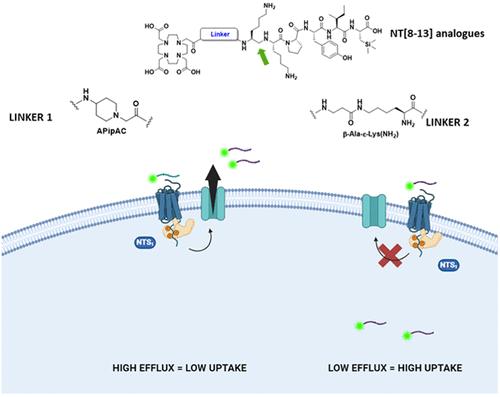
Peptide-based radiopharmaceuticals targeting neurotensin-receptor-1 (NTS1) are mainly stabilized using chemical modifications at the NT[8–13] sequence, thus increasing the stability and the uptake of the corresponding radionuclide-macrocycle-linker-bioconjugate. We postulate that the introduction of the linker at the N-term part induces additional cleavage sites that can be further stabilized to achieve a prolonged uptake. Double (JMV 7259 and JMV 7222) and triple-stabilized neurotensin analogues (JMV 7258 and JMV 7490) were synthesized, radiolabeled, and evaluated on HT-29 cells (NTS1+). Nanomolar NTS1-affinity and high internalization rates were observed for all of the radiopharmaceuticals. Efflux was lower for radiolabeled JMV 7490. Consequently, [111In]In-JMV 7490 showed uptake of 5.86 ± 0.86 and 3.65 ± 0.29% ID/g of tissue in HT-29 xenografts at 1 and 4 h, respectively. We have successfully shown that high and persistent uptake of NTS1-positive tumor cells is achievable by stabilization of the N-term part. Efflux also appears to be a critical parameter for the successful targeting of NTS1 using radiopharmaceuticals.
期刊介绍:
The Journal of Medicinal Chemistry is a prestigious biweekly peer-reviewed publication that focuses on the multifaceted field of medicinal chemistry. Since its inception in 1959 as the Journal of Medicinal and Pharmaceutical Chemistry, it has evolved to become a cornerstone in the dissemination of research findings related to the design, synthesis, and development of therapeutic agents.
The Journal of Medicinal Chemistry is recognized for its significant impact in the scientific community, as evidenced by its 2022 impact factor of 7.3. This metric reflects the journal's influence and the importance of its content in shaping the future of drug discovery and development. The journal serves as a vital resource for chemists, pharmacologists, and other researchers interested in the molecular mechanisms of drug action and the optimization of therapeutic compounds.



 京公网安备 11010802042870号
京ICP备2023020795号-1
京公网安备 11010802042870号
京ICP备2023020795号-1

 分享
分享
 求助内容:
求助内容: 应助结果提醒方式:
 扫码关注我们
