Christoph Humberg, Zahide Yilmaz, Katharina Fitzian, Wolfgang Dörner, Daniel Kümmel, Henning D. Mootz
{"title":"A cysteine-less and ultra-fast split intein rationally engineered from being aggregation-prone to highly efficient in protein trans-splicing","authors":"Christoph Humberg, Zahide Yilmaz, Katharina Fitzian, Wolfgang Dörner, Daniel Kümmel, Henning D. Mootz","doi":"10.1038/s41467-025-57596-x","DOIUrl":null,"url":null,"abstract":"<p>Split inteins catalyze protein <i>trans</i>-splicing by ligating their extein sequences while undergoing self-excision, enabling diverse protein modification applications. However, many purified split intein precursors exhibit partial or no splicing activity for unknown reasons. The Aes123 PolB1 intein, a representative of the rare cysteine-less split inteins, is of particular interest due to its resistance to oxidative conditions and orthogonality to thiol chemistries. In this work, we identify β-sheet-dominated aggregation of its N-terminal intein fragment as the origin of its low (~30%) splicing efficiency. Using computational, biochemical, and biophysical analyses, we characterize the fully active monomeric fraction and pinpoint aggregation-prone regions. Supported by a crystal structure, we design stably monomeric mutants with nearly complete splicing activity. The optimized CLm intein (Cysteine-Less and monomeric) retains the wild-type’s ultra-fast reaction rate and serves as an efficient, thiol-independent protein modification tool. We find that other benchmark split inteins show similar precursor aggregation, suggesting that this general phenomenon arises from the intrinsic challenge to maintain the precursor in a partially disordered state while promoting stable folding upon fragment association.</p>","PeriodicalId":19066,"journal":{"name":"Nature Communications","volume":"37 1","pages":""},"PeriodicalIF":15.7000,"publicationDate":"2025-03-19","publicationTypes":"Journal Article","fieldsOfStudy":null,"isOpenAccess":false,"openAccessPdf":"","citationCount":"0","resultStr":null,"platform":"Semanticscholar","paperid":null,"PeriodicalName":"Nature Communications","FirstCategoryId":"103","ListUrlMain":"https://doi.org/10.1038/s41467-025-57596-x","RegionNum":1,"RegionCategory":"综合性期刊","ArticlePicture":[],"TitleCN":null,"AbstractTextCN":null,"PMCID":null,"EPubDate":"","PubModel":"","JCR":"Q1","JCRName":"MULTIDISCIPLINARY SCIENCES","Score":null,"Total":0}
引用次数: 0
Abstract
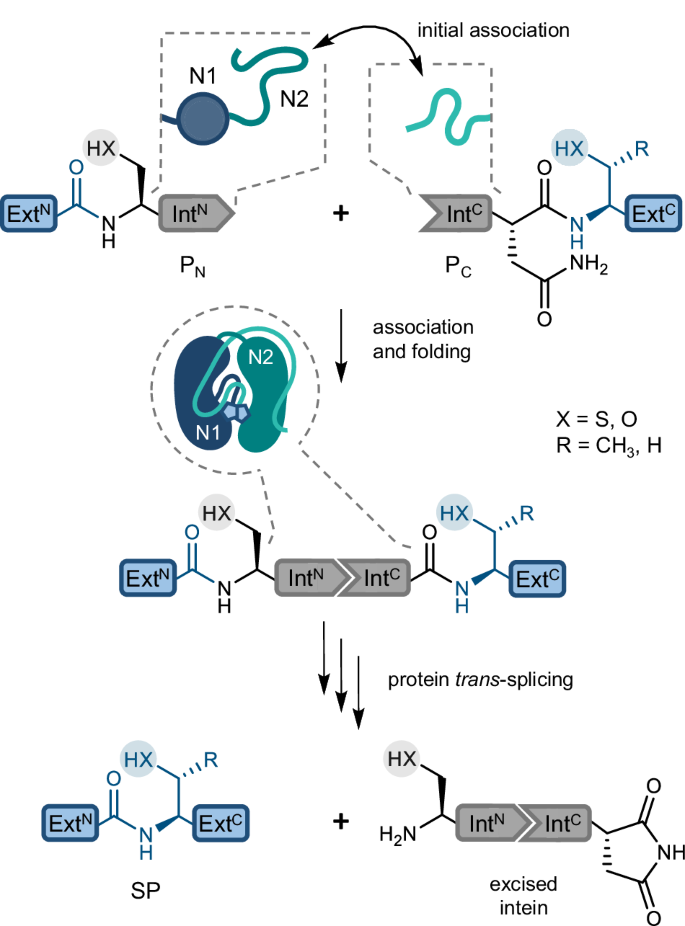
Split inteins catalyze protein trans-splicing by ligating their extein sequences while undergoing self-excision, enabling diverse protein modification applications. However, many purified split intein precursors exhibit partial or no splicing activity for unknown reasons. The Aes123 PolB1 intein, a representative of the rare cysteine-less split inteins, is of particular interest due to its resistance to oxidative conditions and orthogonality to thiol chemistries. In this work, we identify β-sheet-dominated aggregation of its N-terminal intein fragment as the origin of its low (~30%) splicing efficiency. Using computational, biochemical, and biophysical analyses, we characterize the fully active monomeric fraction and pinpoint aggregation-prone regions. Supported by a crystal structure, we design stably monomeric mutants with nearly complete splicing activity. The optimized CLm intein (Cysteine-Less and monomeric) retains the wild-type’s ultra-fast reaction rate and serves as an efficient, thiol-independent protein modification tool. We find that other benchmark split inteins show similar precursor aggregation, suggesting that this general phenomenon arises from the intrinsic challenge to maintain the precursor in a partially disordered state while promoting stable folding upon fragment association.
期刊介绍:
Nature Communications, an open-access journal, publishes high-quality research spanning all areas of the natural sciences. Papers featured in the journal showcase significant advances relevant to specialists in each respective field. With a 2-year impact factor of 16.6 (2022) and a median time of 8 days from submission to the first editorial decision, Nature Communications is committed to rapid dissemination of research findings. As a multidisciplinary journal, it welcomes contributions from biological, health, physical, chemical, Earth, social, mathematical, applied, and engineering sciences, aiming to highlight important breakthroughs within each domain.



 京公网安备 11010802042870号
京ICP备2023020795号-1
京公网安备 11010802042870号
京ICP备2023020795号-1

 分享
分享
 求助内容:
求助内容: 应助结果提醒方式:
 扫码关注我们
